Guilin

Following a very enjoyable but tiring few days in Chongqing we set off again on a high speed train for Guilin, some 857km to the south.

If you are thinking of a trip to China but are anxious about how to book train tickets then I can say there is ne need to worry. I used “trip.com” which I used on my PC before leaving the UK and the app on my phone whilst in China.

Chinese train tickets are only available 2 weeks before the train departure date but using trip.com you can choose from the easy menu which train you want to travel on and how many tickets you want and when tickets are available they are purchased for you. Seat choice is not an option but on all high speed trains the seats in standard class always face forwards, when the train reaches it’s final destination a team of workers quickly go through the train and swivel all the seats around.

When using the site for the first time younter your name, address and passport number together with your payment details and the reservation with China railways is made using your passport number and a confirmation email is sent to you and train details are easily shown on the app for reference.

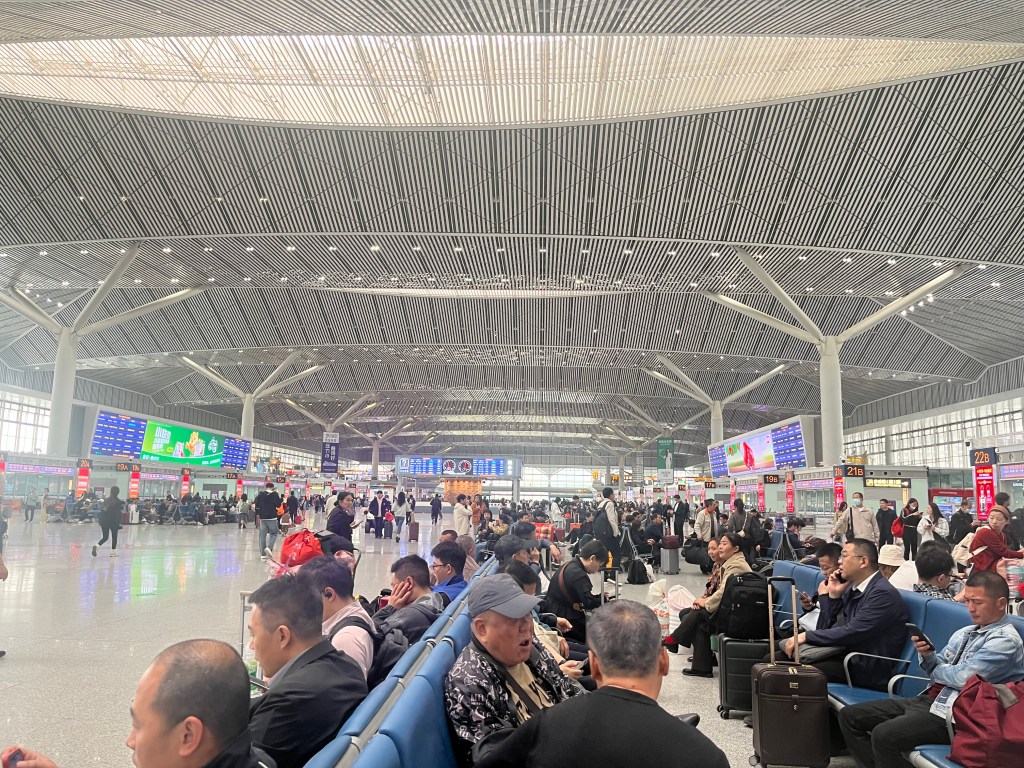
At the railway station after going through the security check, and passing your bags through the scanner you get to the departure area.

When it is time to depart there will be a long queue of Chinese nationals at the check in gate having there ID cards scanned and a much shorter line of foreigners at a separate gate where your passport is scanned and the gate opens, simple as that. No tickets to forget or lose.
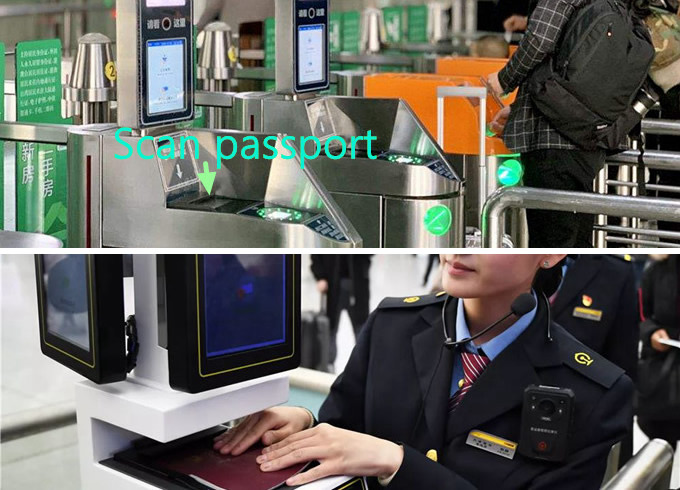
The departures lounge is usually above the platforms and so a short escalator ride takes you down to your train.

Photos courtesy of China airline travel.

There are other apps available for train tickets but I found trip.com extremely easy to use for airline tickets, entry tickets to attractions such as river cruises, more of that later. By the way I have no connection with trip.com and receive no commission from them.
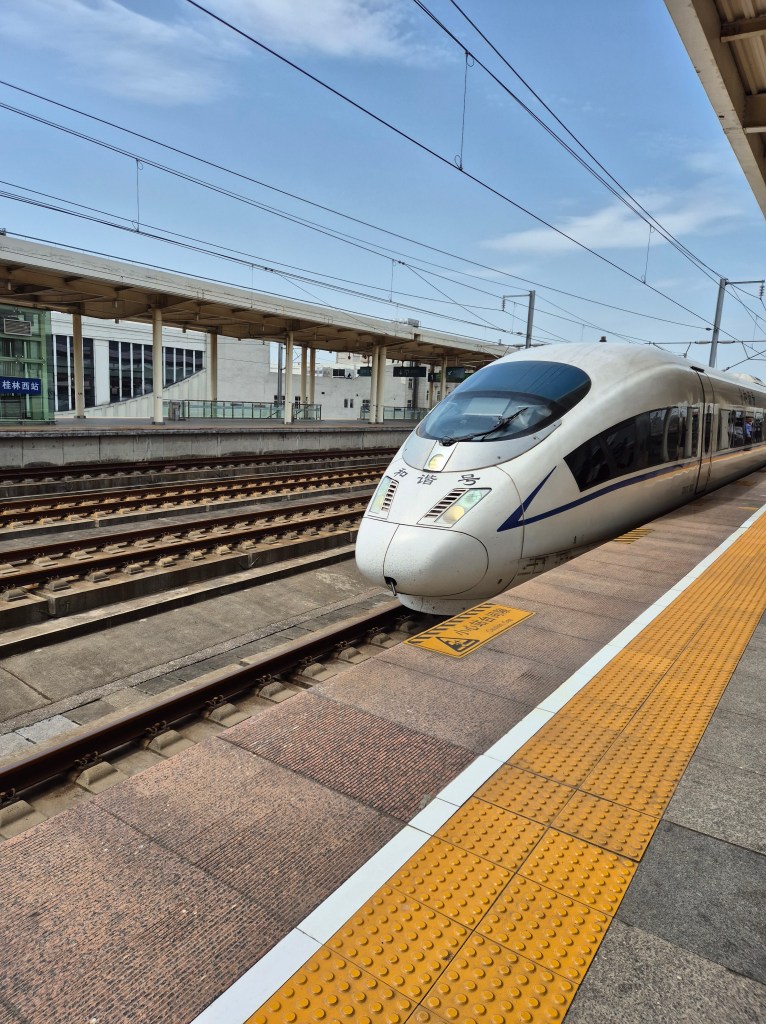
So a few hours later we arrived at Guilin and transferred to our hotel, the Holiday Inn Express in the centre of the city.
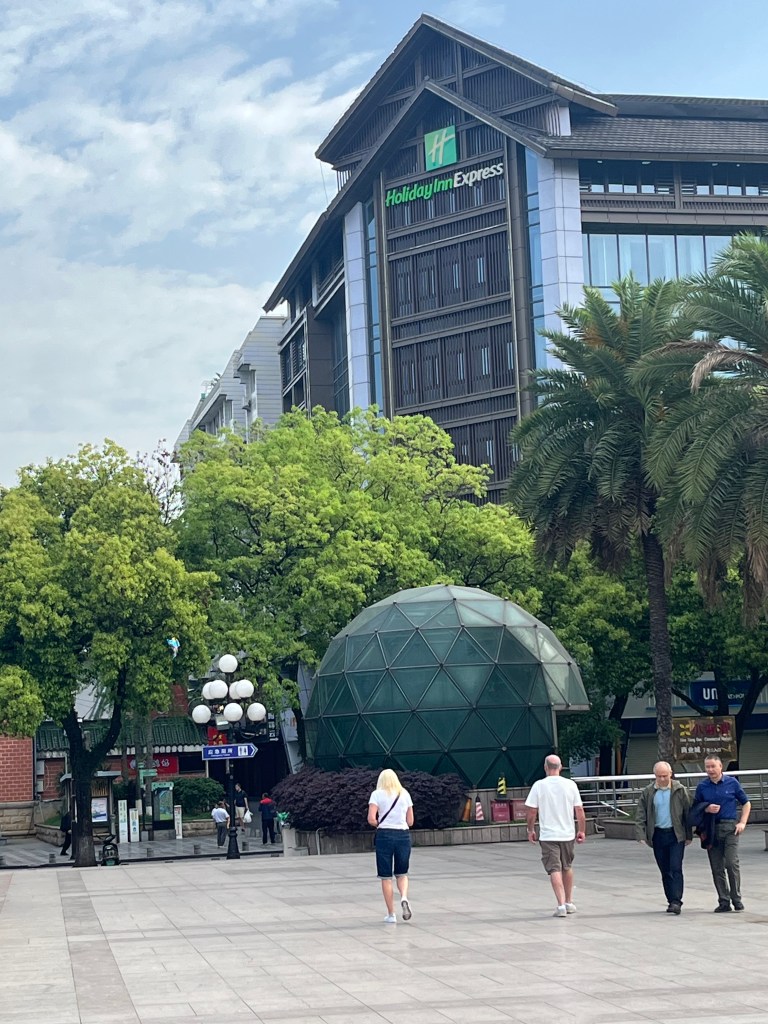
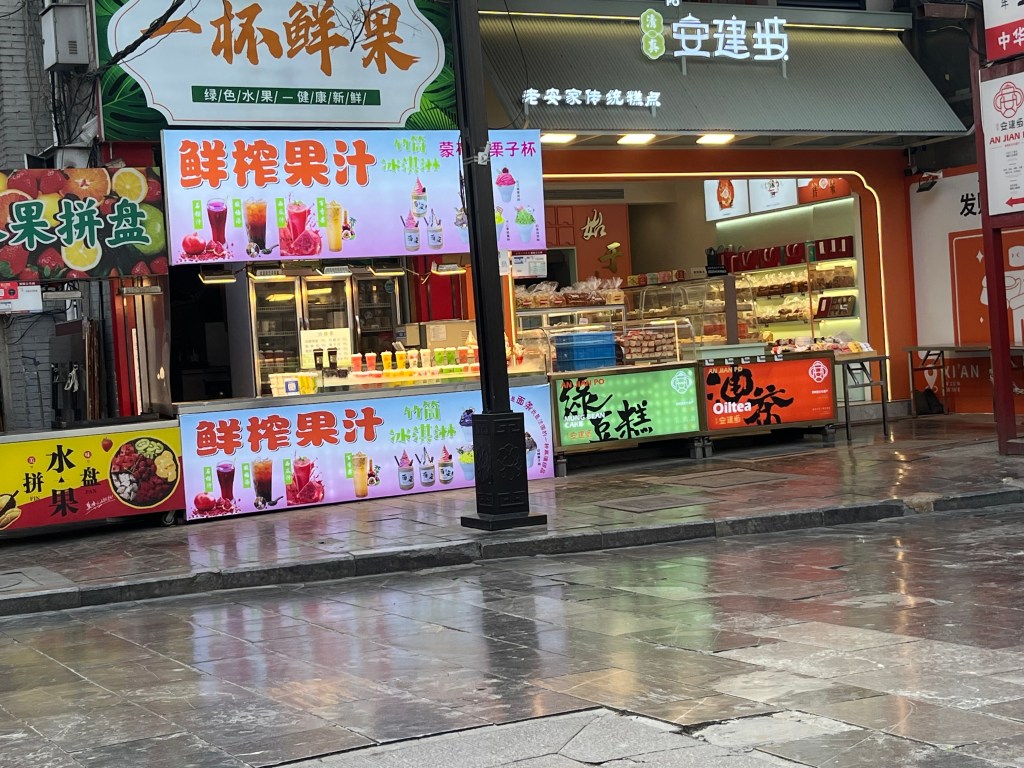
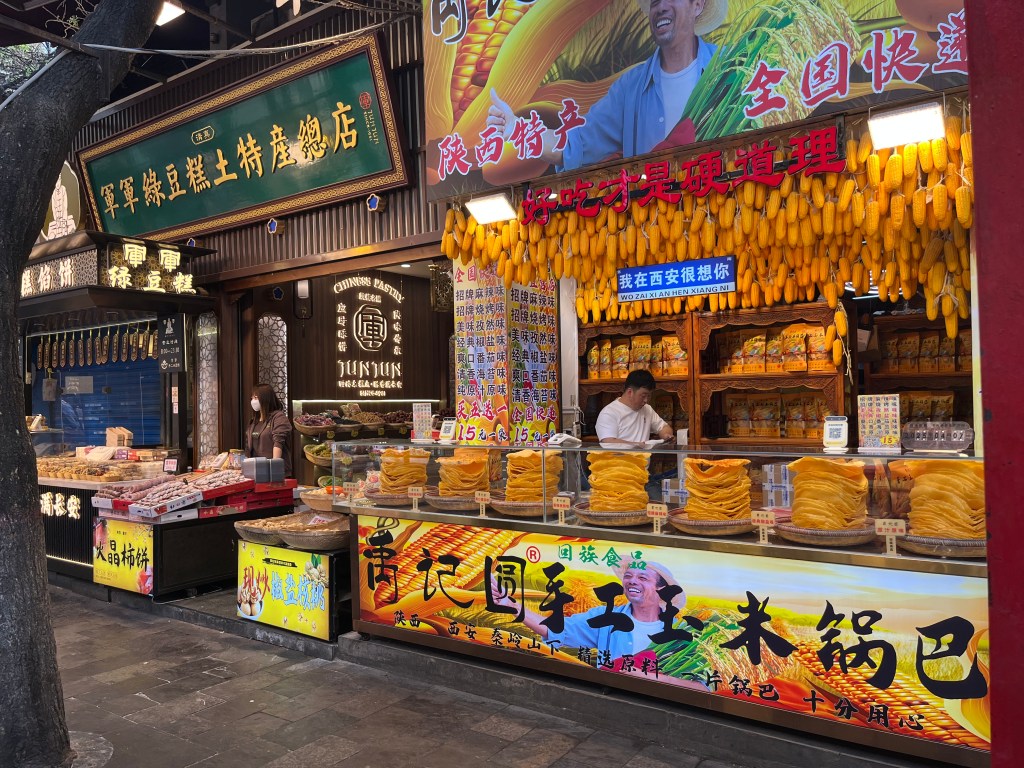
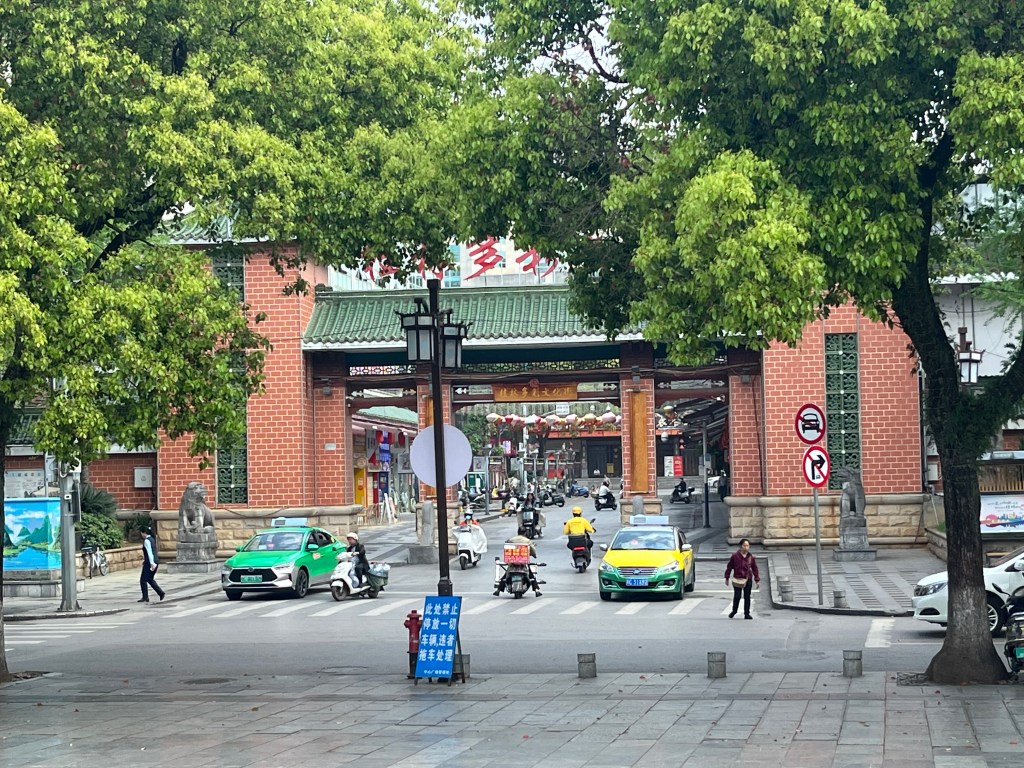
Next to the hotel was the entrance to an area of restaurants, cafes and street food stalls and as usual many maniac scooter riders.
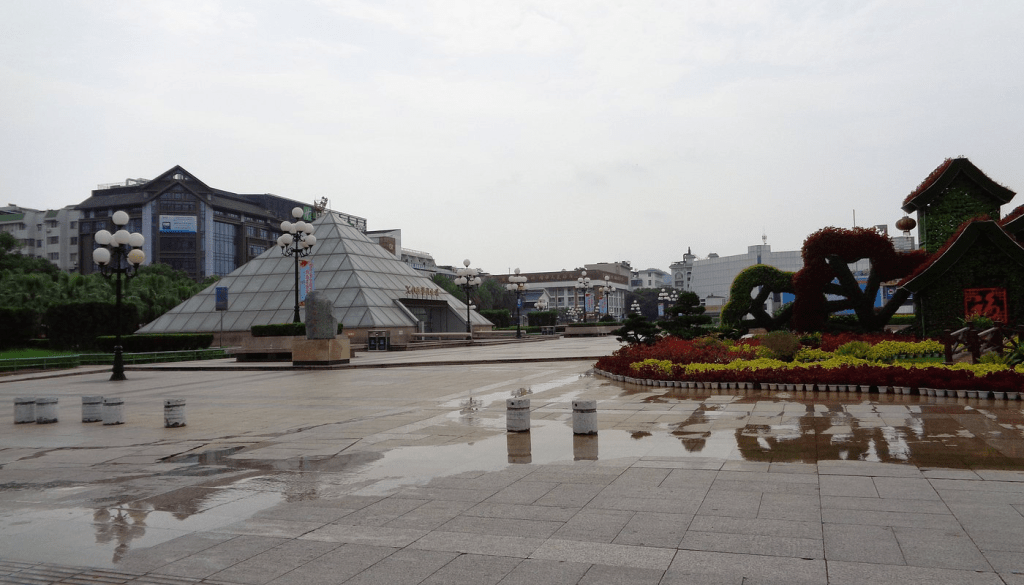
In front of the hotel was a large open square where the locals could be seen doing their morning exercises to music. In the photo you can see a glass pyramid structure with further ones at the other corners.

We were intrigued by these and too a closer look. They were actually stairs leading down to a large underground shopping centre known as the “Little Hong Kong”, selling mainly cheap clothes and shoes and is apparantly well liked by students and others on a tight budget.
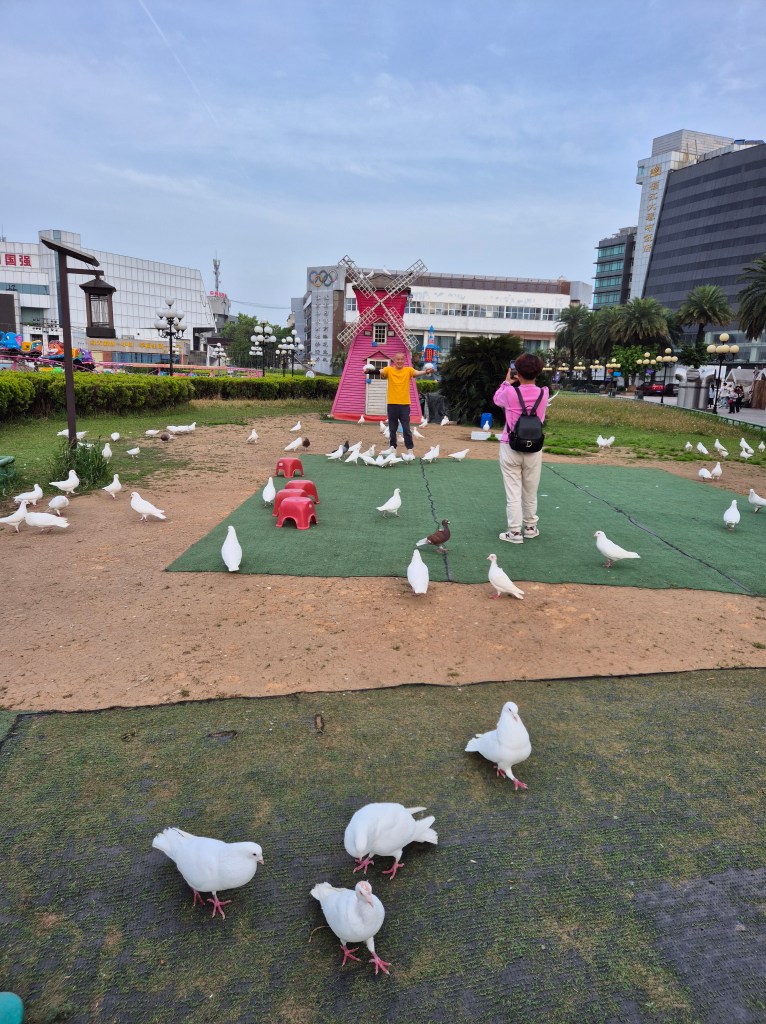
On the far side of the square was an area of childrens rides and a large number of tame doves that lived in this windmill.
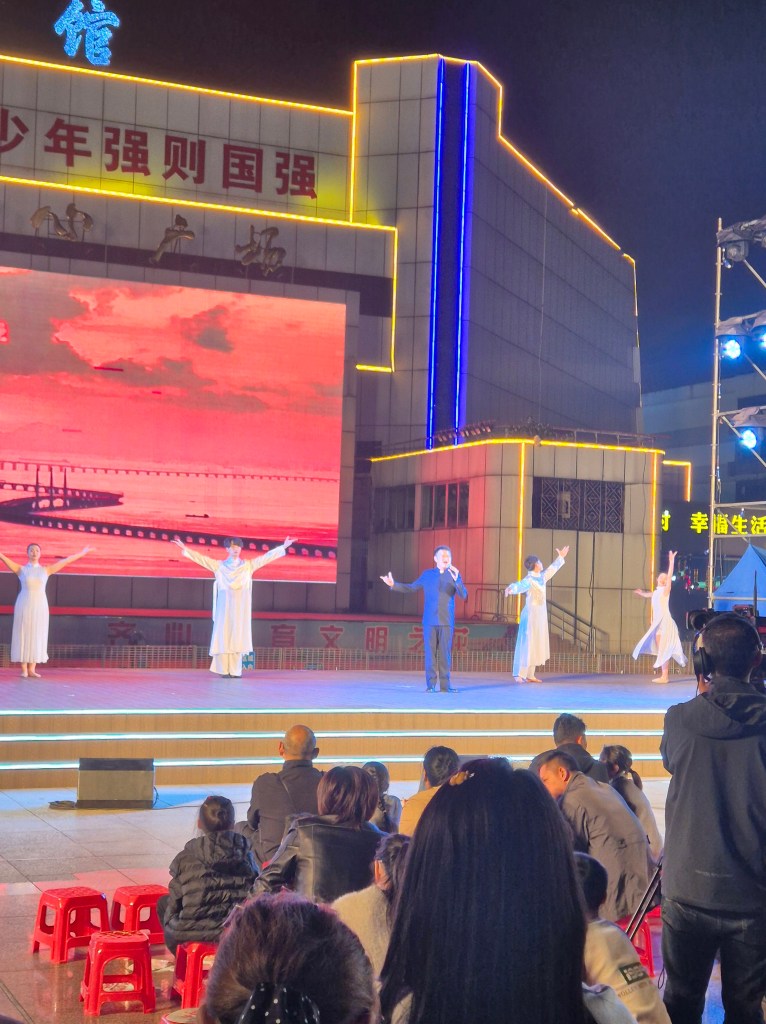
On our way back to the hotel in the evening there was some sort of show taking place in the square which was being filmed by Guilin TV.

Note the little plastic stools, these are everywhere in China, in the markets, cafes, bars, outside the food stalls and wherever people wanted to sit for a rest.
In true “Uncle Bob’s Tours” fashion we found an Irish pub in a side road just off Zhengyang Pedestrian Street.
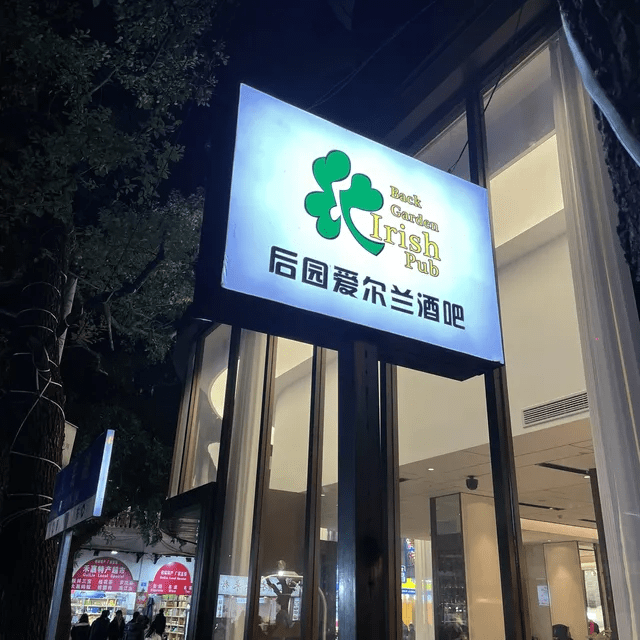
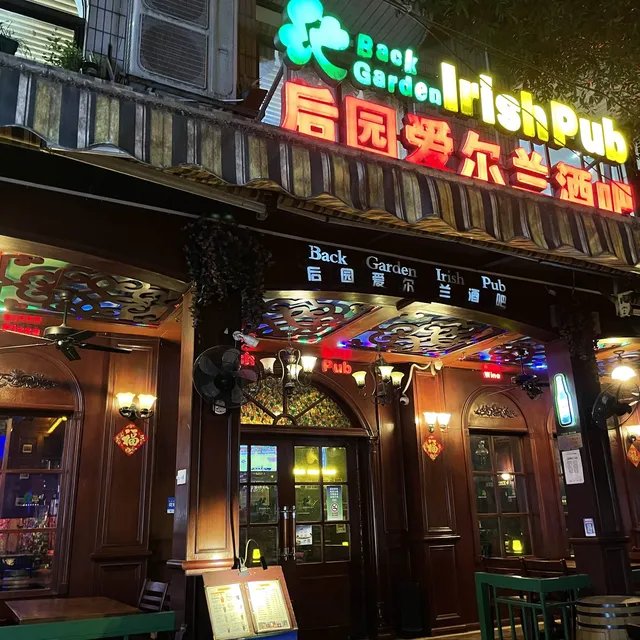
There was plenty to chose from on the menu, both Chinese and western dishes, I had the beef in black bean sauce which was delicious.

The following day we toook the short walk across the square and down Zhengyang Pedestrian Street towards the “two rivers and four lakes scenic area”.
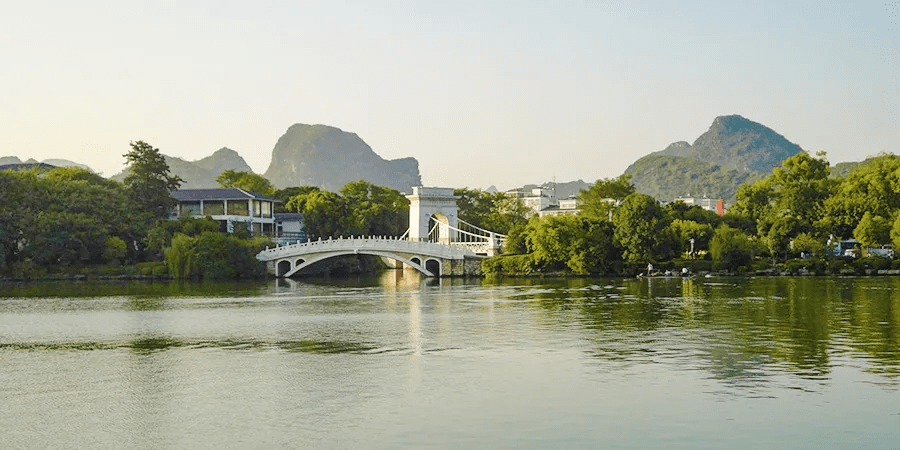
The two rivers are the Li and the Taohua and four lakes are the Rong, Shan, Gui and Mulong. The Two Rivers and the Four Lakes form a continuous picturesque waterway through the center of Guilin City and there are plenty of boat trips for you to while away an hour or two.

One of the main attractions are the Sun and Moon pagodas. Originally built in the Tang dynasty in the mid 7th century they were reconstructed in the year 2000 when the lake was drained and the original foundations were uncovered.
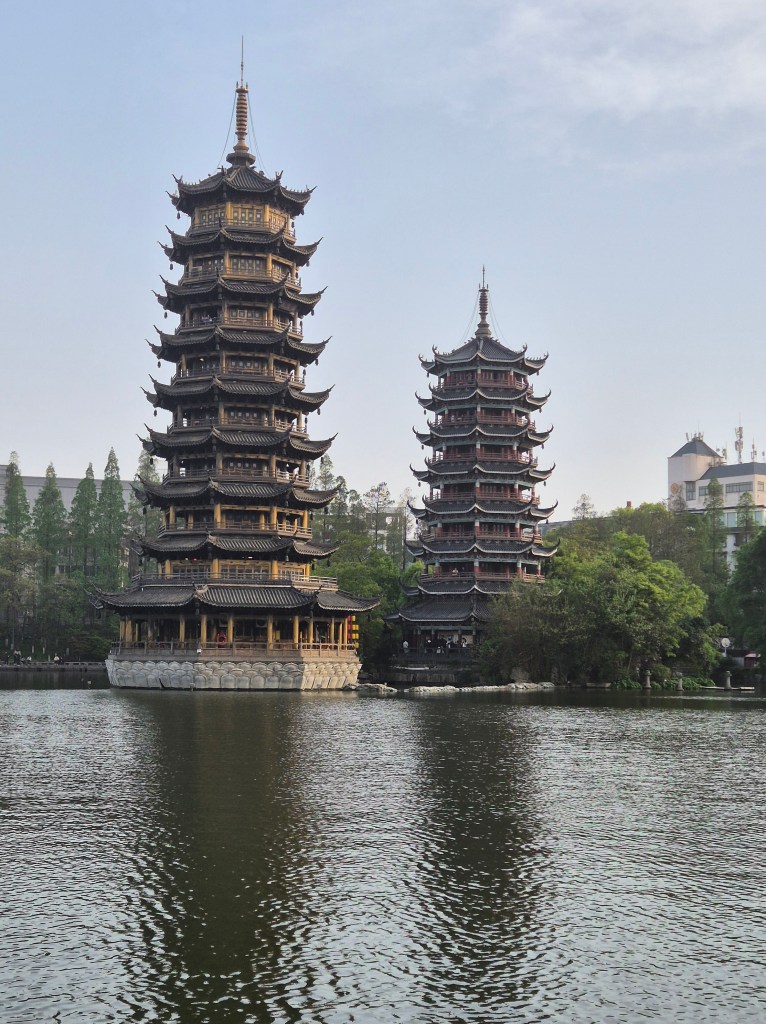
The Sun Pagoda is the tallest bronze pagoda in the world and is one of the few pagodas in the world that has an elevator. The Moon Pagoda has an octagonal base, is coated with glazed tile, has seven stories, and is 35 m (115 ft) tall. A tunnel under the lake connects them and where there was a small display of relics from the original pagodas. The entrance fee was only 35Yuan each, (about £3.50).
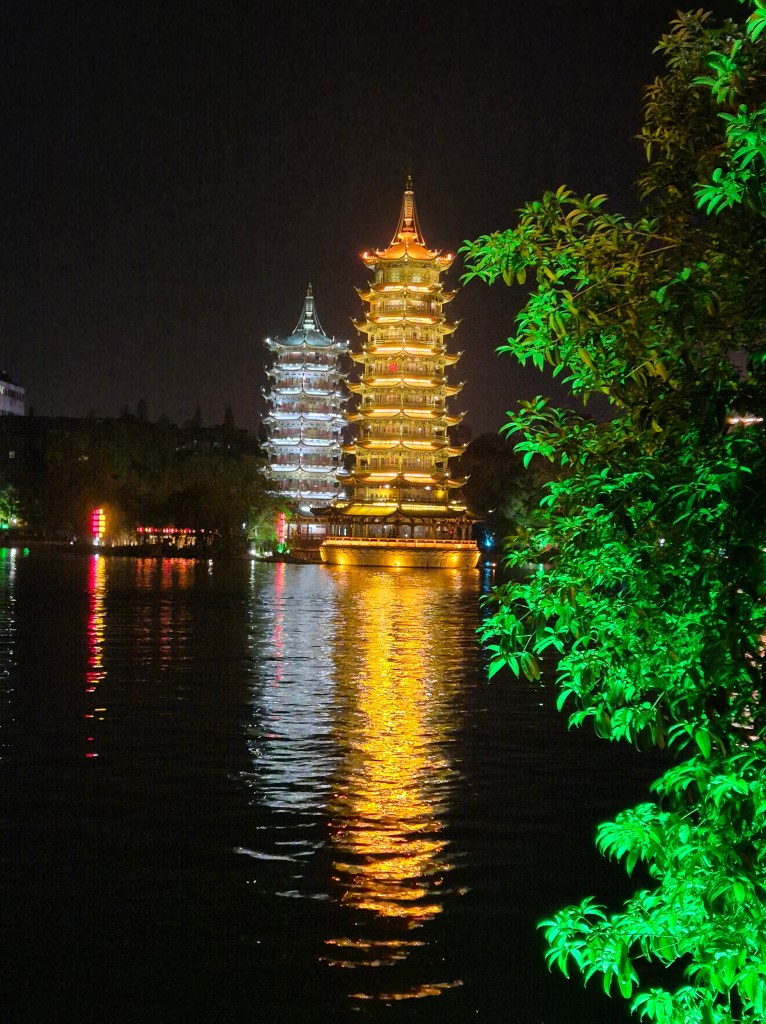
When illuminated after dark they are stunningly beautiful!
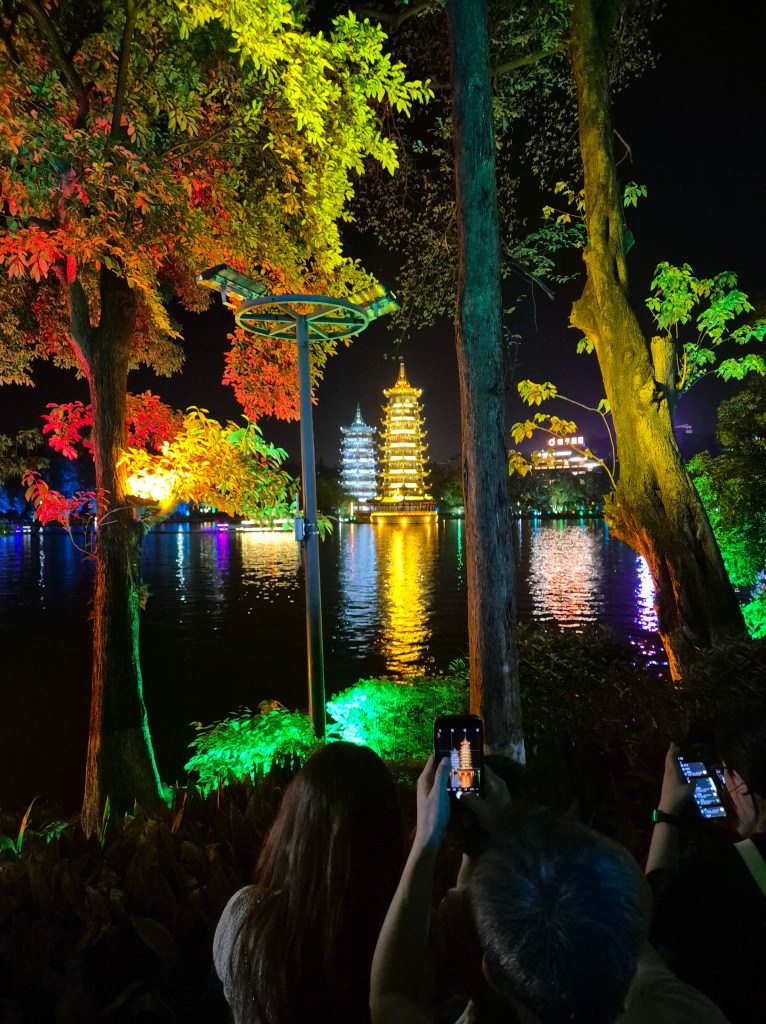
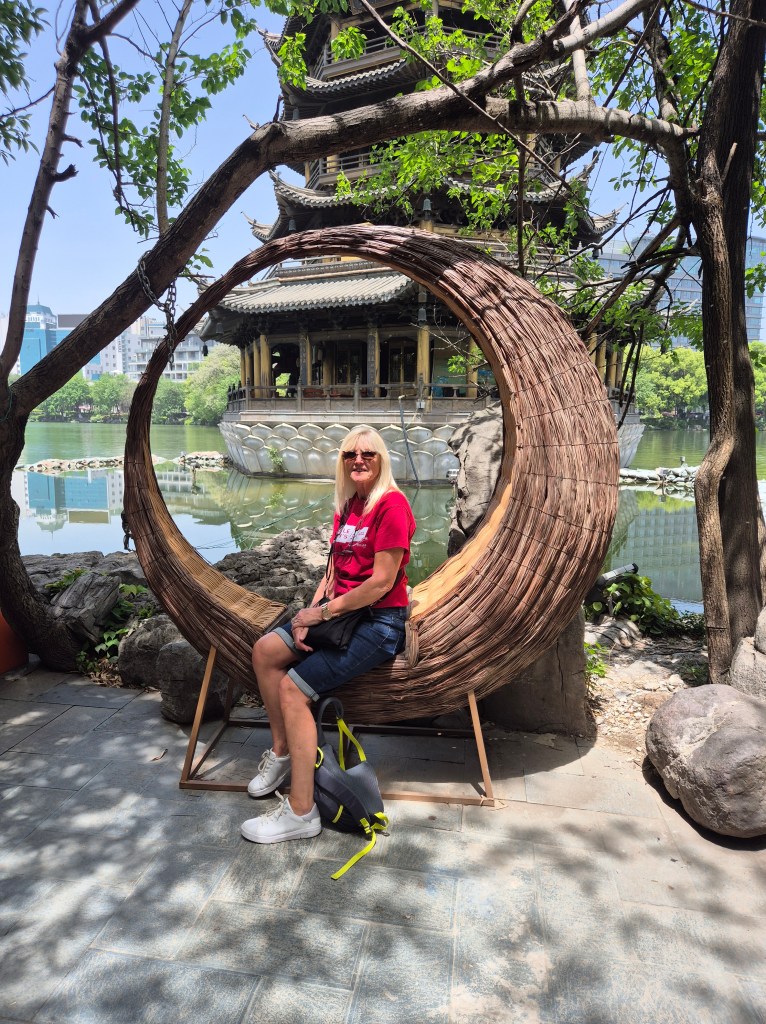
We took a very pleasant walk around the lakes.
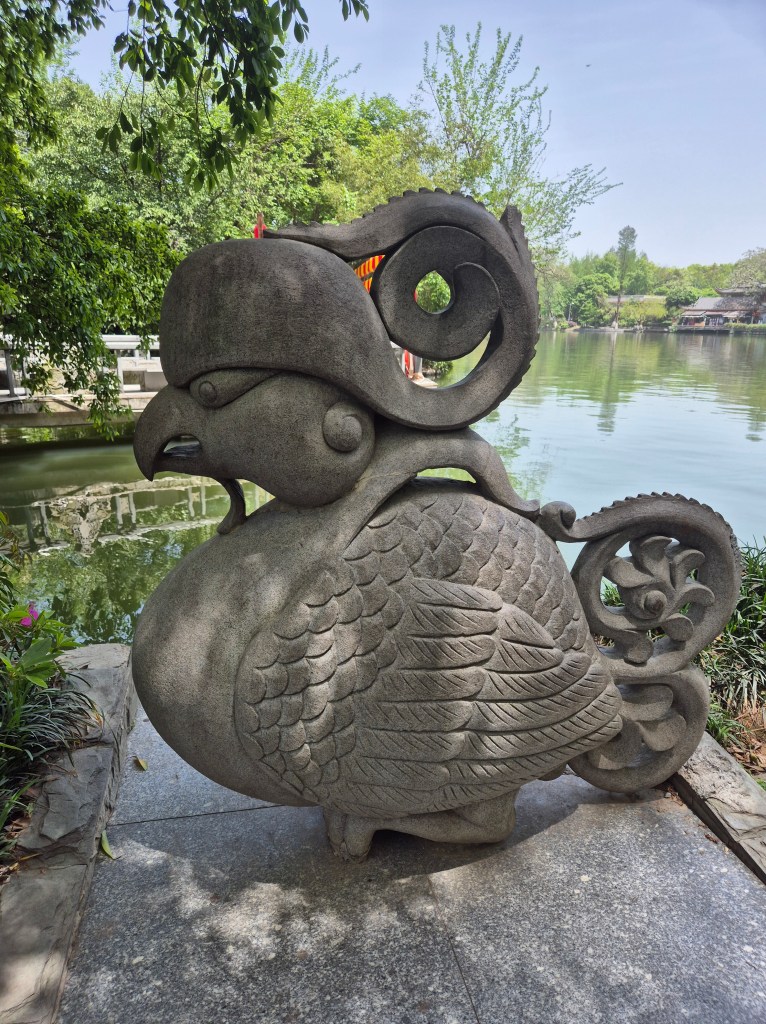
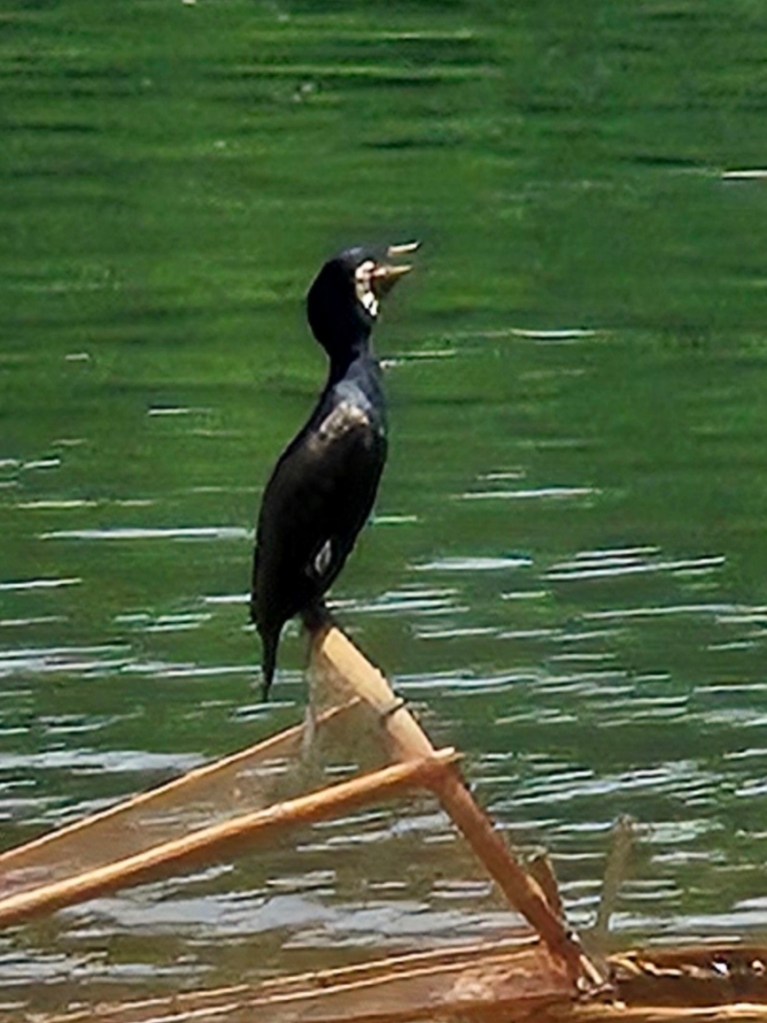
Cormorant taking a rest from catching fish
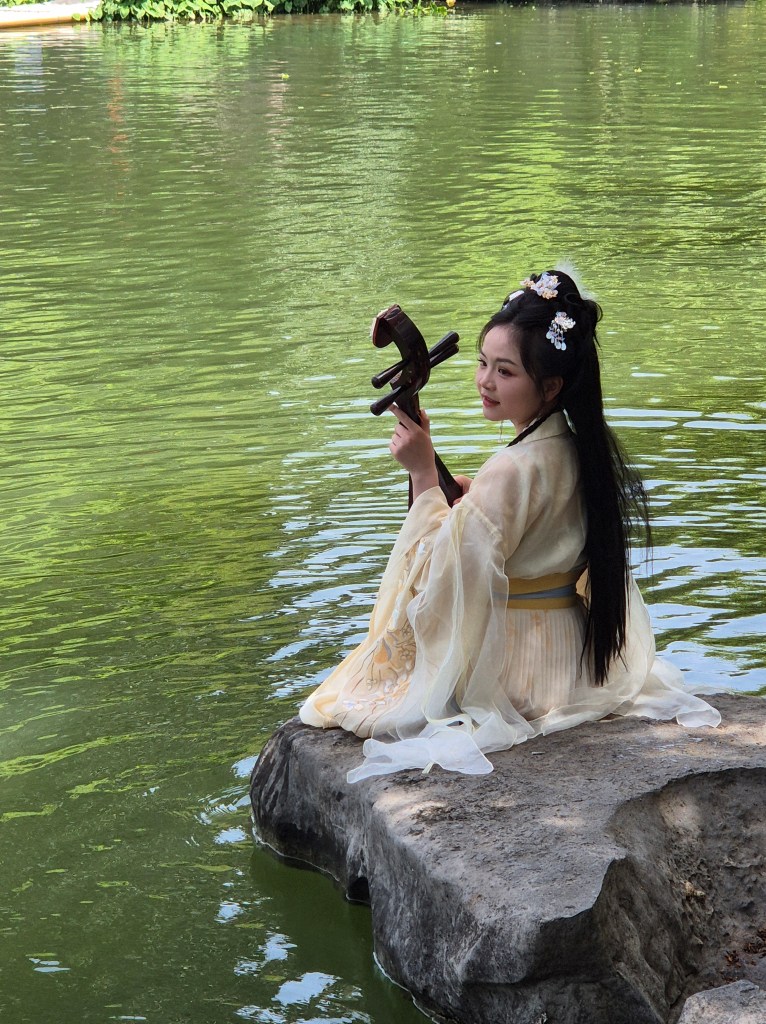
The lake wa a popular place for photo shoots.
In the morning we crossed the square where we were picked up by coach for the 20 mile journey to the River Li cruise terminal to board our boat for the 4 hour sightseeing journey along the river to Yangshuo.
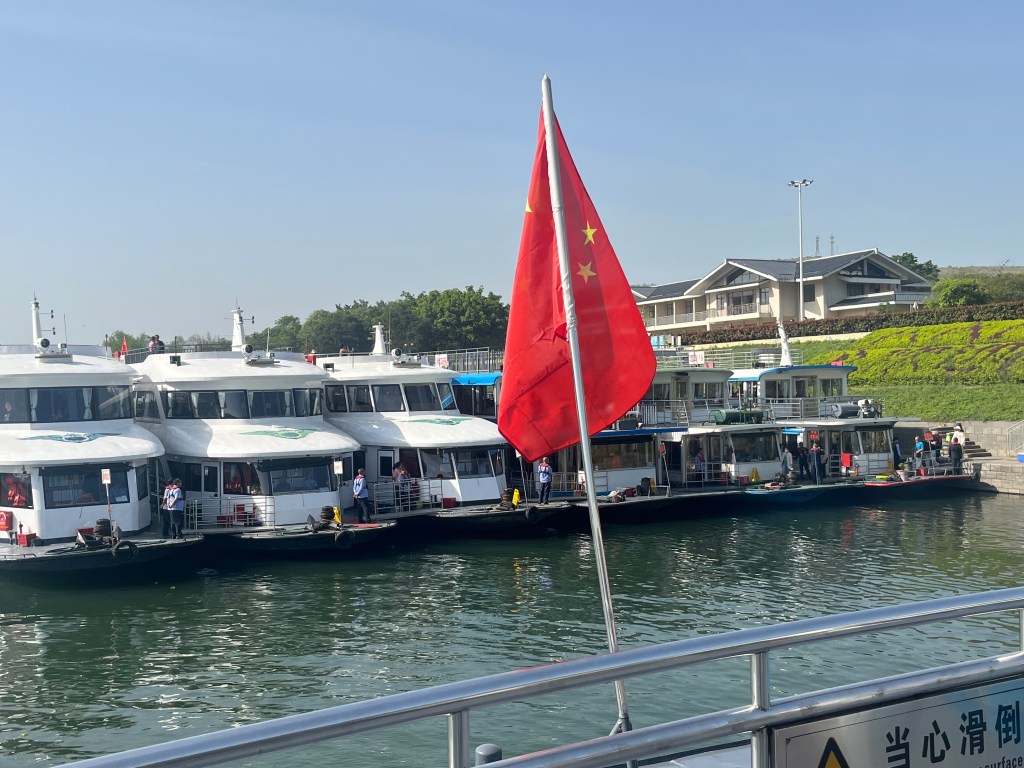
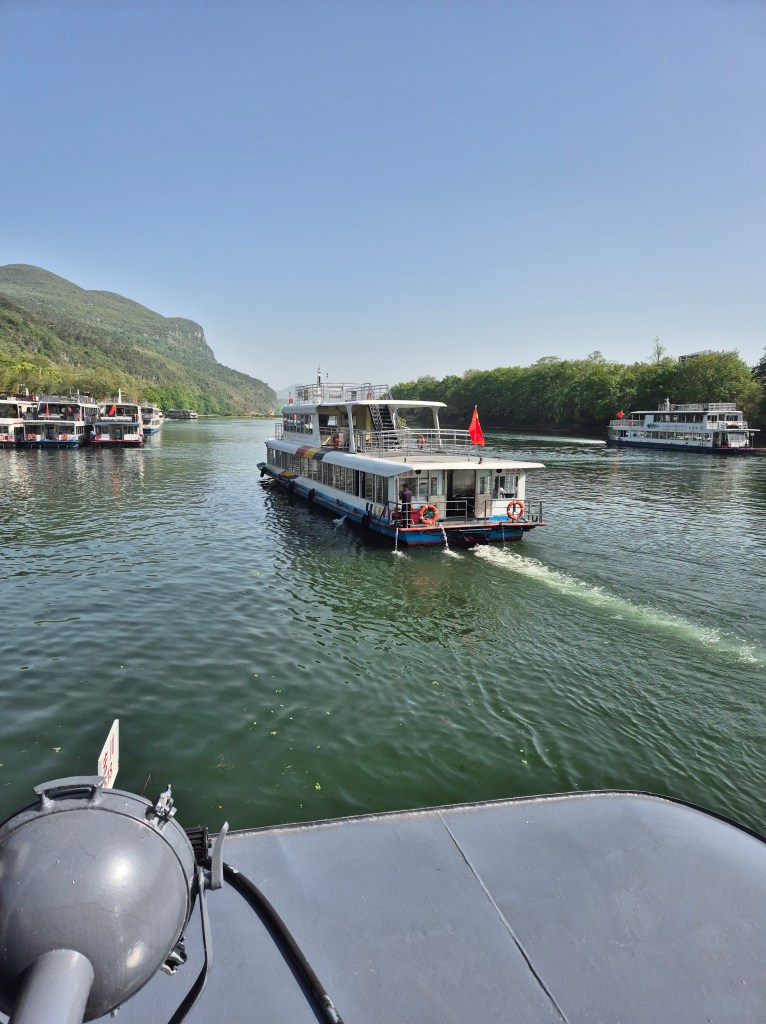
There are 3 classes of boat, 3 star 4 star and 5 star, the main difference being that in the more expensive boats lunch is cooked and served on board but we opted for the cheaper option where snacks and drinks can be purchased which suited us better.
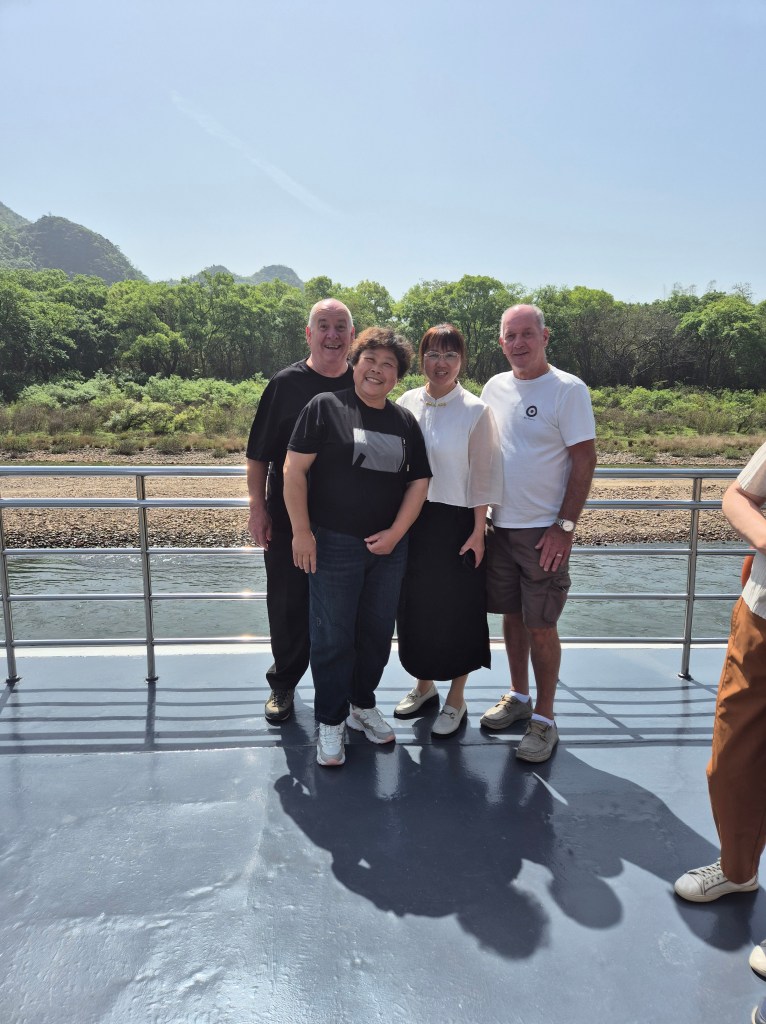
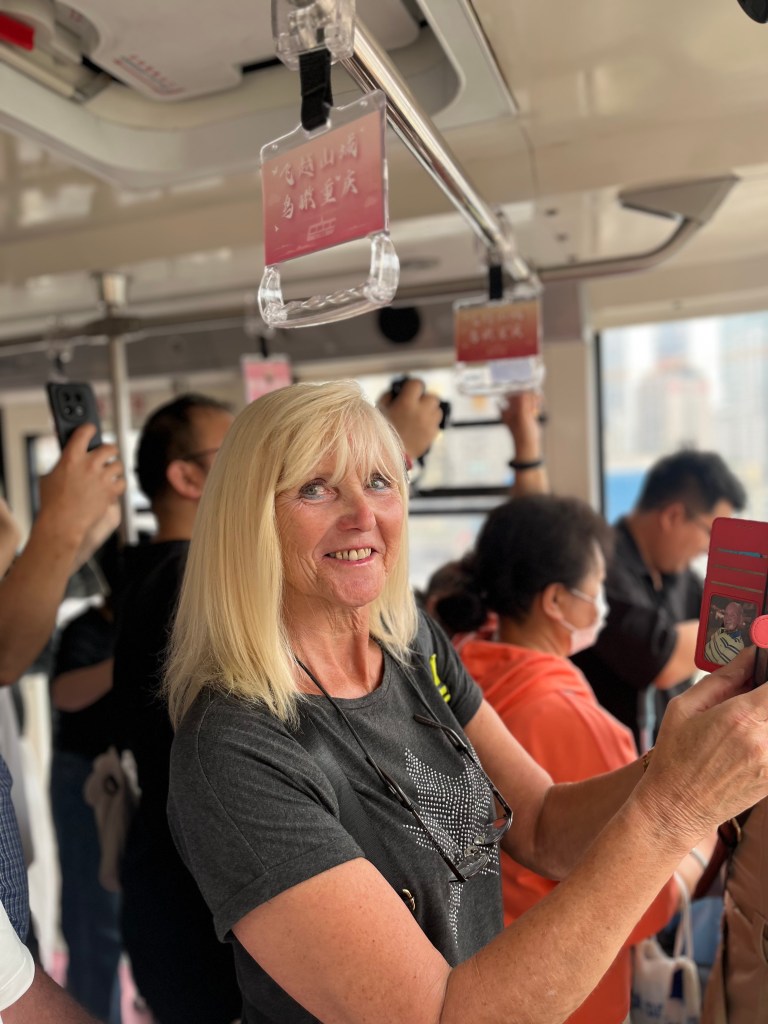
Again we were soon in demand by the locals for selfies with these strange foreigners!
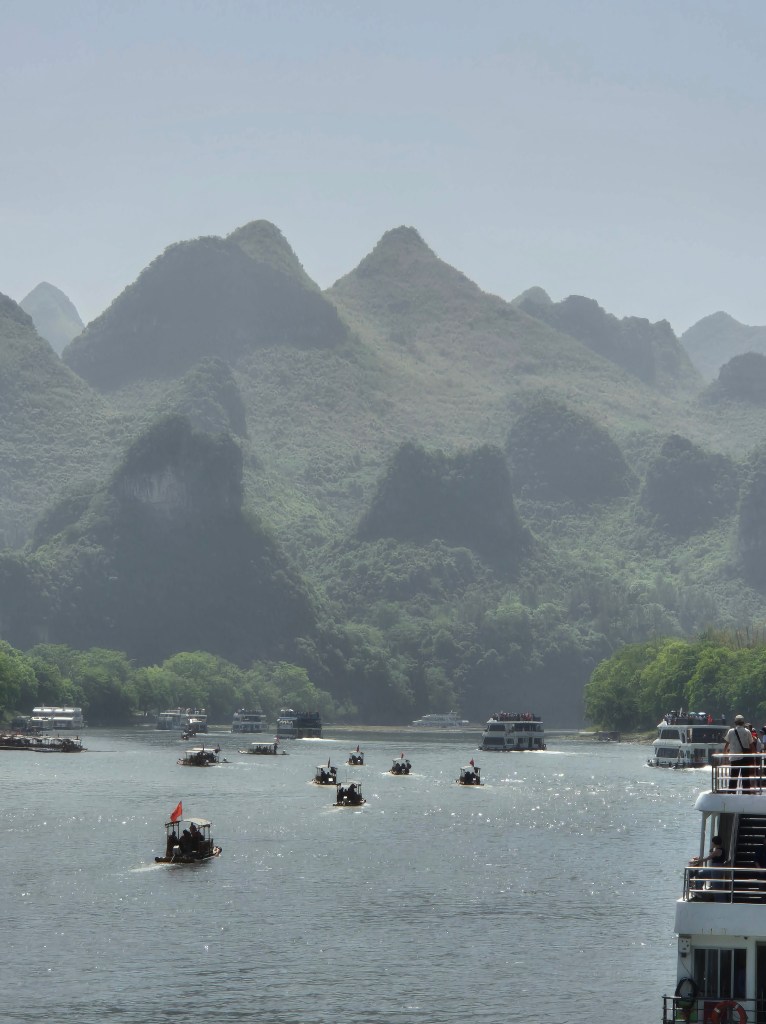
Before long our flotilla was cruising past the karst mountains where many smaller rafts were also enjoying time on the river.

The cabin area was spacious and comfortable and we had assigned seats for the trip.
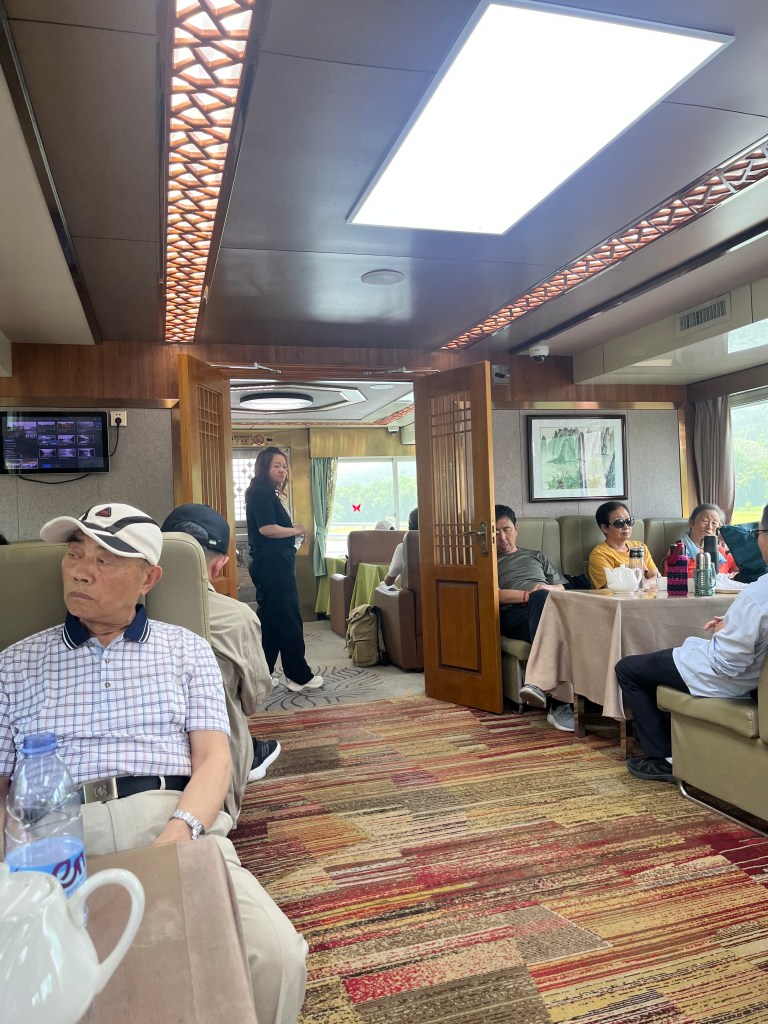
Inside the cabin (first class seats at the front)
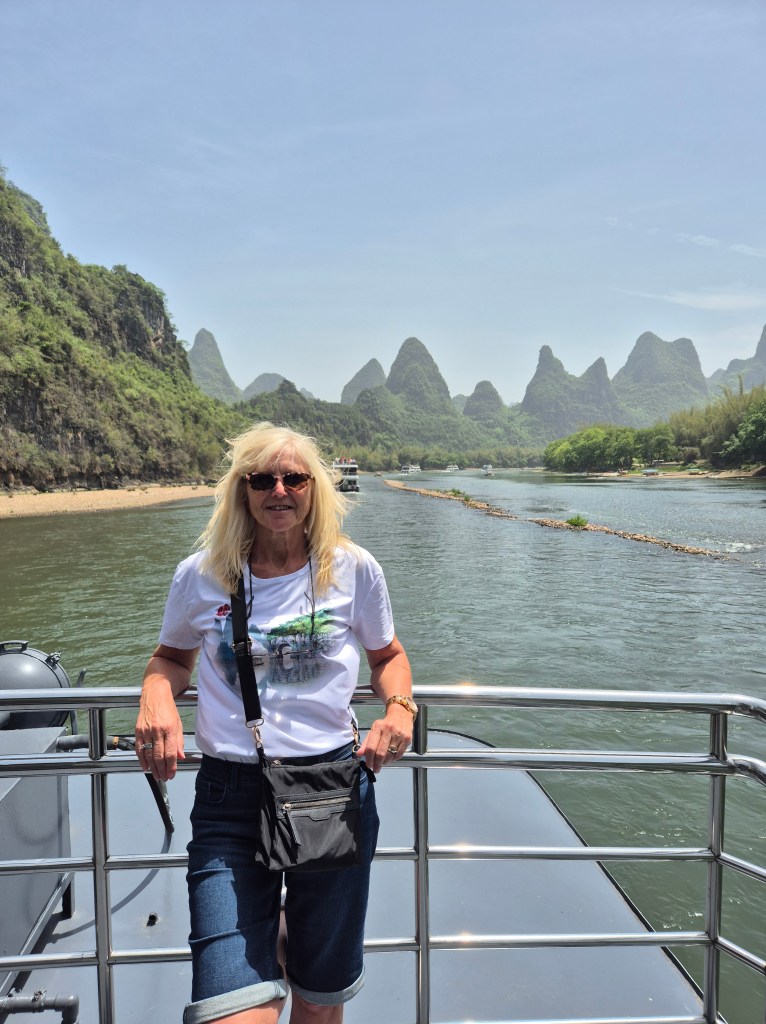
There were open areas on the roof of the cabin and at each end on the cabin deck.
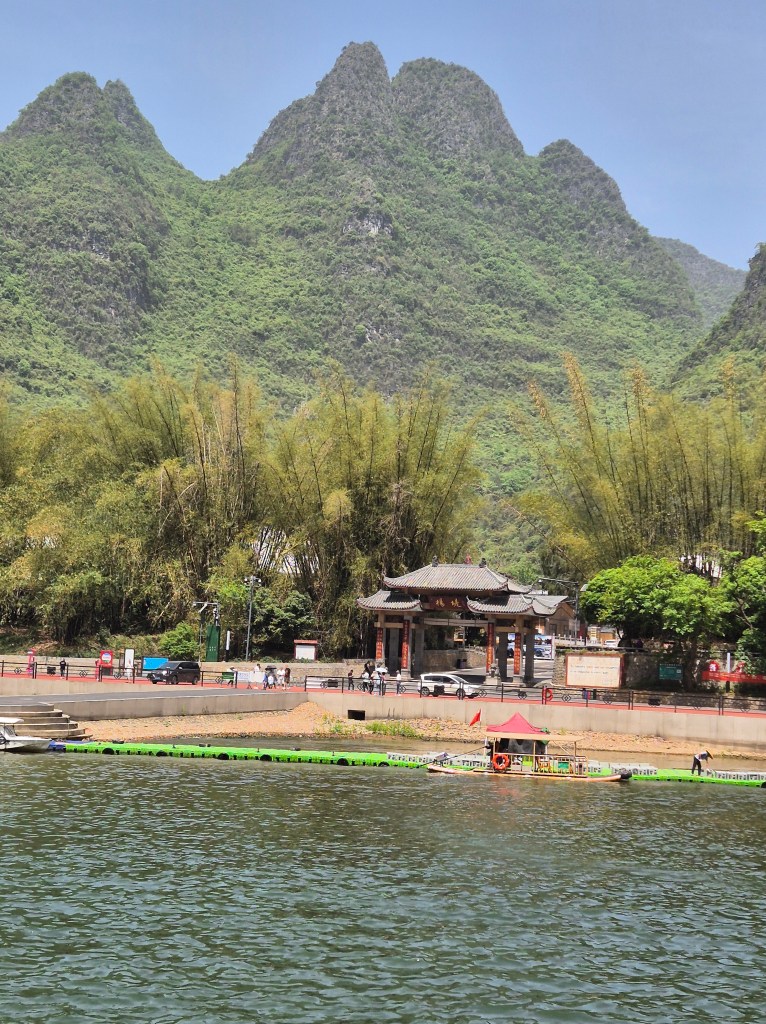
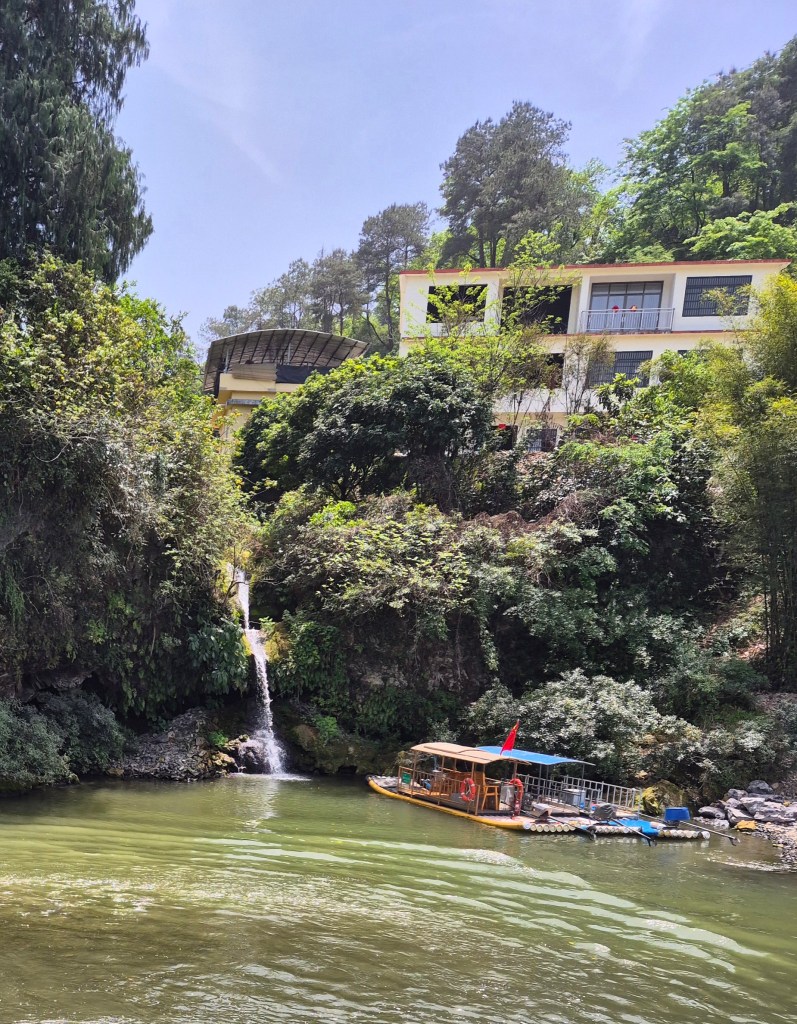
Small holiday areas were dotted along the river.
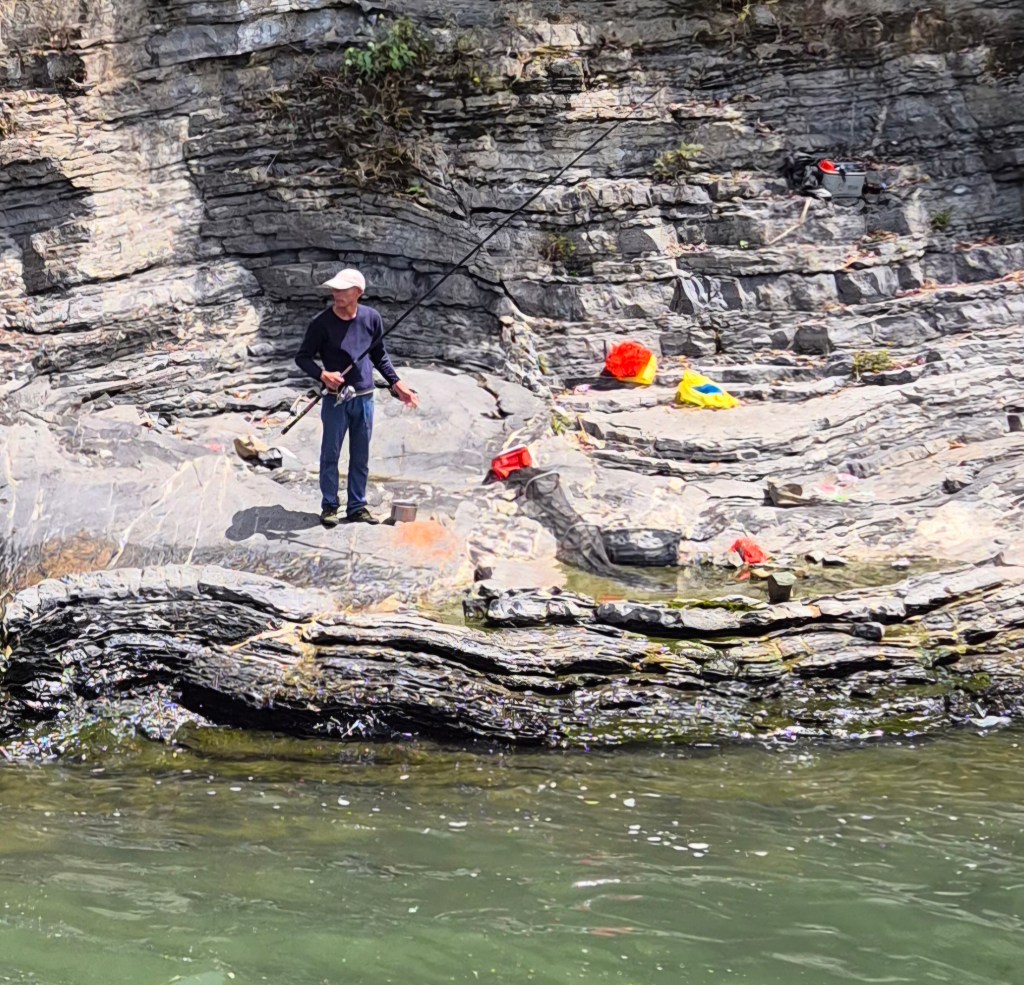
Enjoying a spot of fishing.
A traditional Junk.

A traditional fisherman on his bamboo raft with his tame cormorants. The birds have a string around their neck and when they catch a small fish they eat it but if they catch a lager fish that they can’t swallow they bring it back for the fisherman.
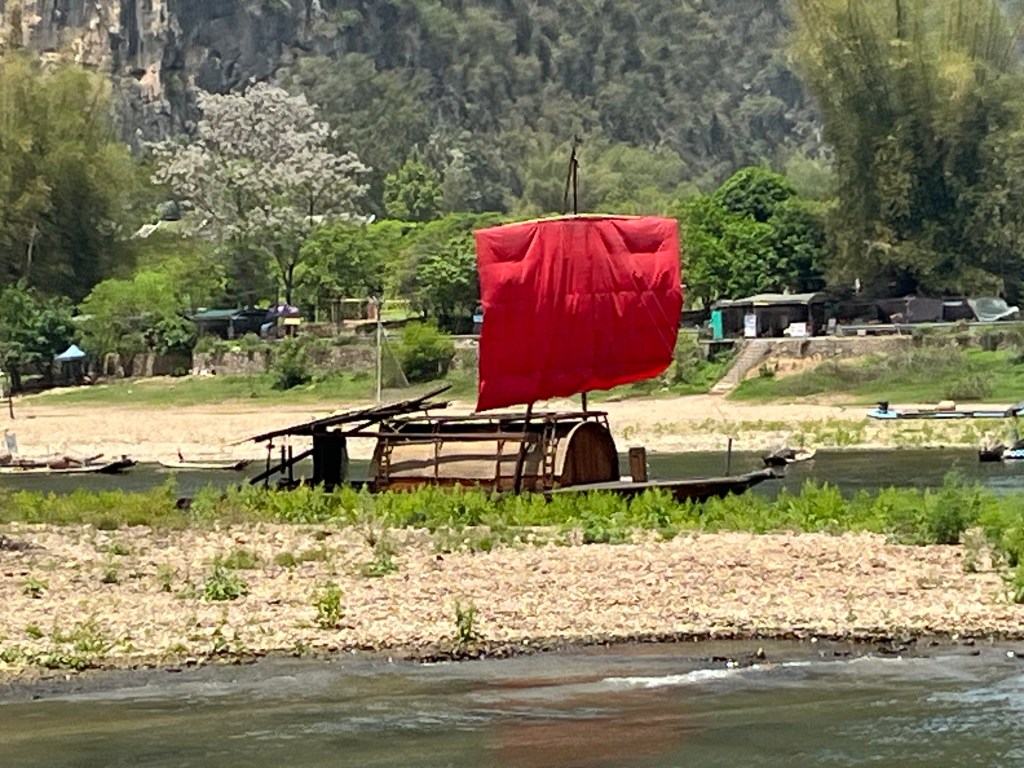
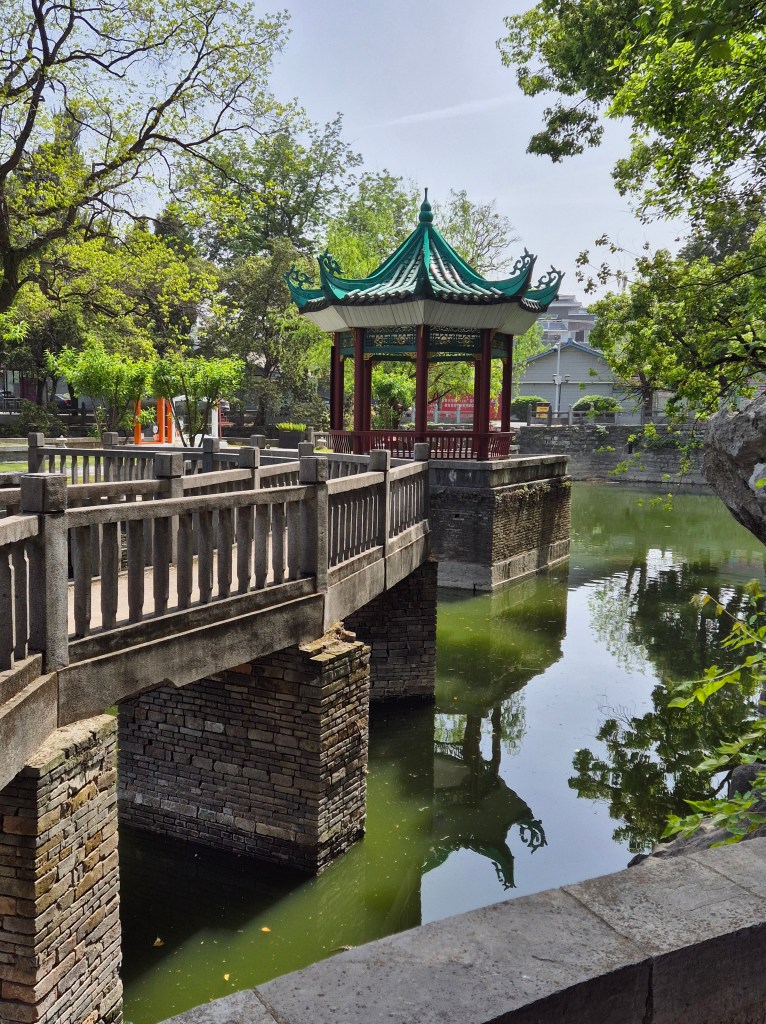
In the morning we strolled through town in the opposite direction from the lake and came across the entrance to Jingjiang Princes’ Palace. This was built between 1372 and 1392 AD during the Ming dynasty and is now the site of Guilin University and also a tourist attraction with a hotel.

During the 257 years from the building of the palace to the end of Ming dynasty, 14 kings from 12 generations lived here.

Very nice gardens and a lake
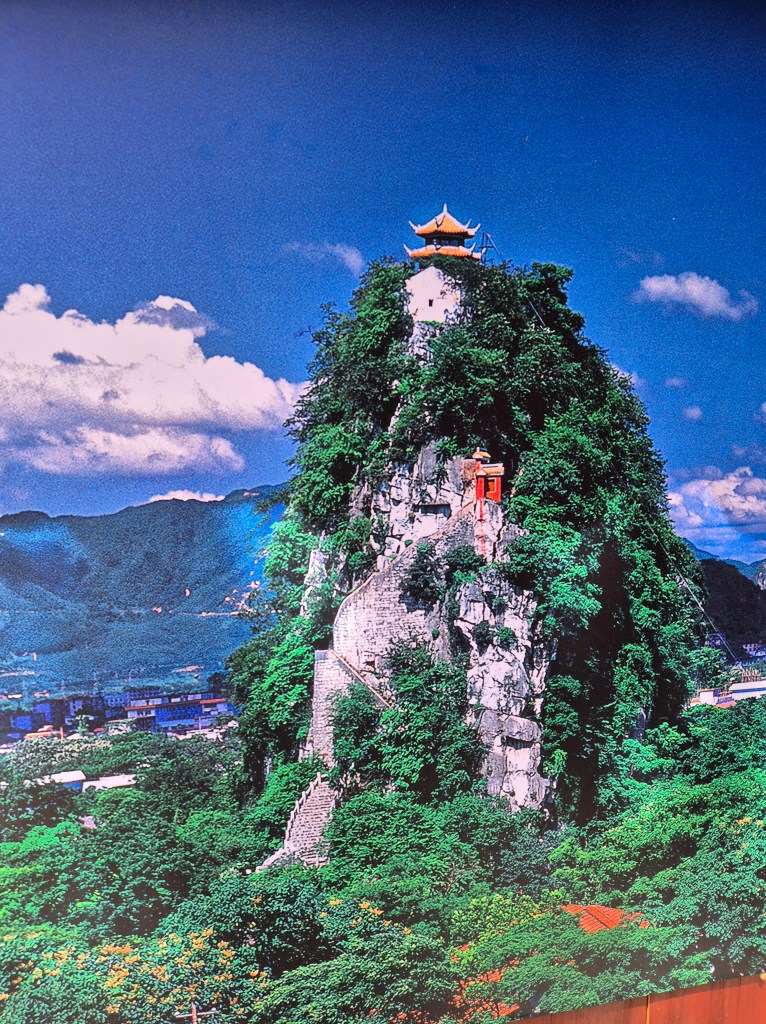
We decided not to climb to the top.
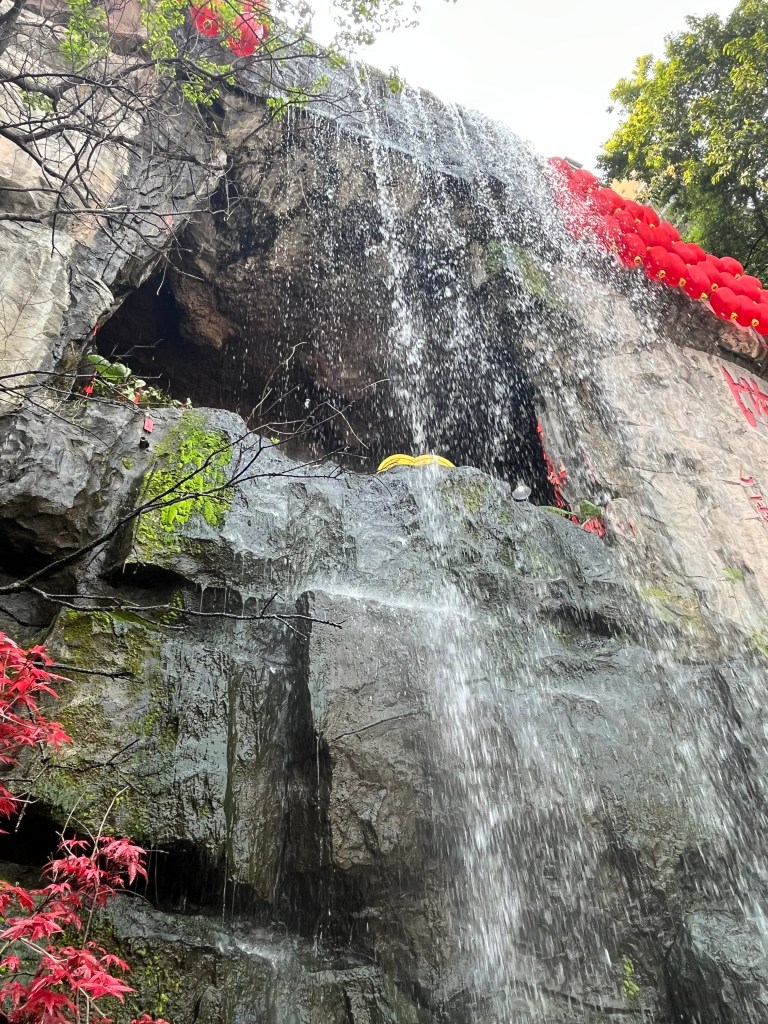
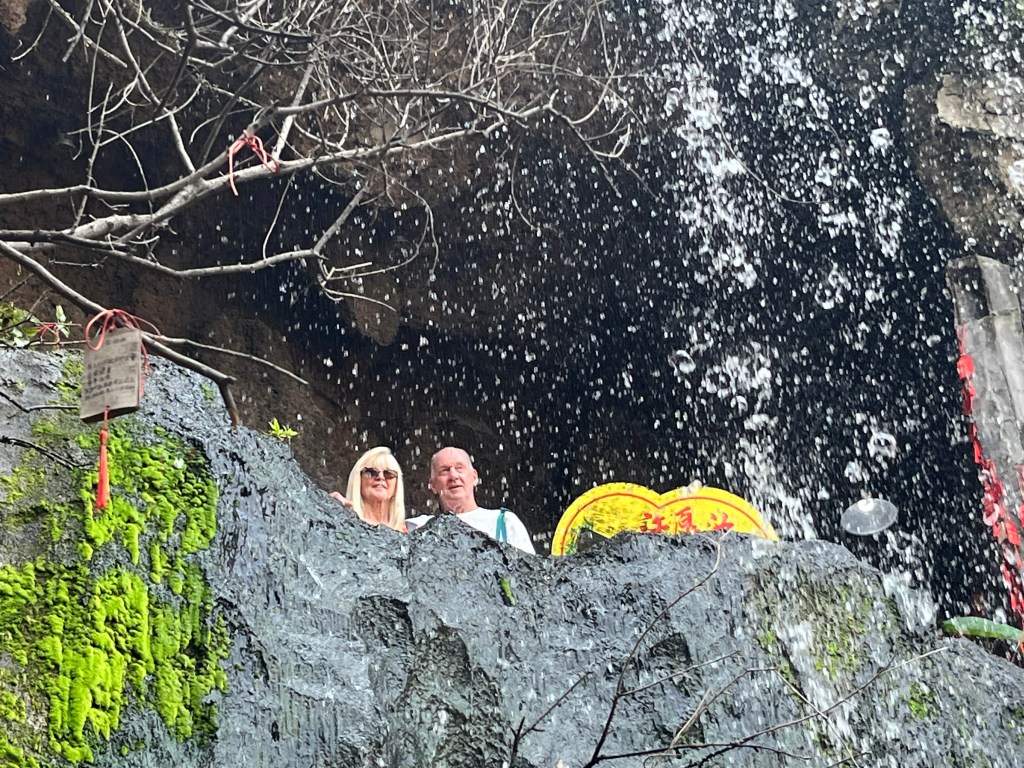
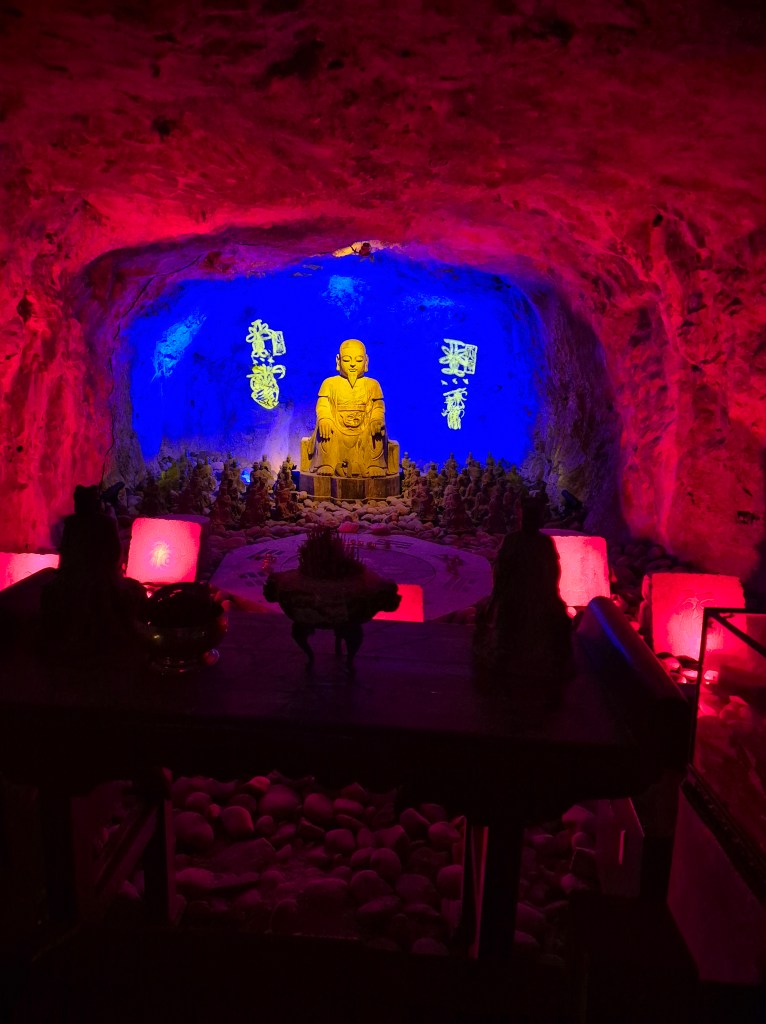
There was a shrine in a cave where many people were praying.
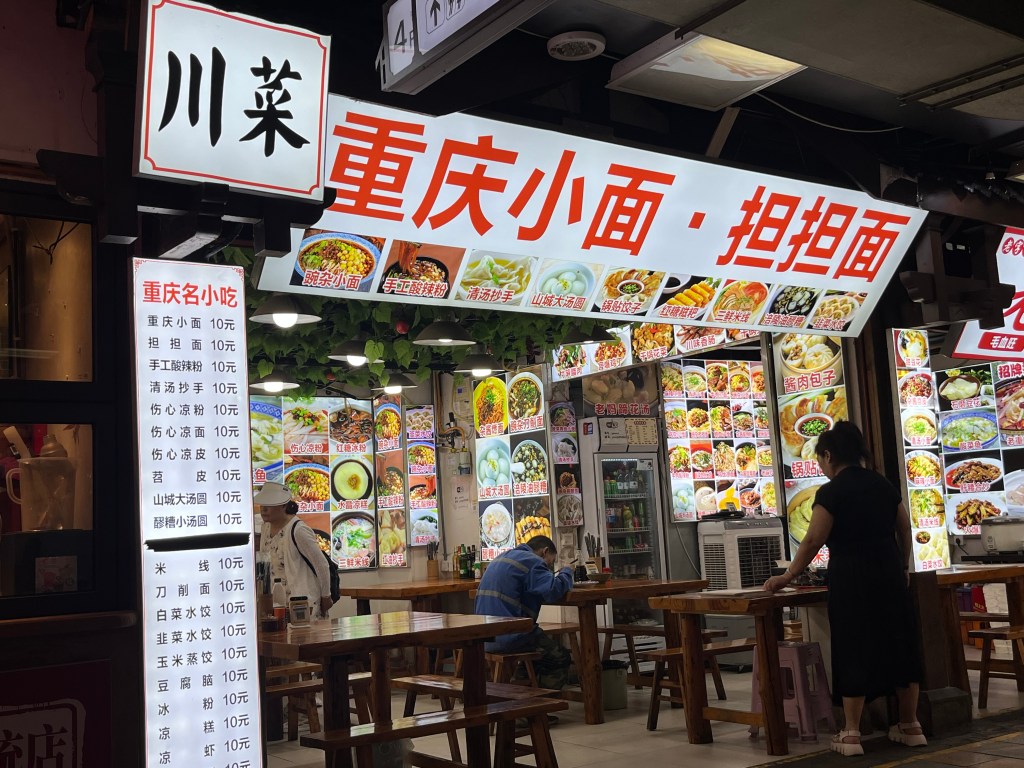
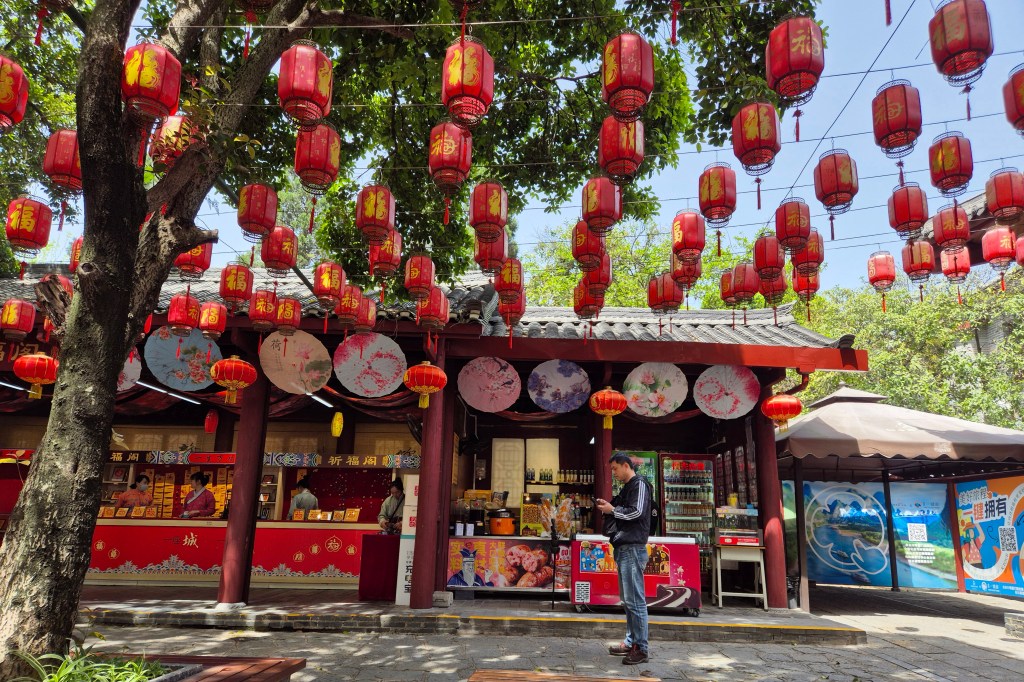
The normal food stalls.
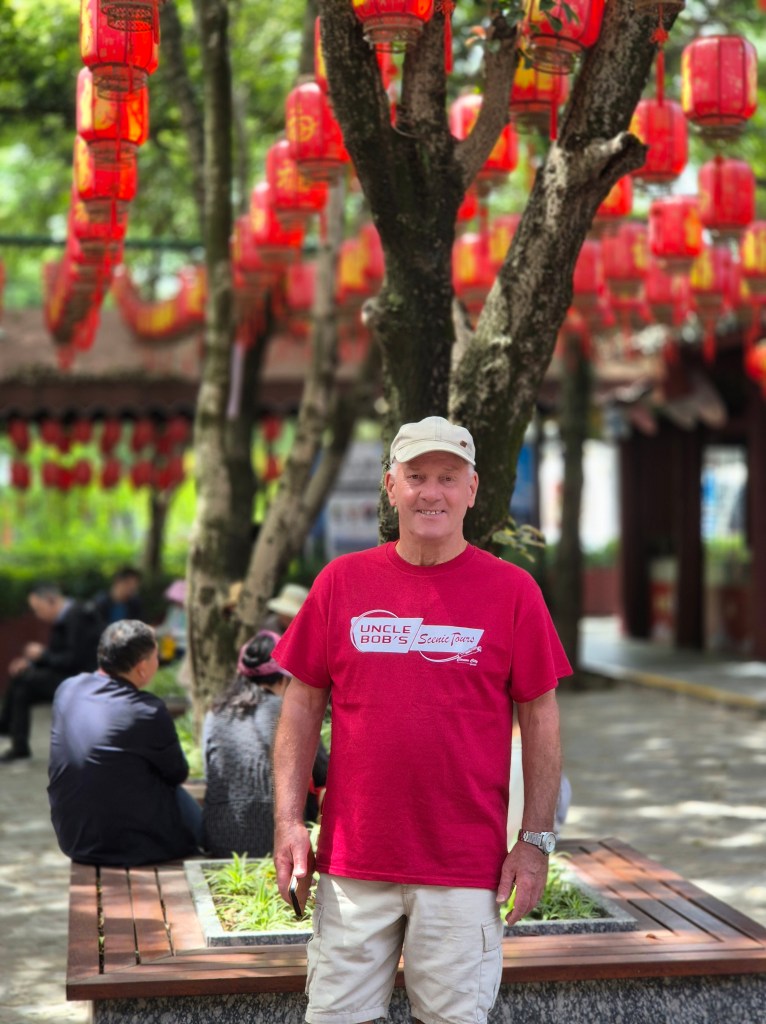
Today was an Uncle Bob’s Scenic Tours T-shirt day.
So that was the end of our short visit to Guilin where we had a great time around the lake and the river and were looking forward to our next stop in Shenzen and look forward to bringing you our memories from there.

TTFN

Bibbley

Chongqing Part 2

The following morning we set off to visit Liziba station on line 2 of the

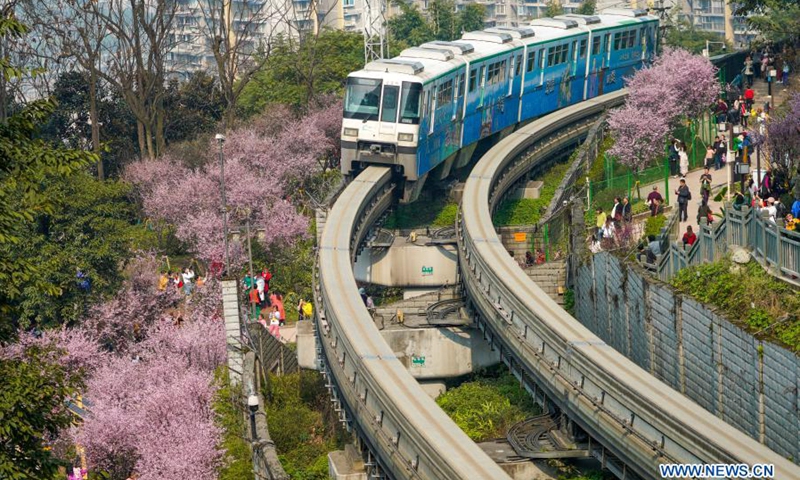
Chongqing Rail Transit System opened in 2005. Line2 together with line 3 are the longest monorail sytem in the world, carrying up to 637,000 passengers per day.

The system utilizes heavy monorail technology, which is capable of navigating steep grades and tight curves, making it suitable for Chongqing’s mountainous terrain.

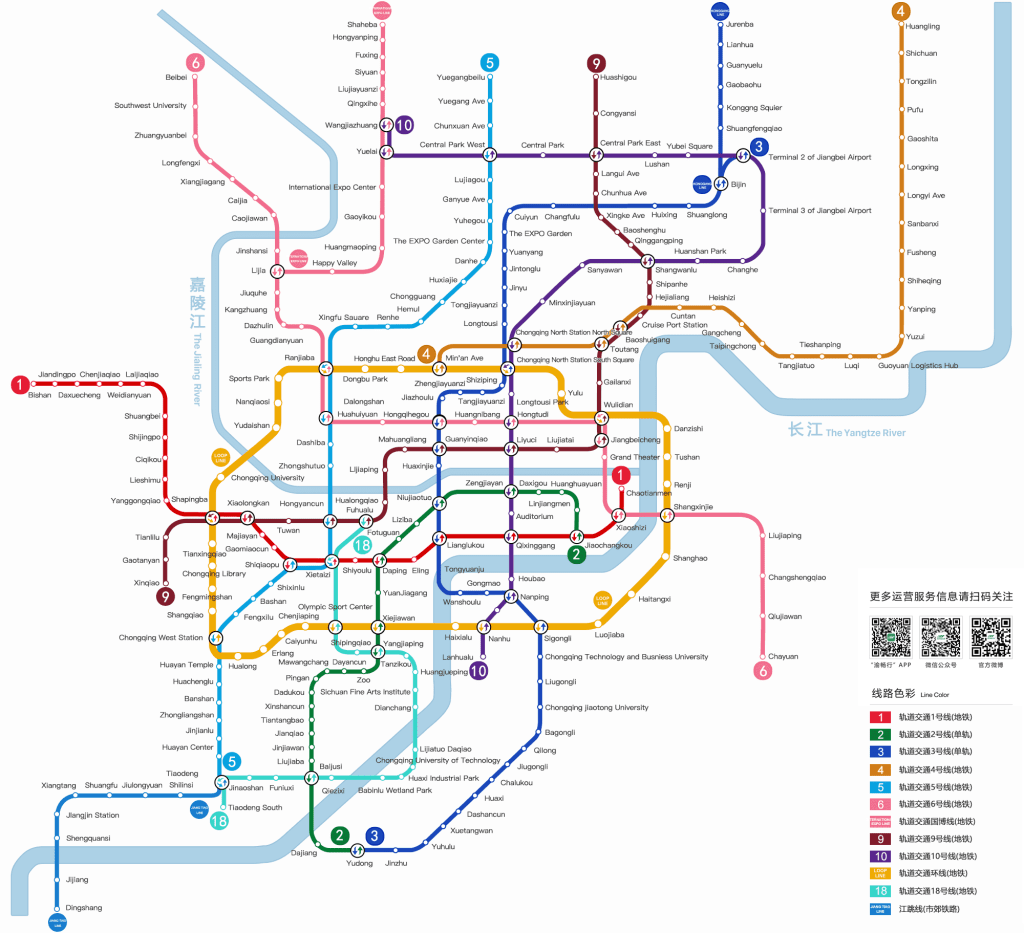
Map of the metro system. Our hotel is at the start of Line 1 near the centre of the map. We changed to Line 2 (green) and rode 6 stops to Liziba.

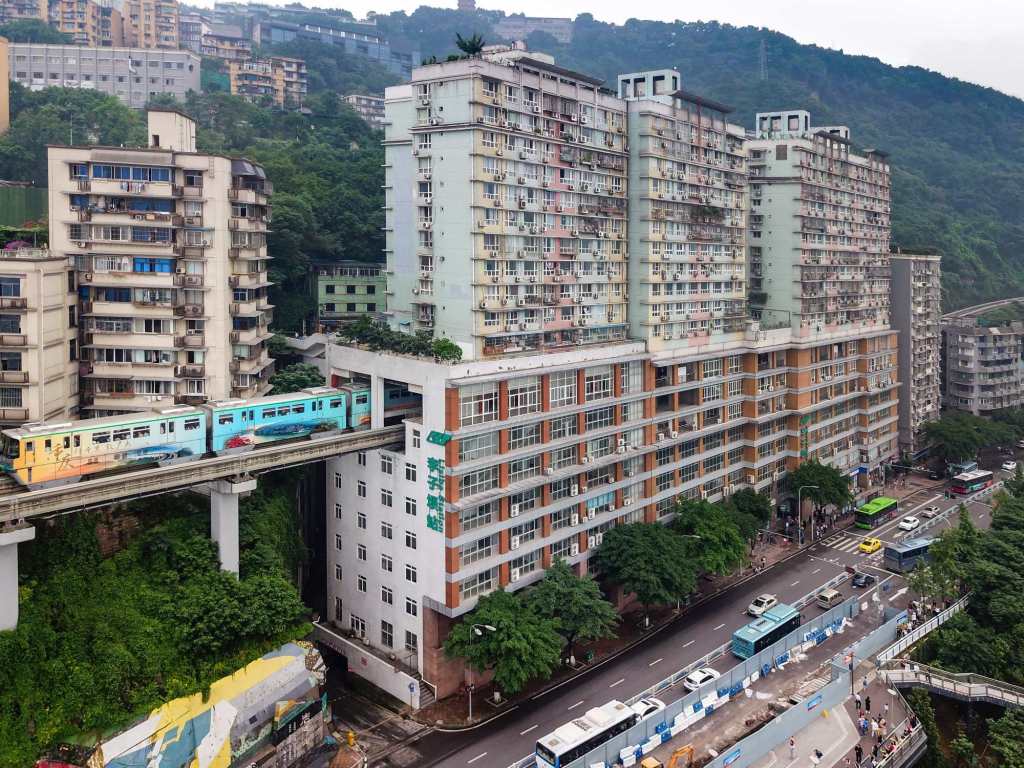
The station is unique in that it is located on the sixth to eighth floors of a 19-story residential building, with the monorail trains going through the middle of the building. It uses specialized noise reduction equipment to isolate station noise from the surrounding residence. 

The station and building were actually constructed together as one whole structure, and the monorail was not retrofitted through the middle of an existing structure as some people think.

Photo courtesy of David290 – Wikipedia

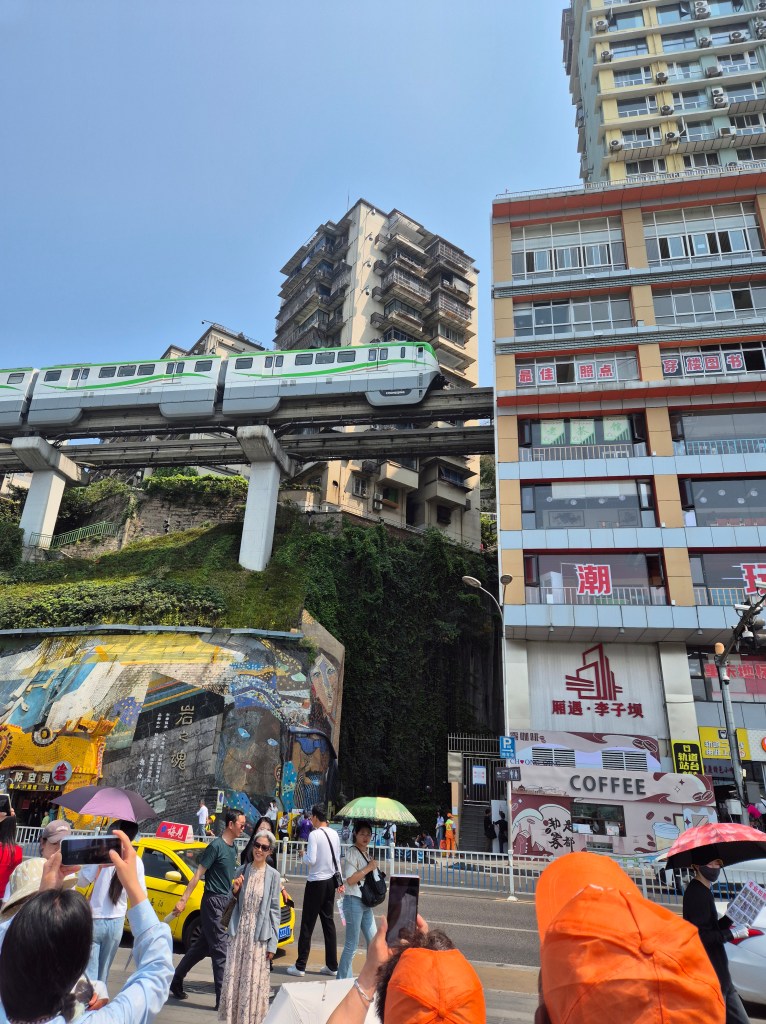
The station is quite famous and the city has built a viewing platform beside the street below to cater for the many thousands of visitors. Plenty of street vendors here selling souvenirs, drinks, fridge magnets, ice creams etc.

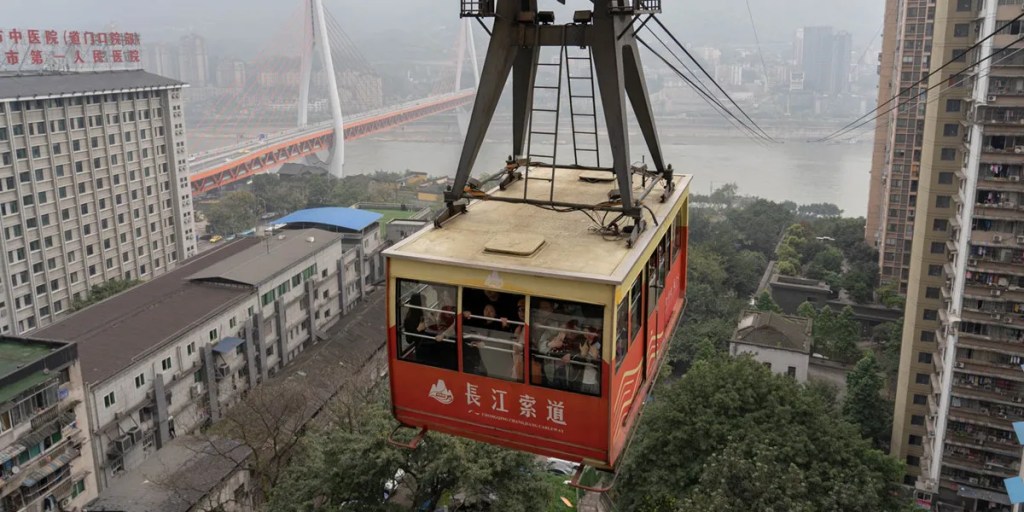
Another of the way to get around the city and cross the river is the Yangtze River cableway.

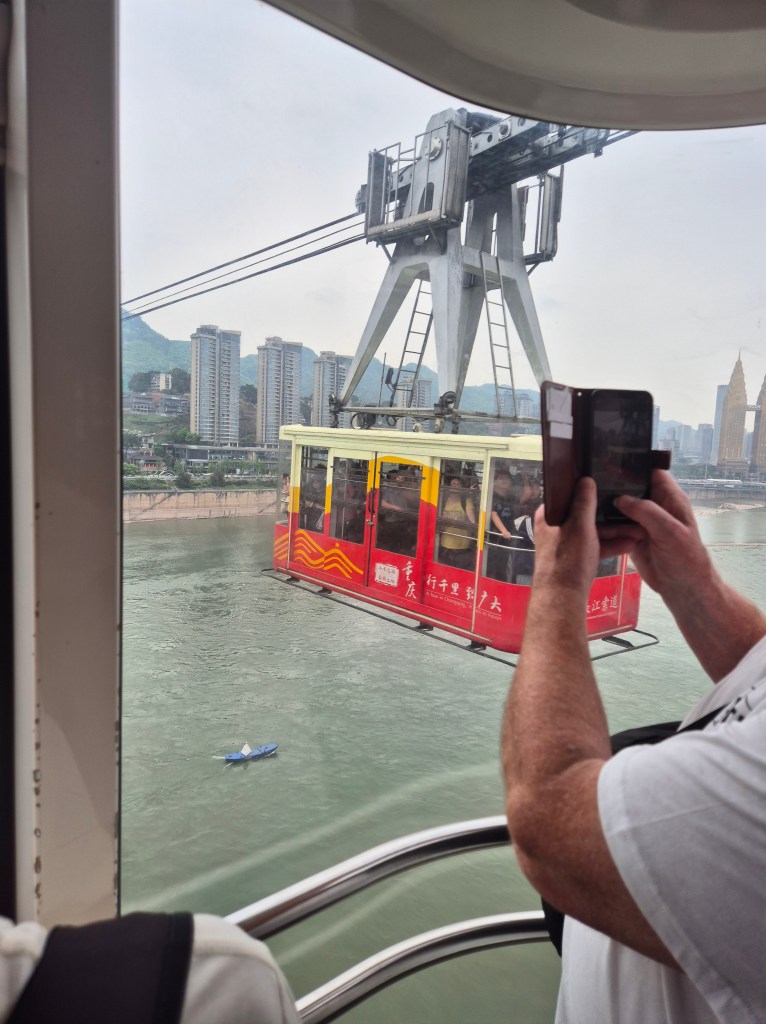
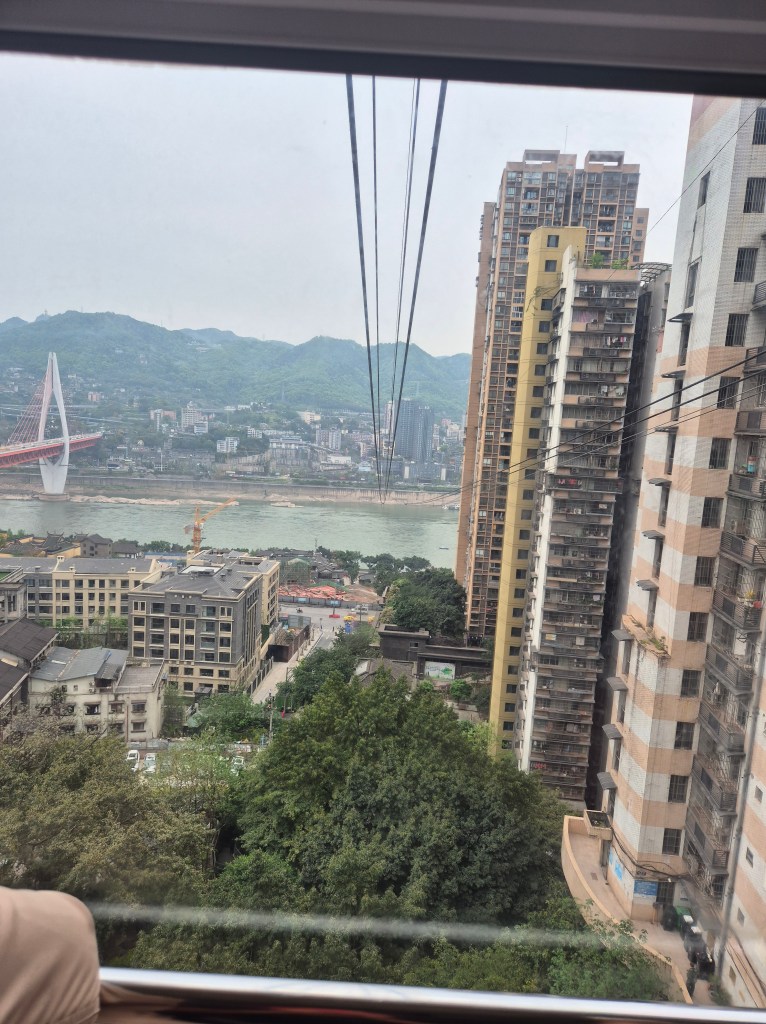
The Yangtze River Cableway, which has been operating since 1984, is the major means of public transportation for people crossing the Yangtze River from Yuzhong district to Nan’an.

Although only half a mile from the hotel is was all uphill and quite a slog!

The Cableway, stretching 1,166m, with a one-way trip taking 5 to 6 minutes, is a tourist spot rather than public transportation nowadays. 

The ticket office looking great in the spring sunshine.

With Gary at the cableway station on the far bank.

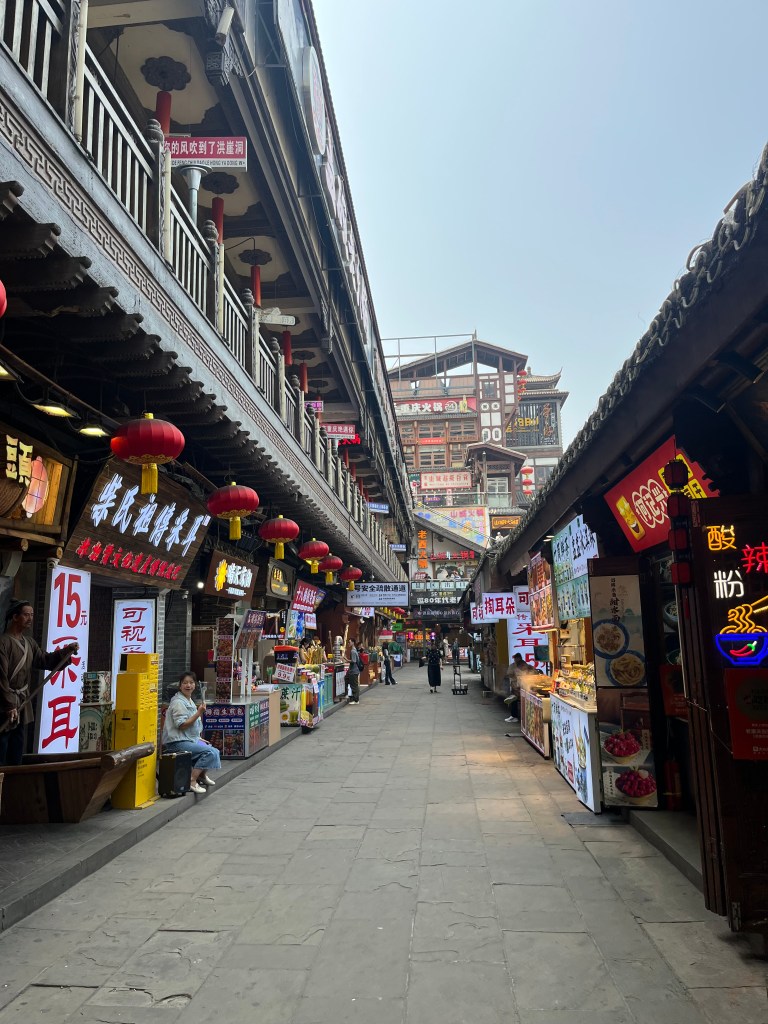
The usual shopping street with plenty of food choice.

Down by the river was an area of restaurants and souvenir shops, our hotel in the background.

It was soon time to cool off.

After relaxing for a while we headed back to our hotel and decided to go up to the 53rd floor, which is reached by a lift from the basement floor of the shopping mall beneath the hotel.

I was feeling quite giddy at the entrance, let alone on the 53rd floor!

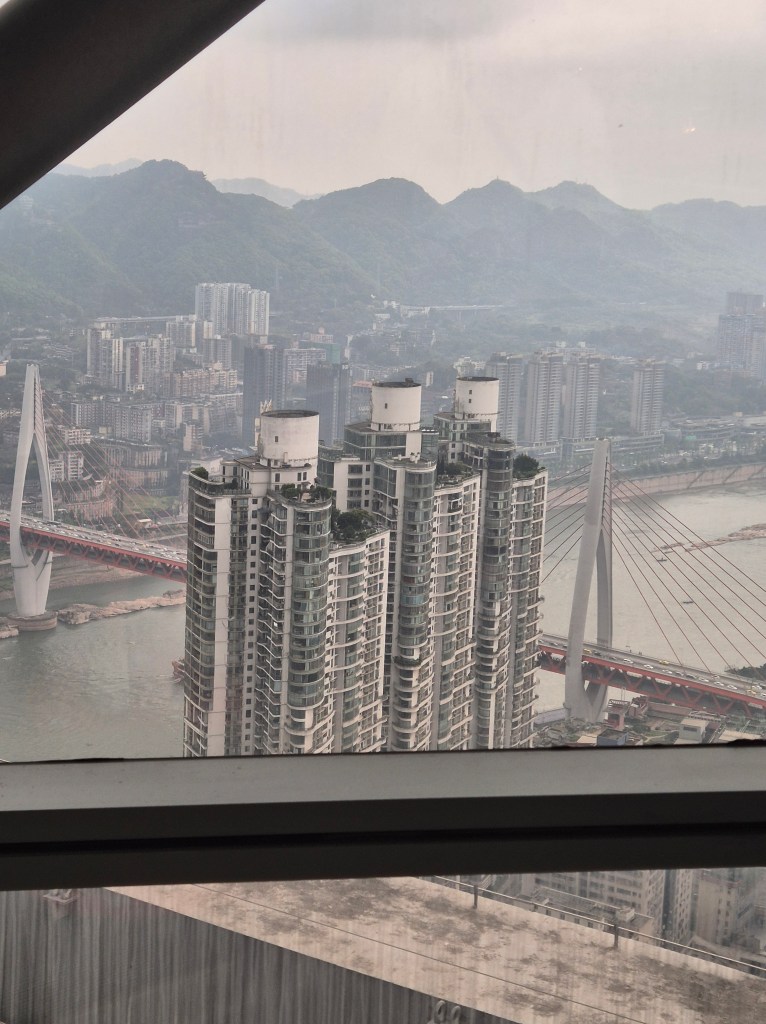
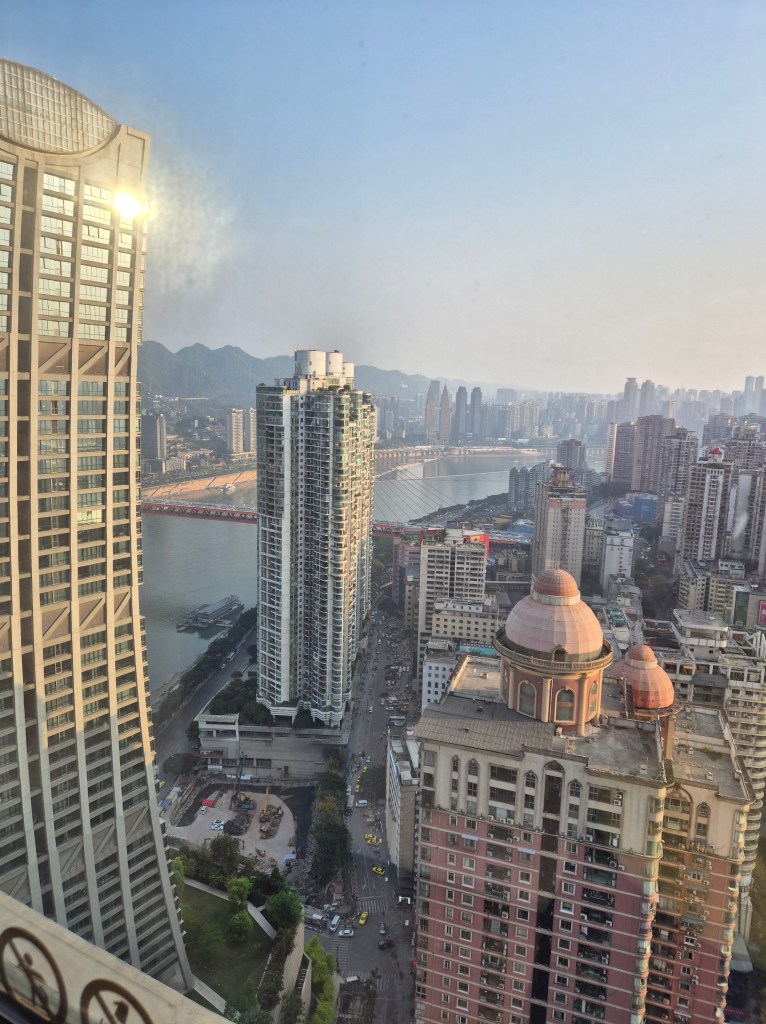
Great views from up there, this is looking back to where we had just come from on the other side of the Yangtze river.

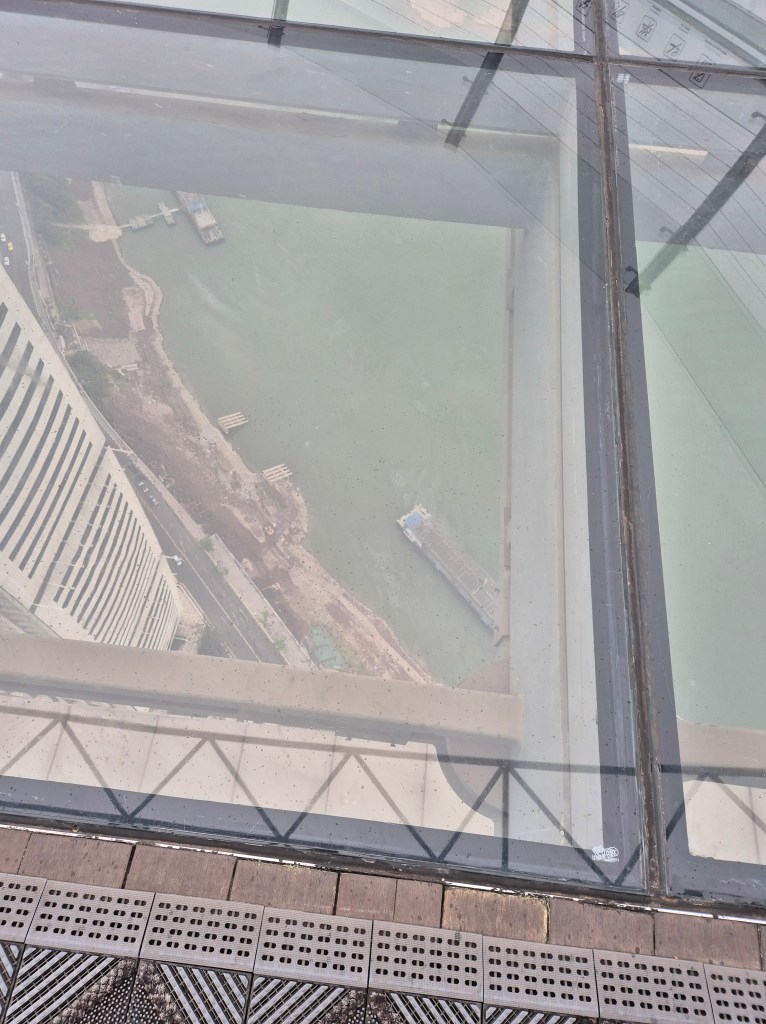
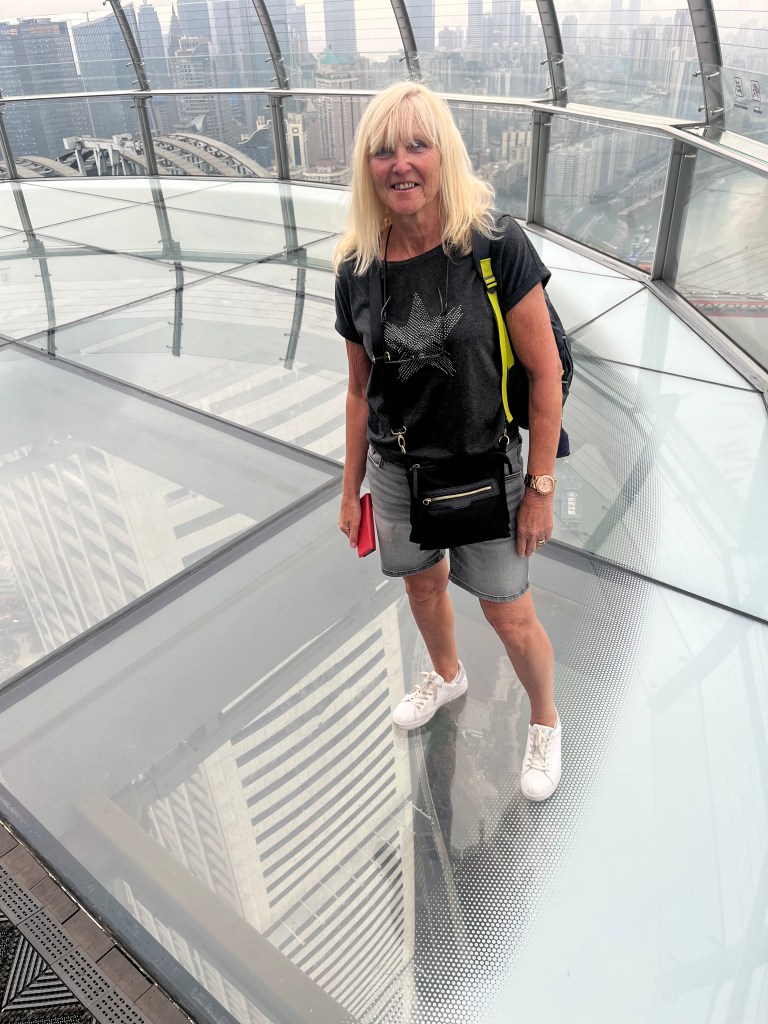
Standing on the edge and looking through the glass floor it looked a long way down!

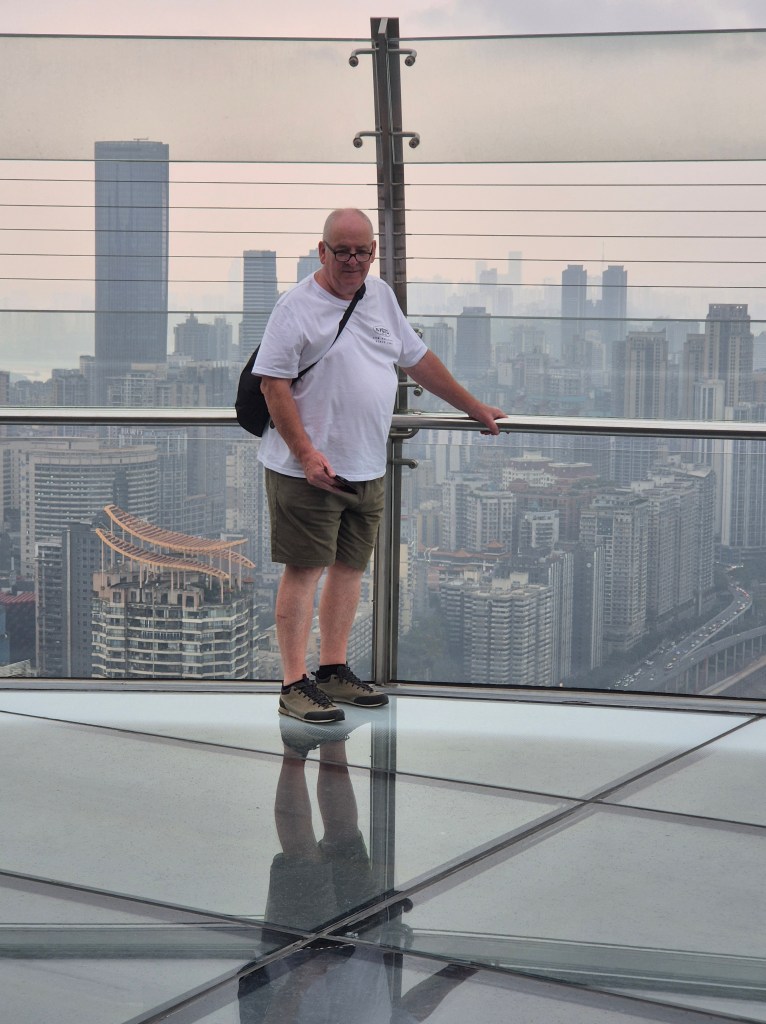
Holding my breath and not looking down seemed the best option and I was soon on the far side of the glass floor, holdng on tightly to the hand rail.

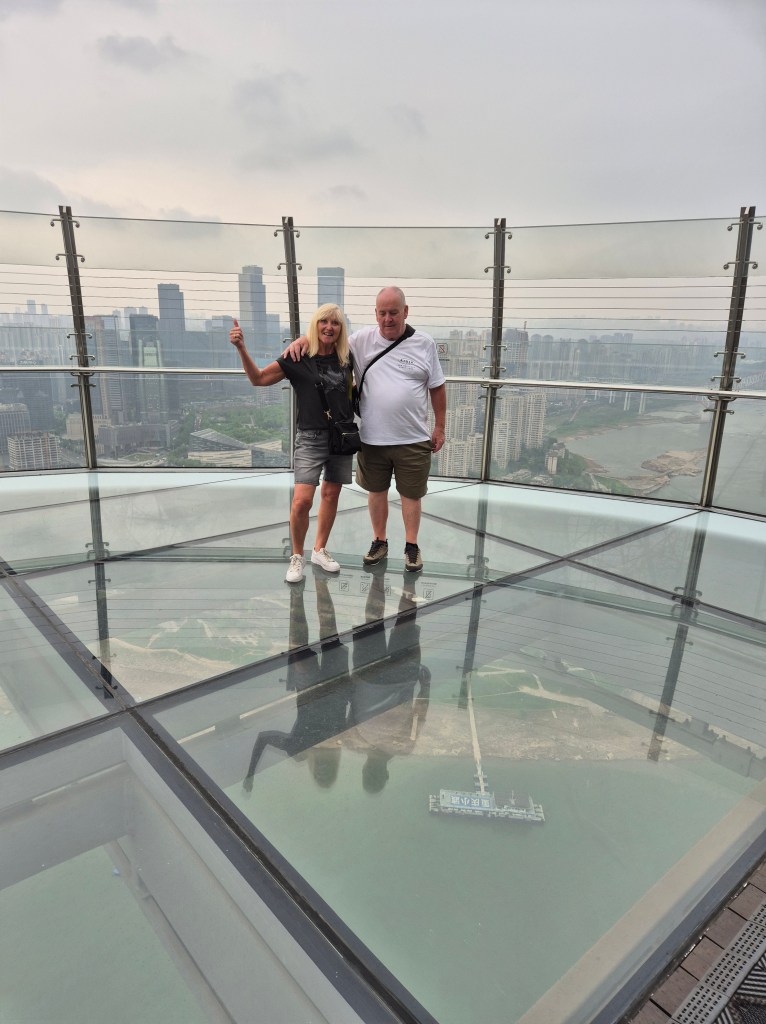
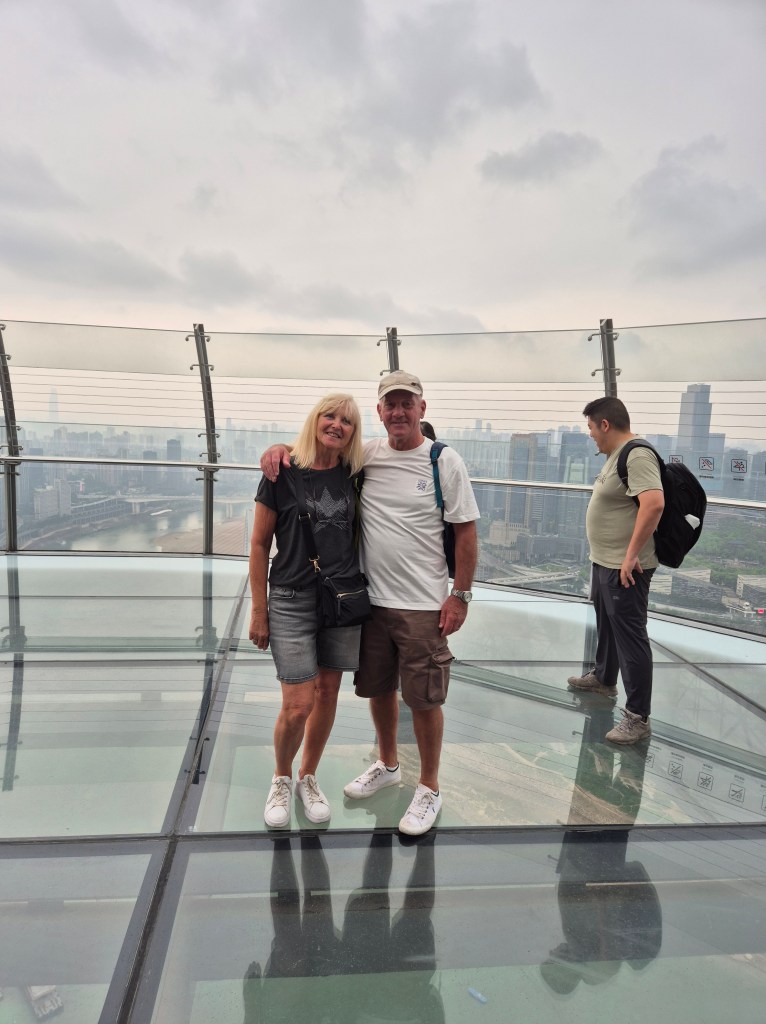
Diane soon joined me, as did Gary.

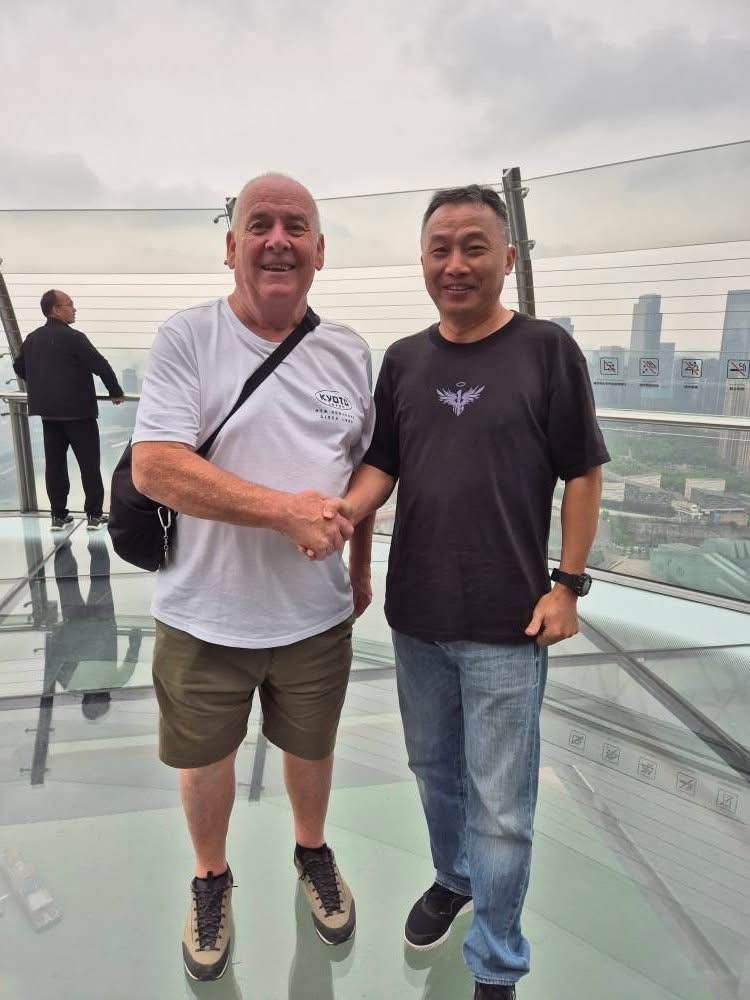
I was feeling quite brave and there was a Chinese guy too frightened to walk on the glass floor but I led him forward and he finally made it and was very grateful to me for helping him.

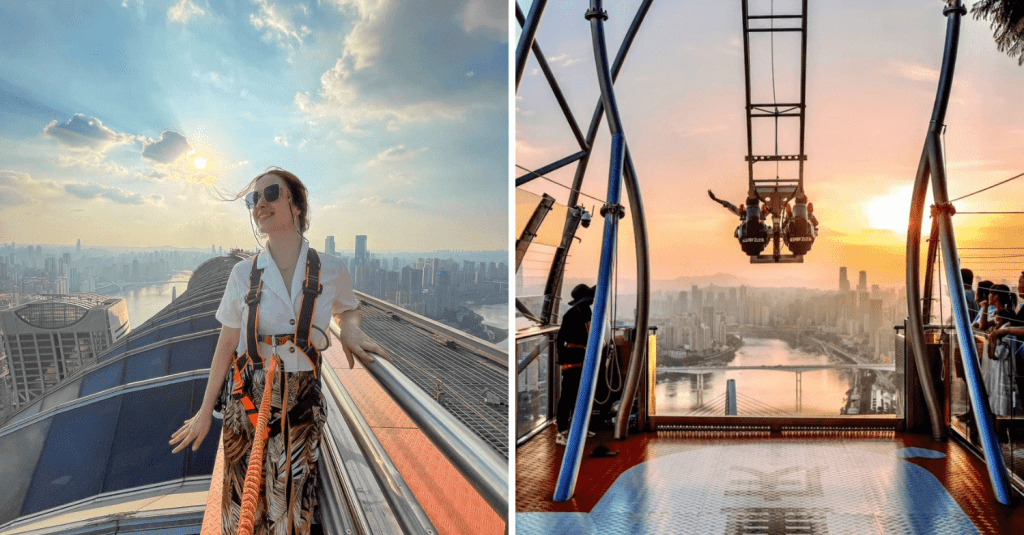
Some nice photo spots up there.

Photos by Sadie Architects who designed the Raffles City Complex.

There is also a swing but fortunately this was closed for maintenance!

Walking along the roof is also an option but we all felt it was a bit too windy up there for us.

We looked around and found a simulator ride with VR headsets but the operator said we were too old, had to be younger that 60! Bloomin cheek!

Part 3 of Chongqing will come later and I hope you enjoyed today’s post.

TTFN

Bibbley
Chongqing Part 1

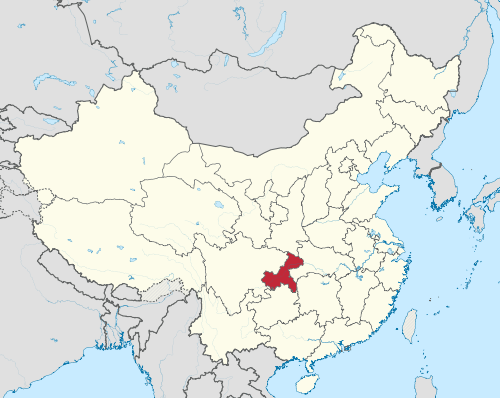
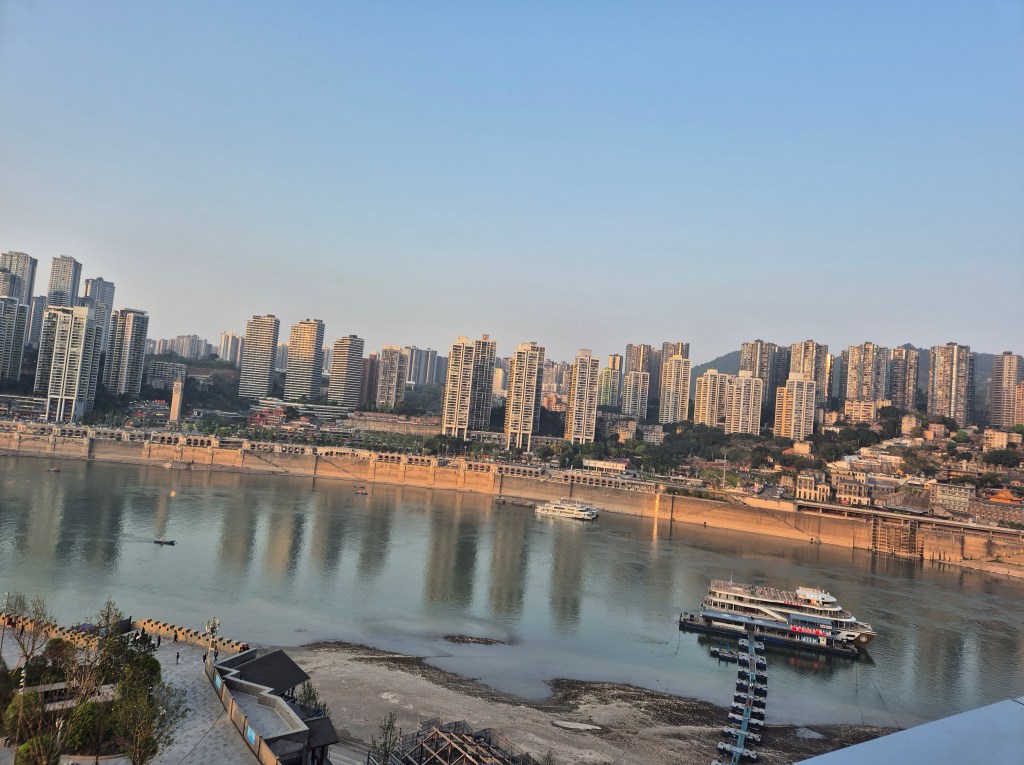
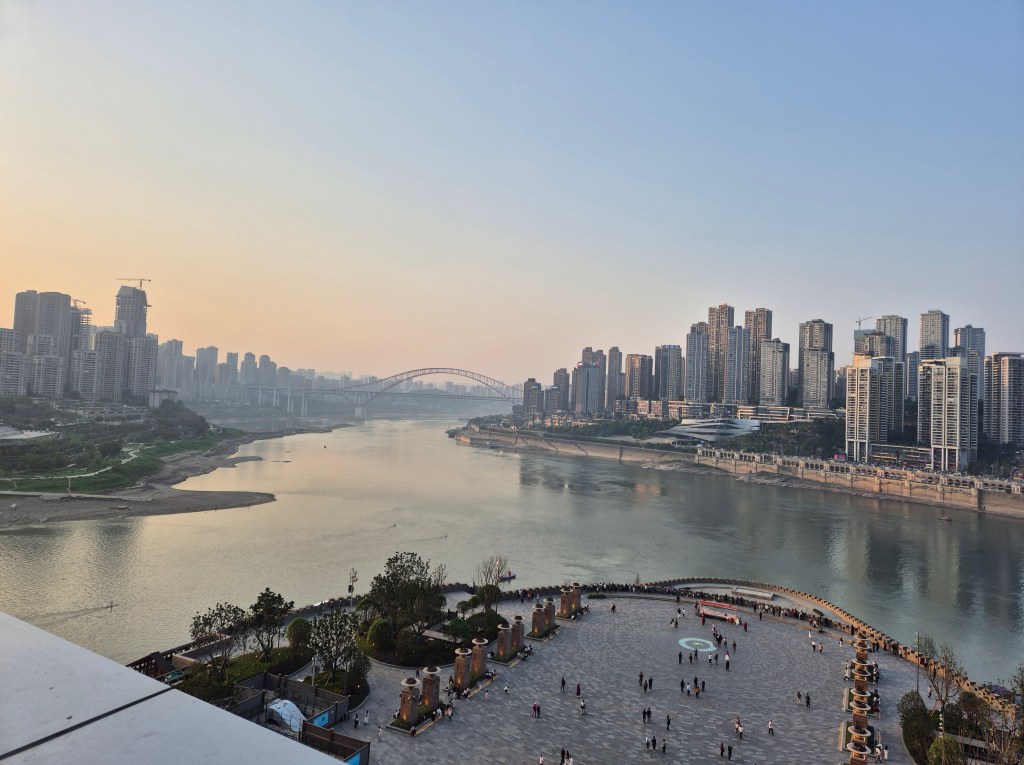
After another very fast and very smooth 1,000 km train ride we arrived in the mega city of Chongqing which sits at the confluence of the Yangtze and Jialing rivers in central China.

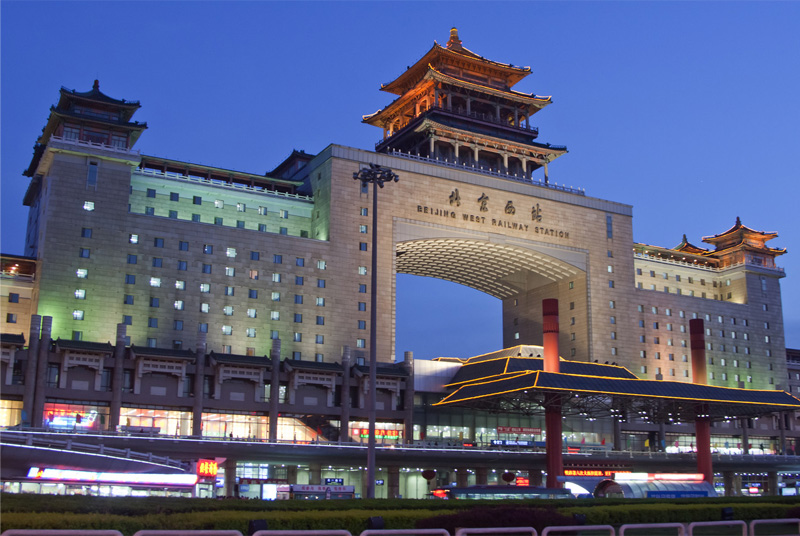
Although small in comparison with the railway stations in Beijing and Shanghai, Xi’An North station is still quite impressive, with plenty of shops and seating areas.

With a population of over 32,000,000 Chongqing is said to be the most populated city in the world.

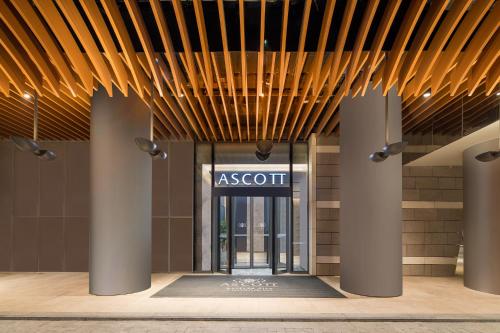
A hair raising 30 minute taxi ride from the station to our hotel with a driver who must have been a stunt driver in “Fast and Furious”, weaving in and out of all 4 lanes of the motorway into the city centre we were soon at our hotel, The Ascott Raffles City in downtown Chongqing, right where the 2 rivers converge.

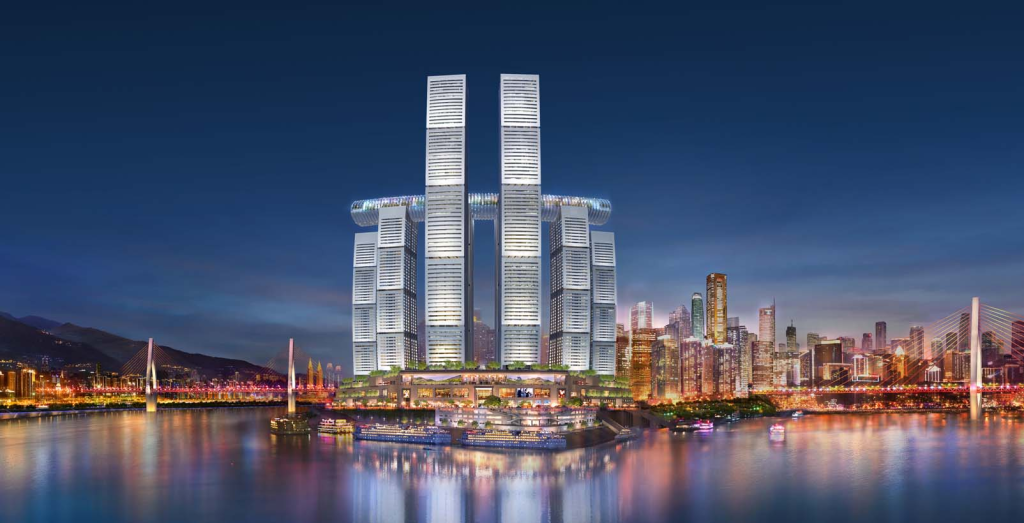
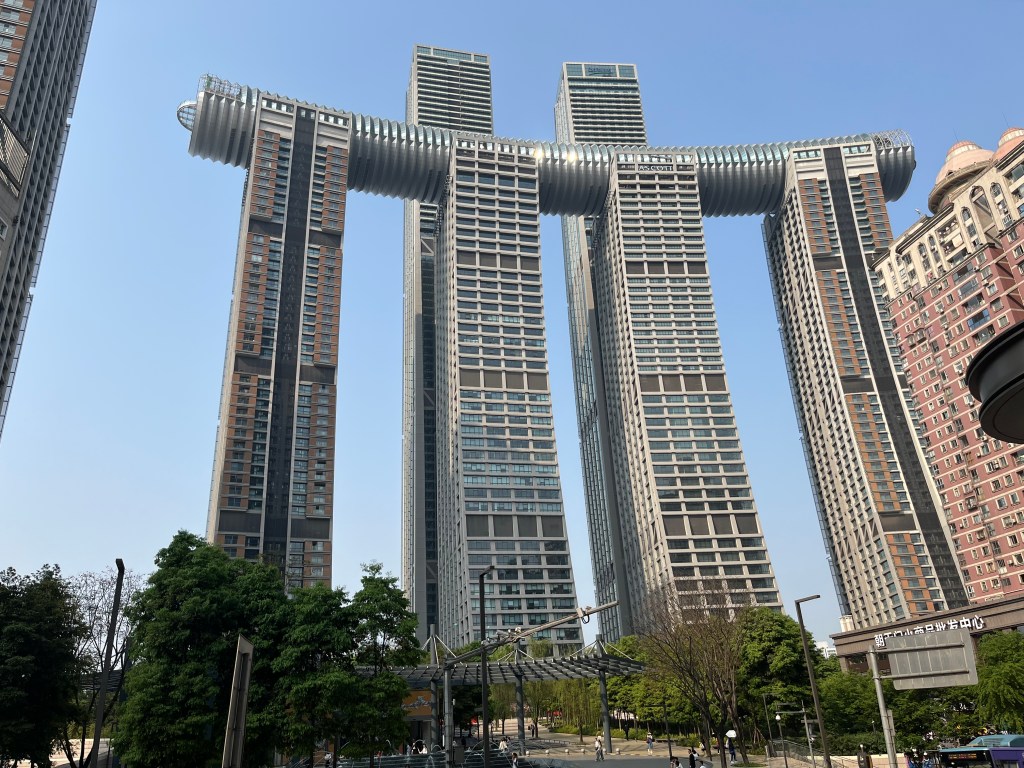
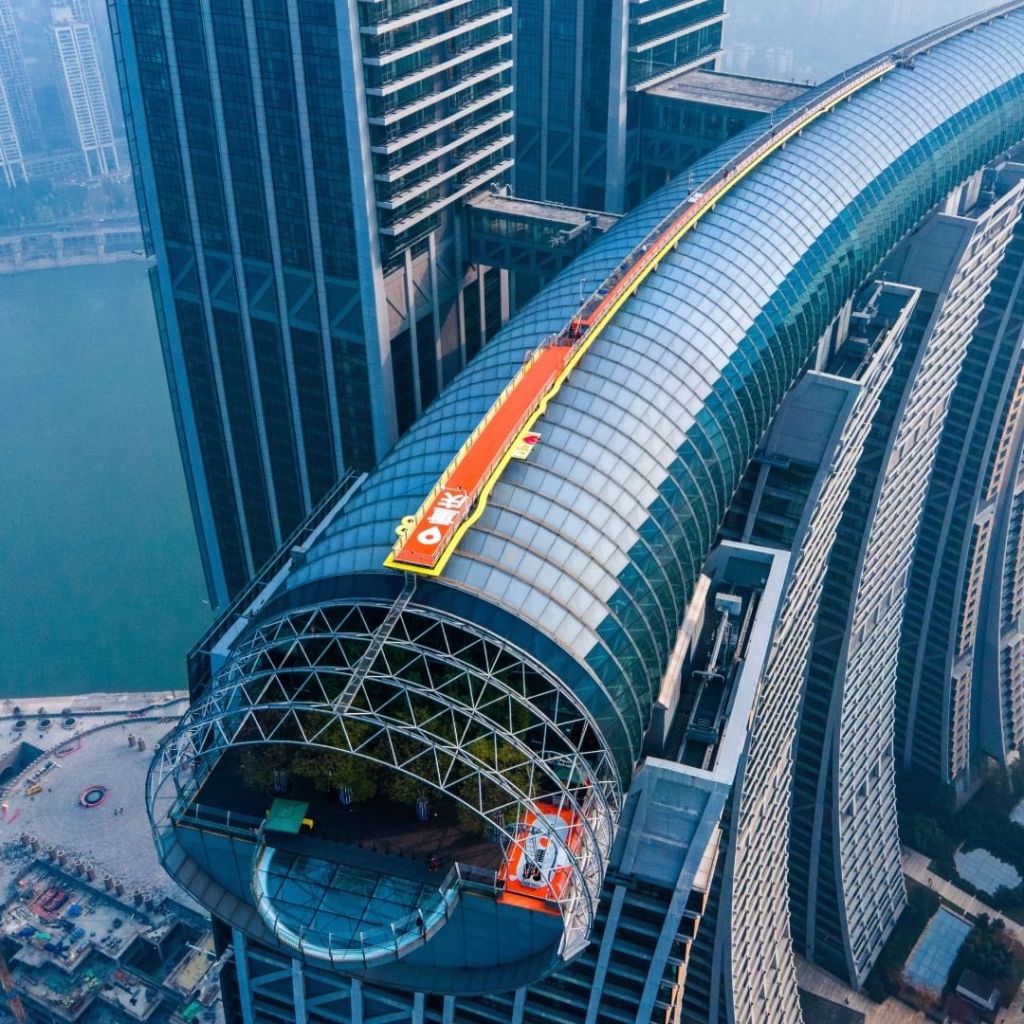
Raffles City Chongqing consists of eight skyscrapers situated on a site covering 9.2 hectares Atop four of the 250-metre-tall towers is an enclosed skyway, called the Crystal, with a swimming pool, bar and restaurant and a glass floor outdoor space which you can see in the photo below, but more on that later.

The two 350-metre-tall towers connect to the other 4, via a cantilever bridge. Two other 250-metre-tall towers are adjacent to these six.

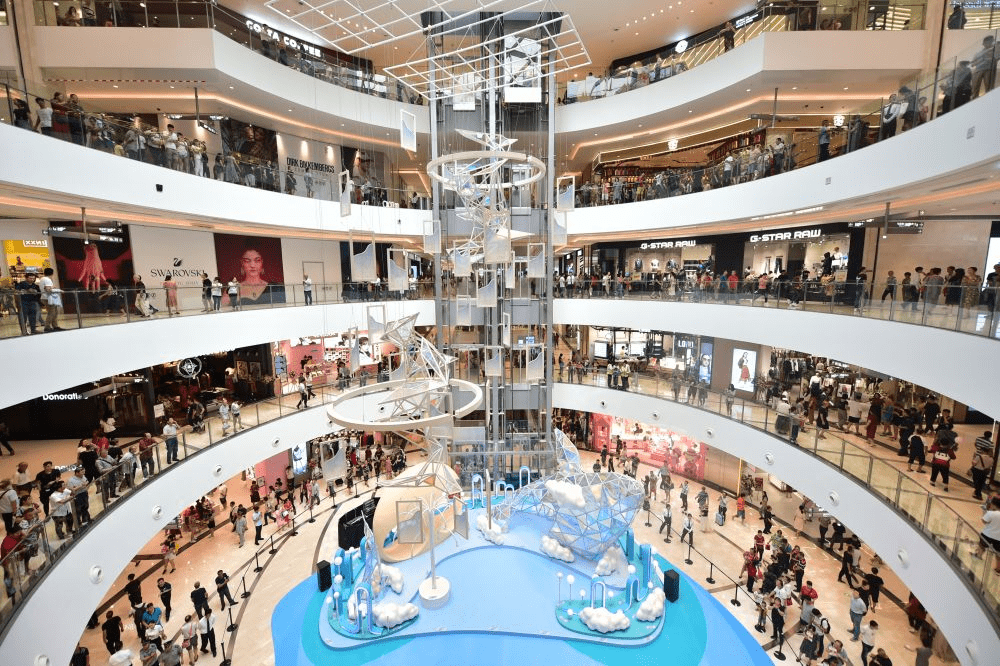
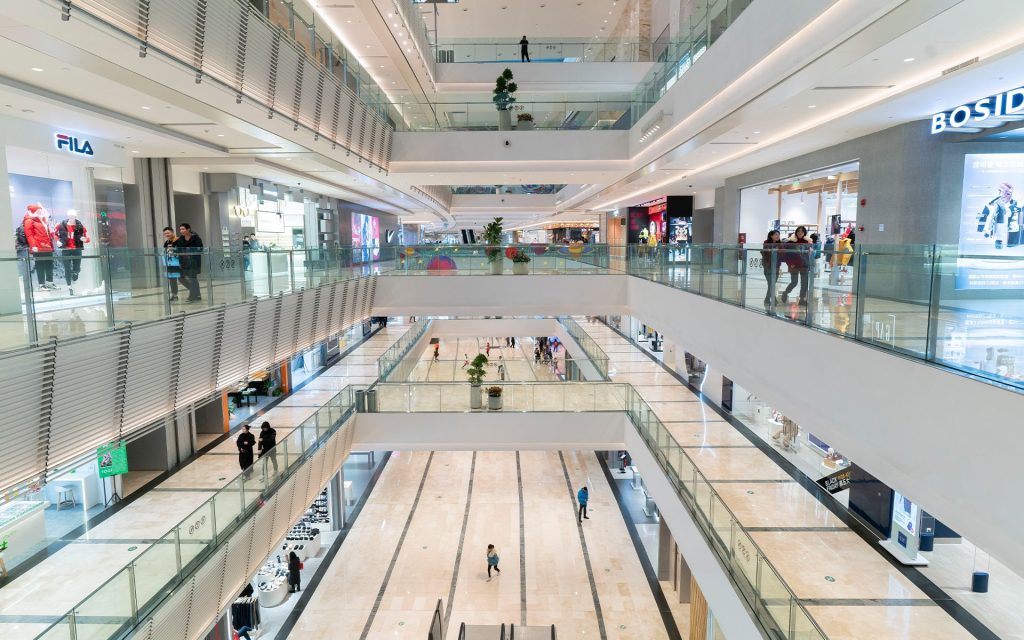
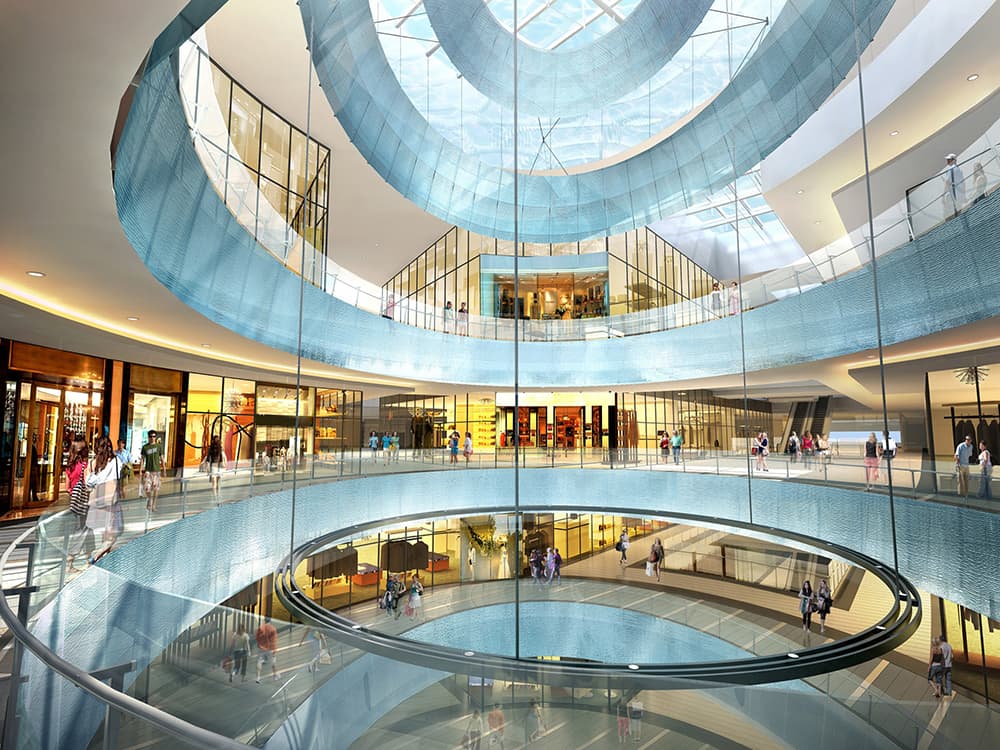
The Raffles City complex has 1.12 million square metres of space, including 150,000m2 of offices and 1,400 apartments, a hotel, and a 235,000m2 5 floor underground shopping mall, railway station and cruise ship terminal, all very impressive indeed.

Our 43rd floor apartment gave us great views over the rivers and the city.

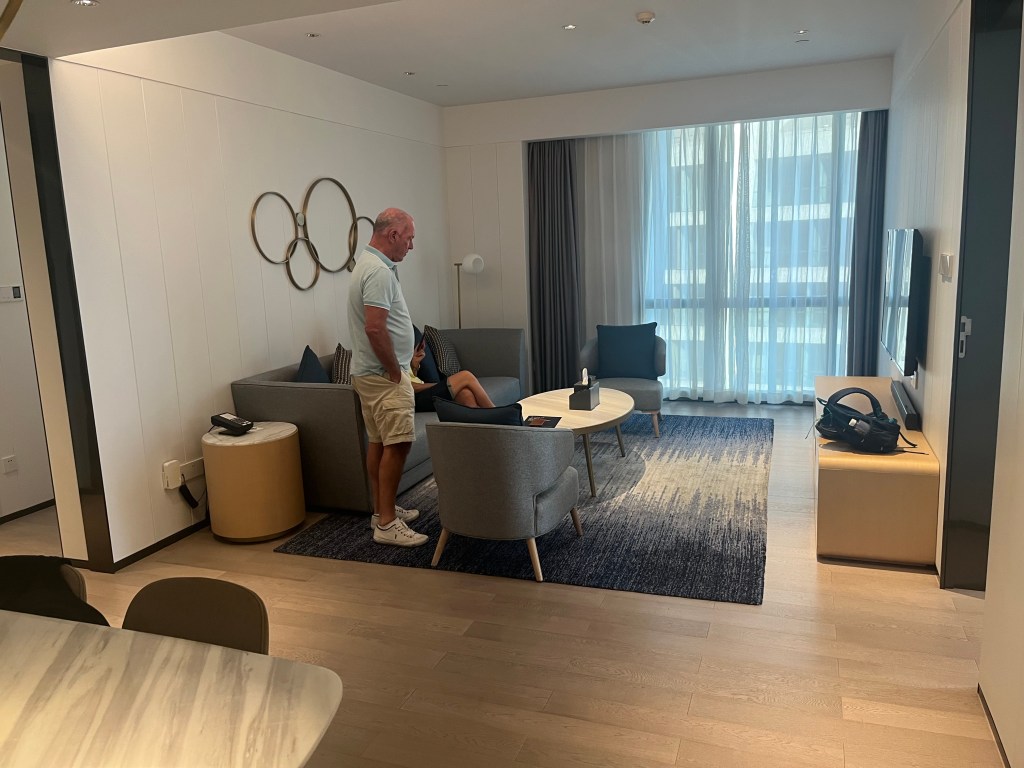
We stayed in a 2 bedroom apartment with a comfy lounge / dining area, a spacious kitchen and separate laundry room where we took advantage of the washing machine to freshen up some of our clothes at this midpoint of our holiday.

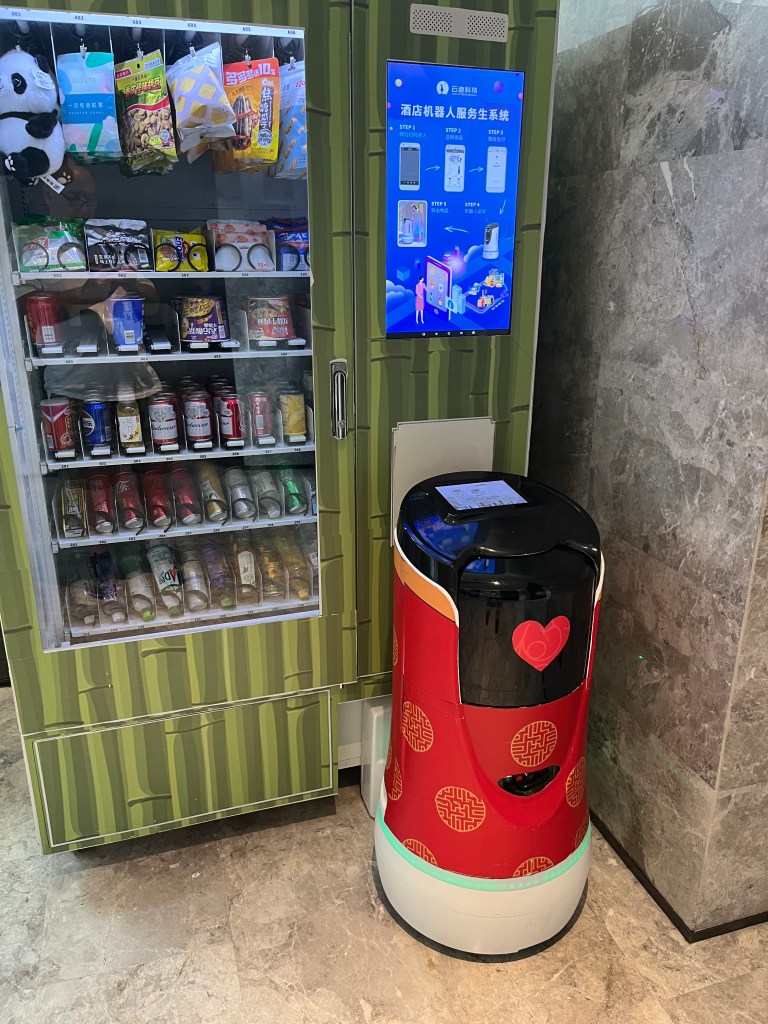
Thwe following morning on our way out for the day we spotted this little chap by the vending machine in the reception area, but more of him later.

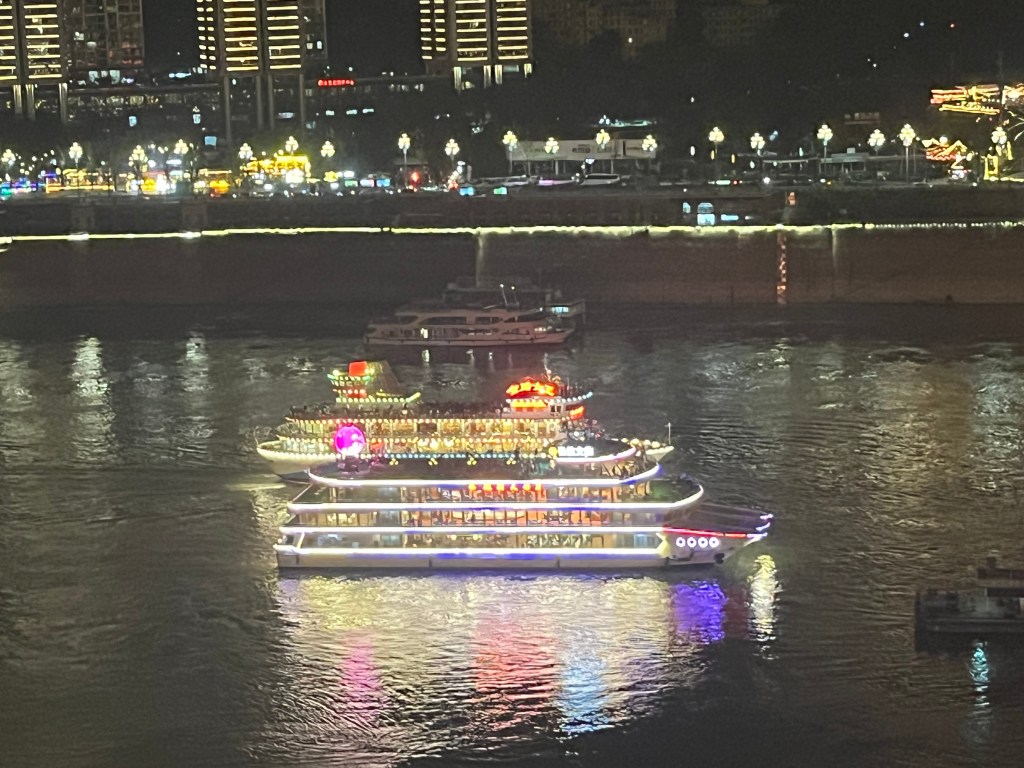
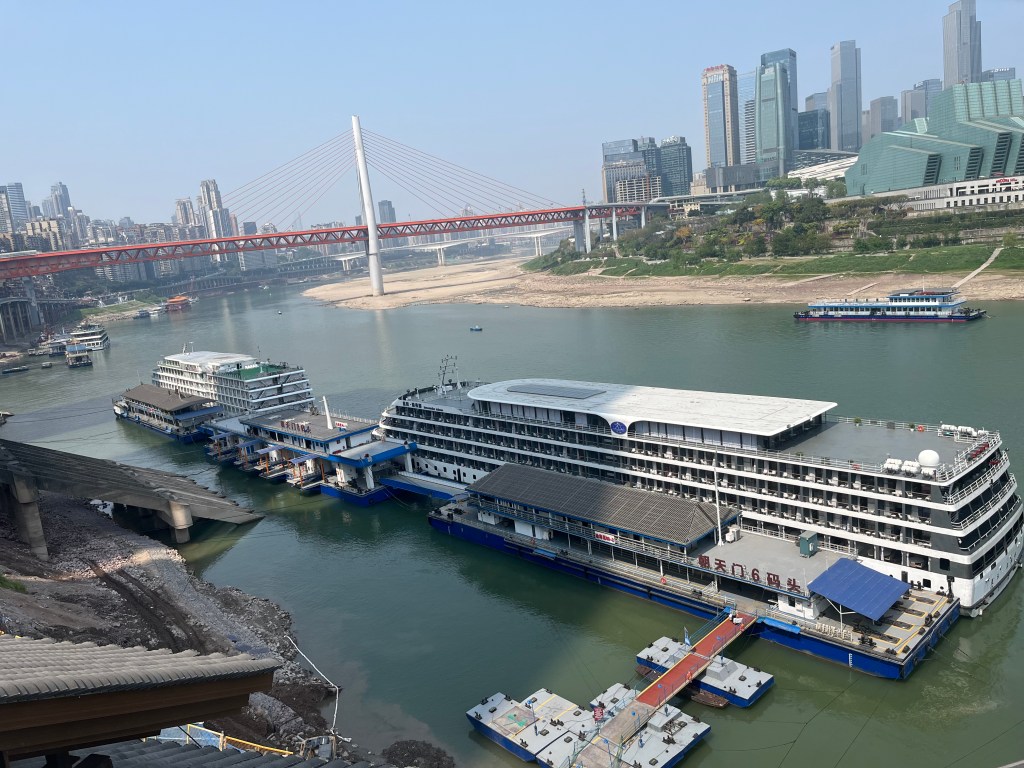
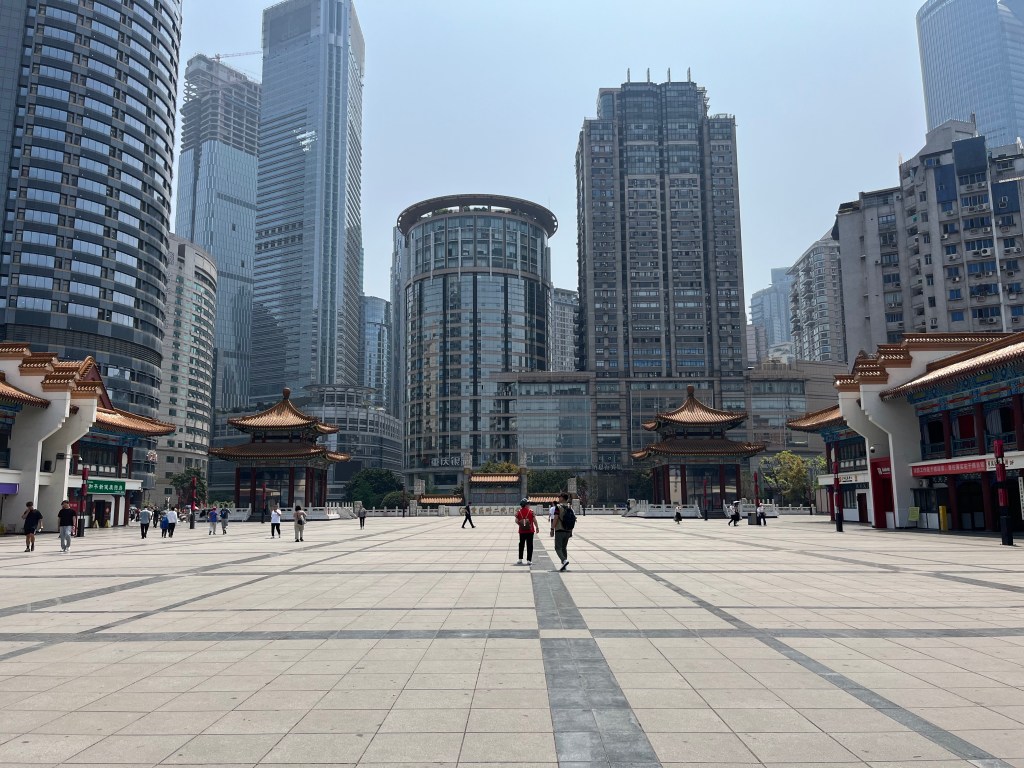
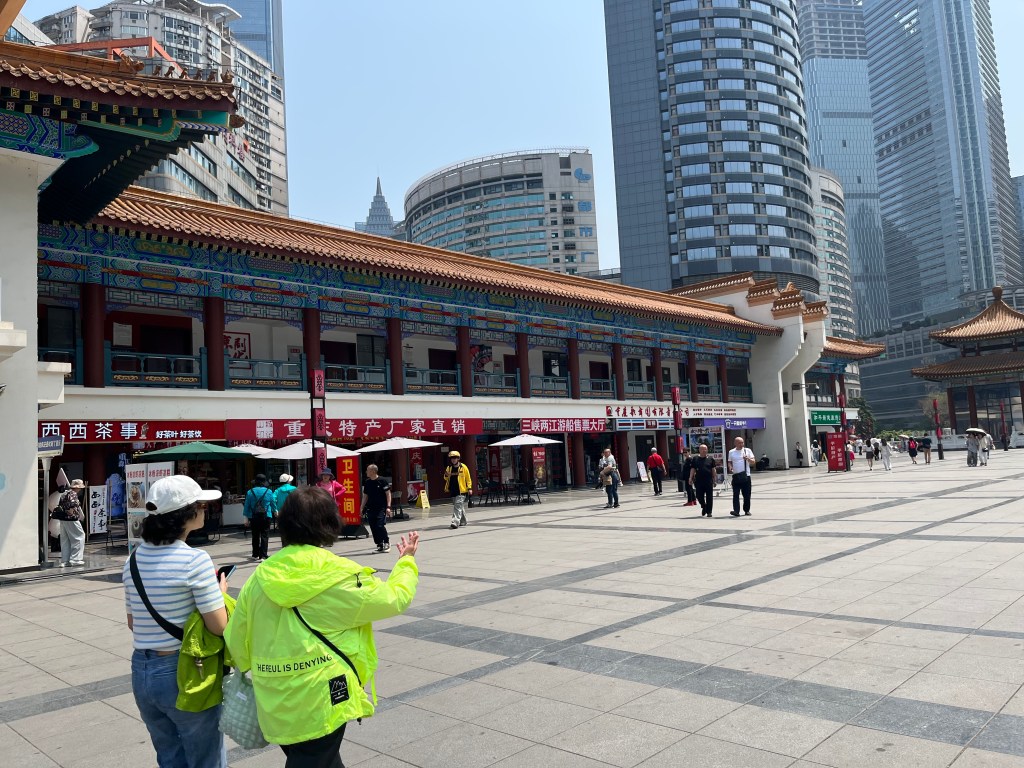
We walked down through the huge and very impressive shopping mall to Chaotianmen Square near the cruise terminal where ships leave for the 3 day trip up the Yangtze River to the 3 gorges dam.

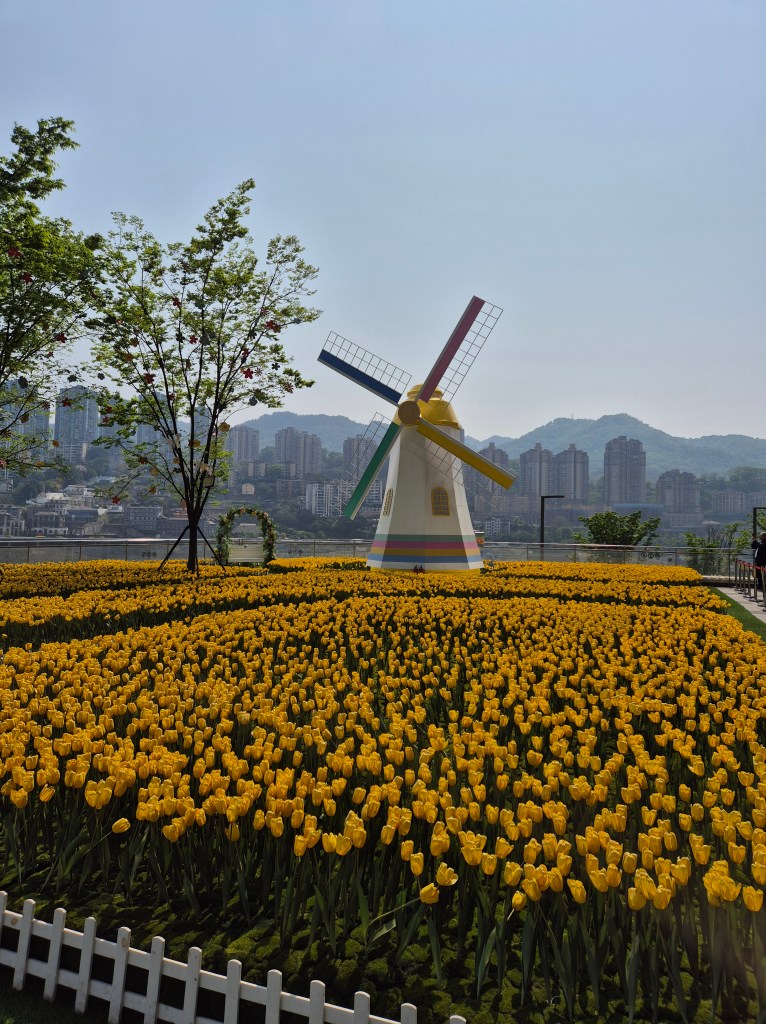
Once outside there was something we didn’t expect, a field of tulips and a windmill.

Chaotianmen dock with the river cruise ships.

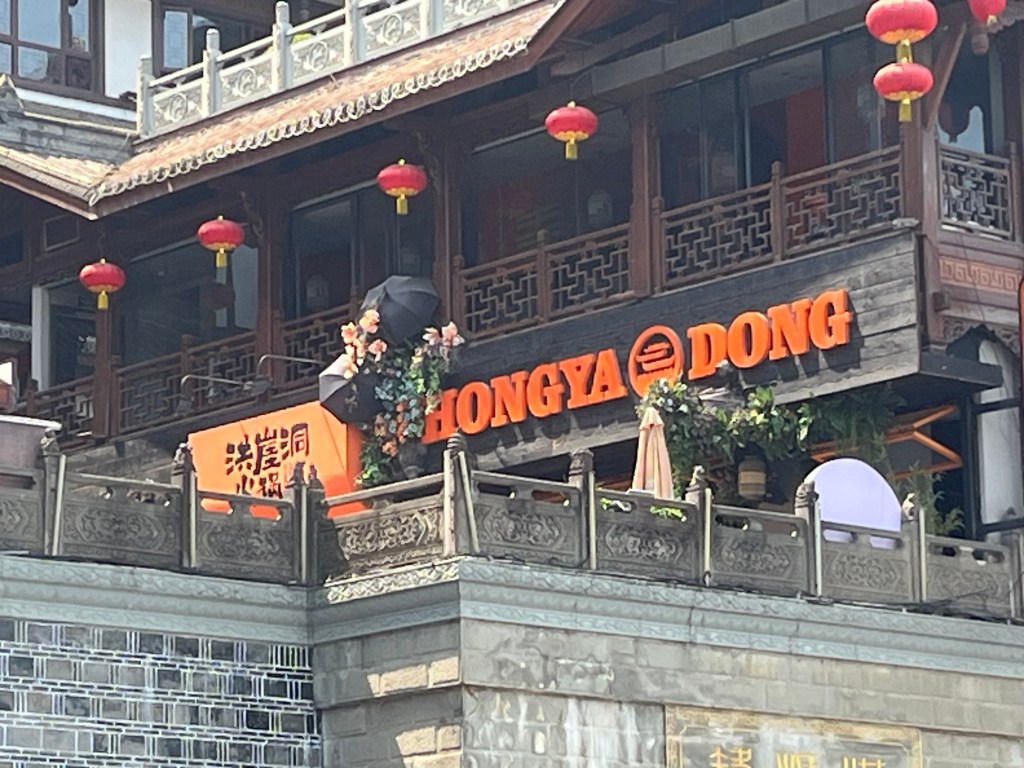
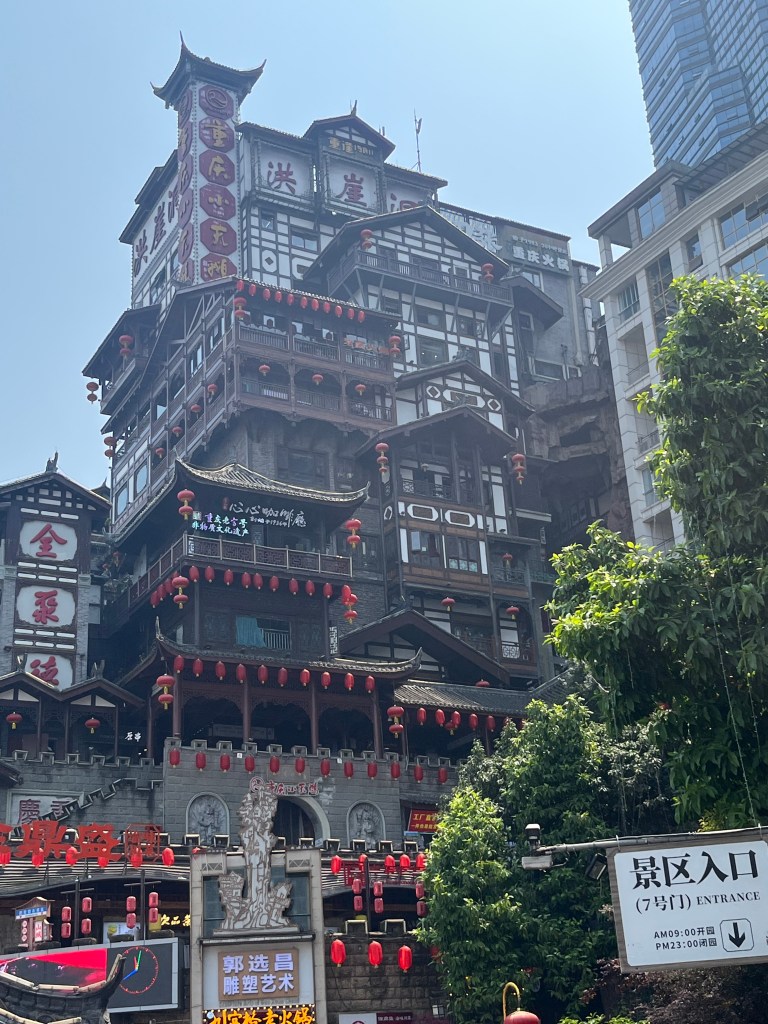
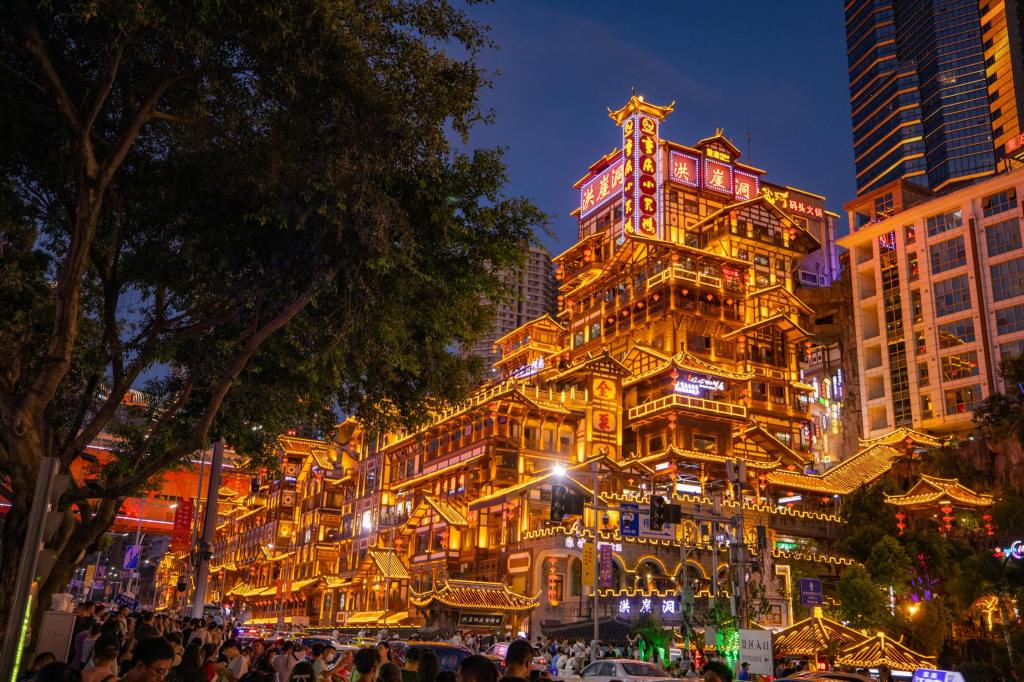
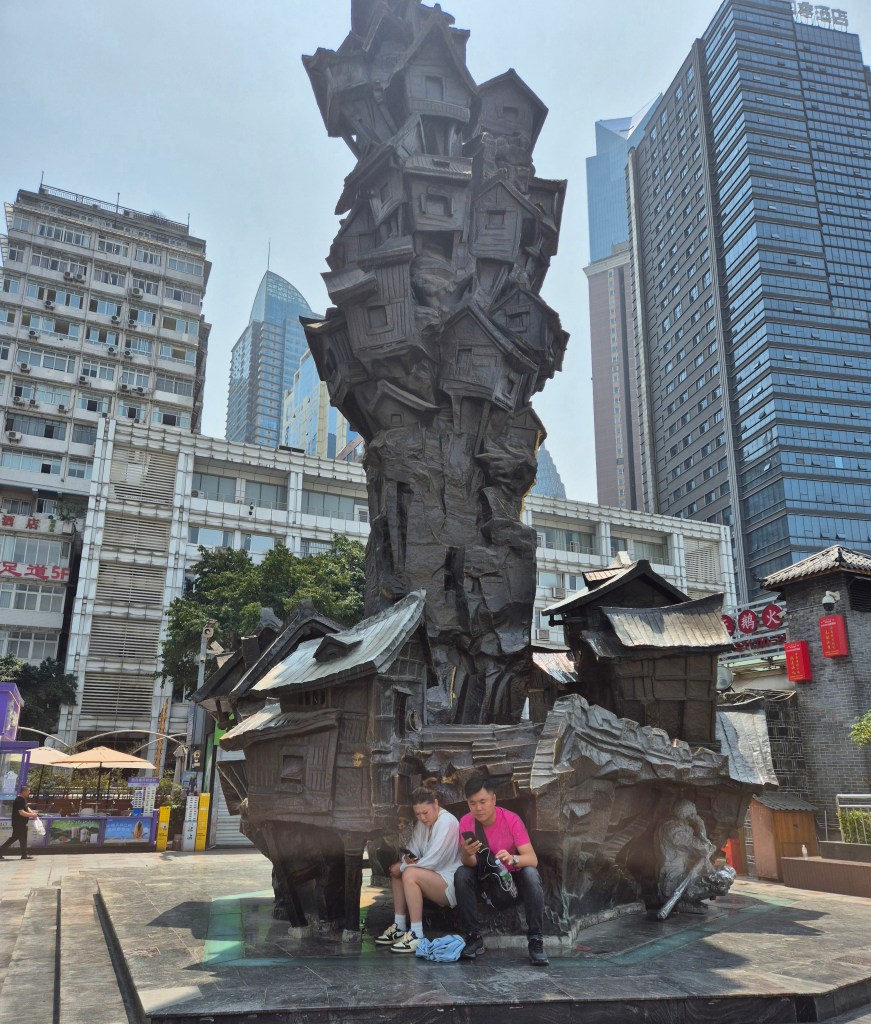
A pleasant half hour walk along the riverbank brought us to Hongya Cave, also known as Hongya Dong, an 11-story stilt-building structure built into the hillside along the southern bank of the Jialing river and one of the most popular tourist attractions in the city.

The complex is believed to have functioned as a fortress from  1046 BC and Its history can be traced back to the Hongyang Gate, dated from the 14th century during the early Ming dynasty. Stilt houses (diaojiaolou) were built along the river bank and were populated until 1949. As the shipping industry declined and the diaojiaolou were left in disrepair before starting to be torn down in 2005, newer buildings in the style of the diaojiaolou were built in place. Construction of the new complex alongside preservation began in 2006.

Plenty of places to stop for a bite to eat or a drink, all the noodle and rice dishes here were 10Yuan, about £1, as were the bottles of cold beer, very welcome on a warm day!

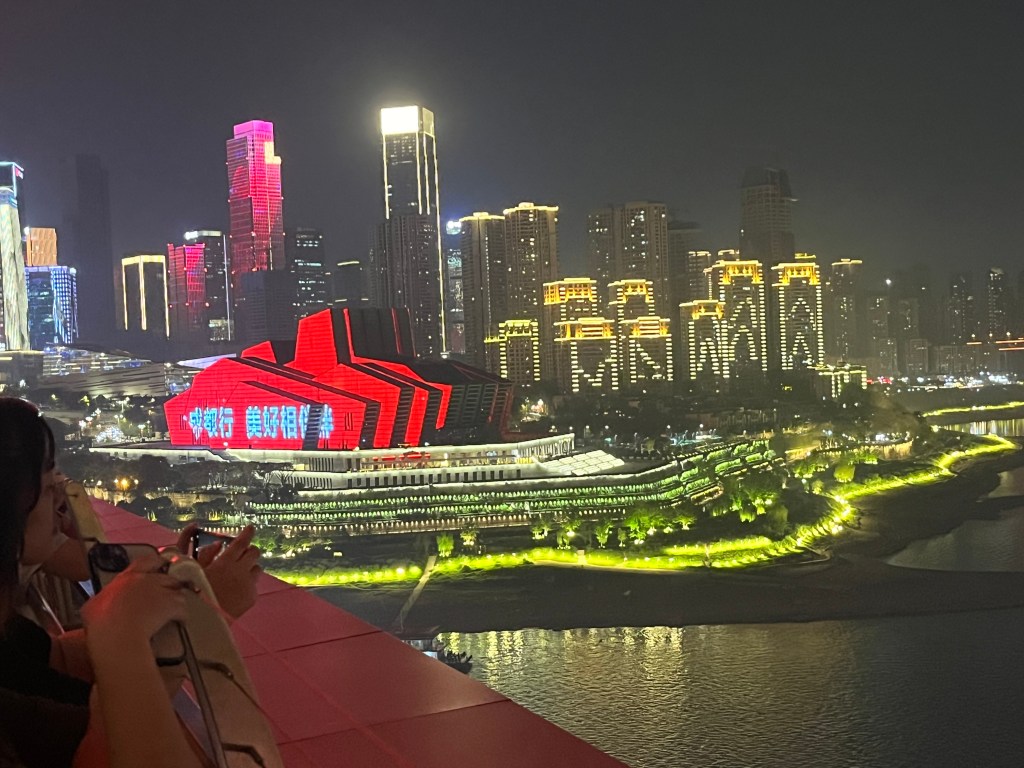
This place really comes to life after dark when all the lights are turned on.

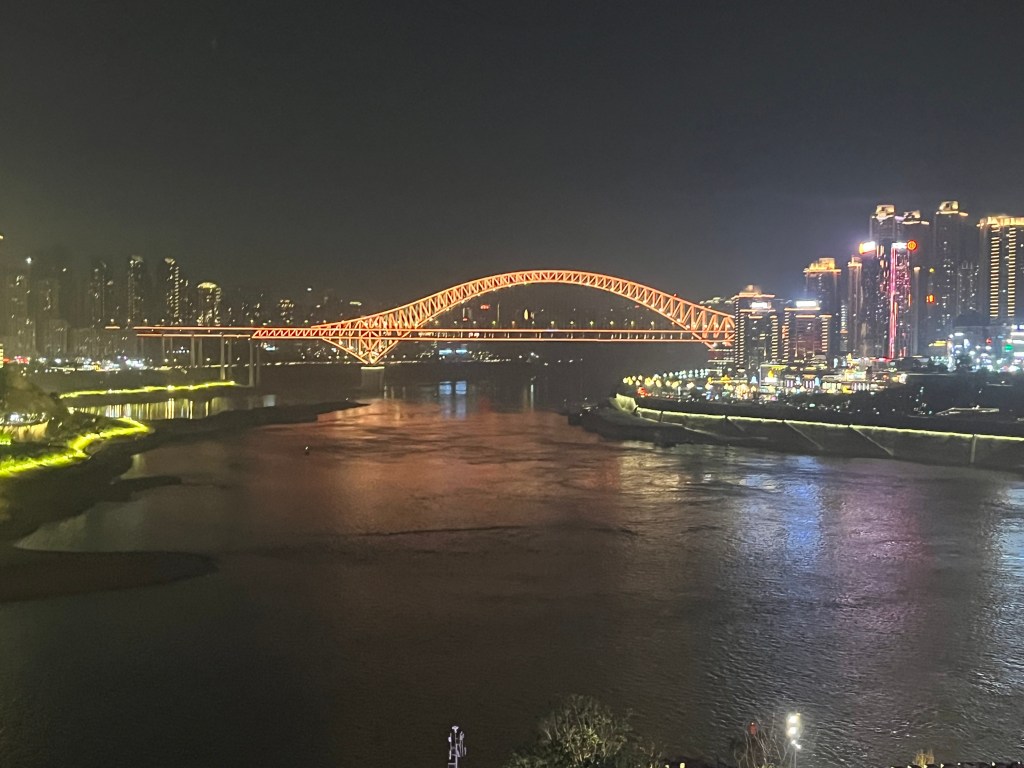
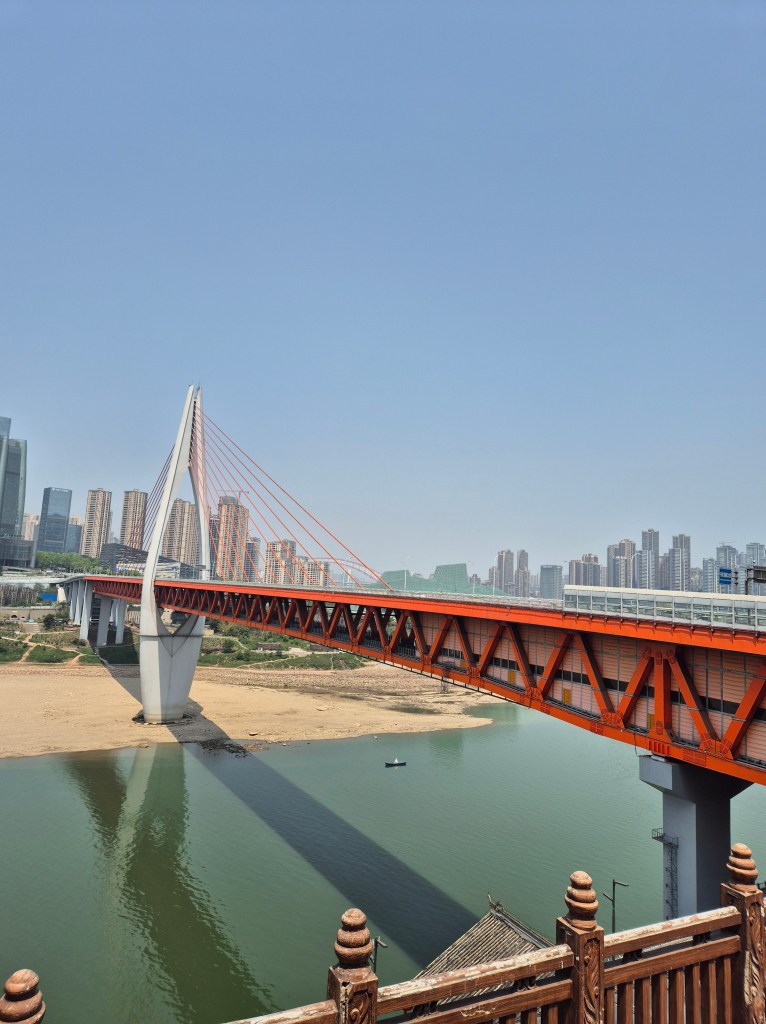
The view across the river.

Luckily there are lifts and escalators built into this 11 floor building and so it was easy to get to the top, Which strangely enough was also the ground floor as the whole of Chongqing is built into the side of a mountain.

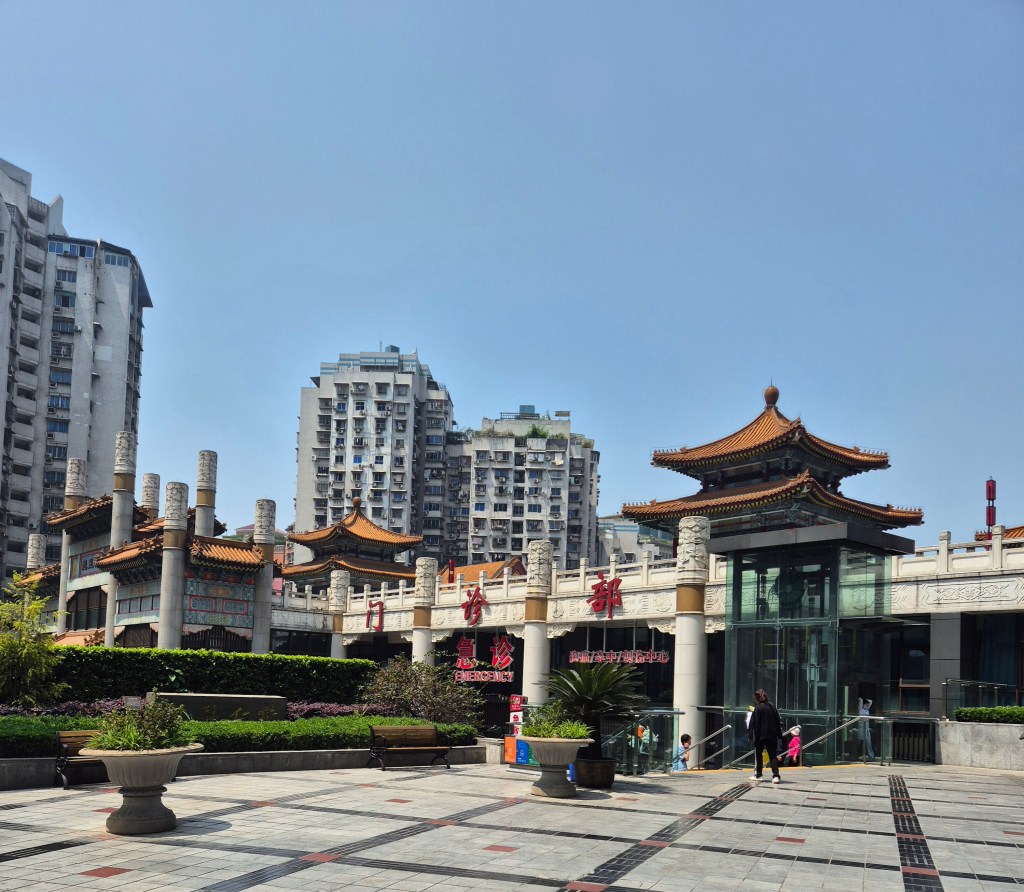
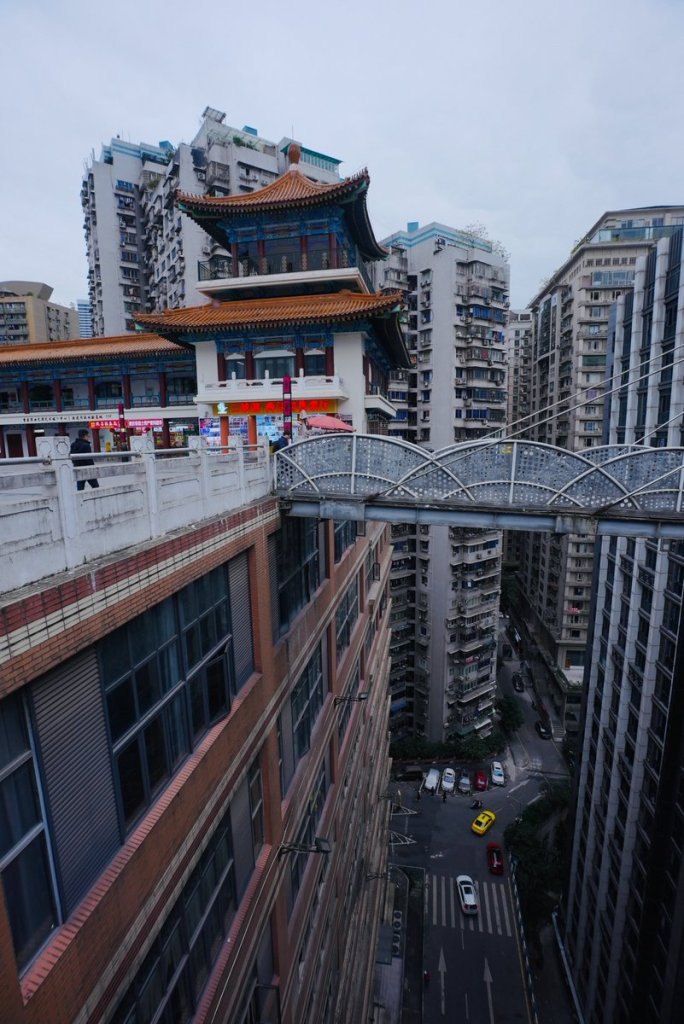
We strolled a bit further into the city going uphill and were soon at a large square with many shops around the edge on the second floor, remember this is Chongqing and is not what it seems at first glance!

Walking over to the far side and looking down from what is the 2nd floor on the opposite side of the square is also the 22nd floor on this side!

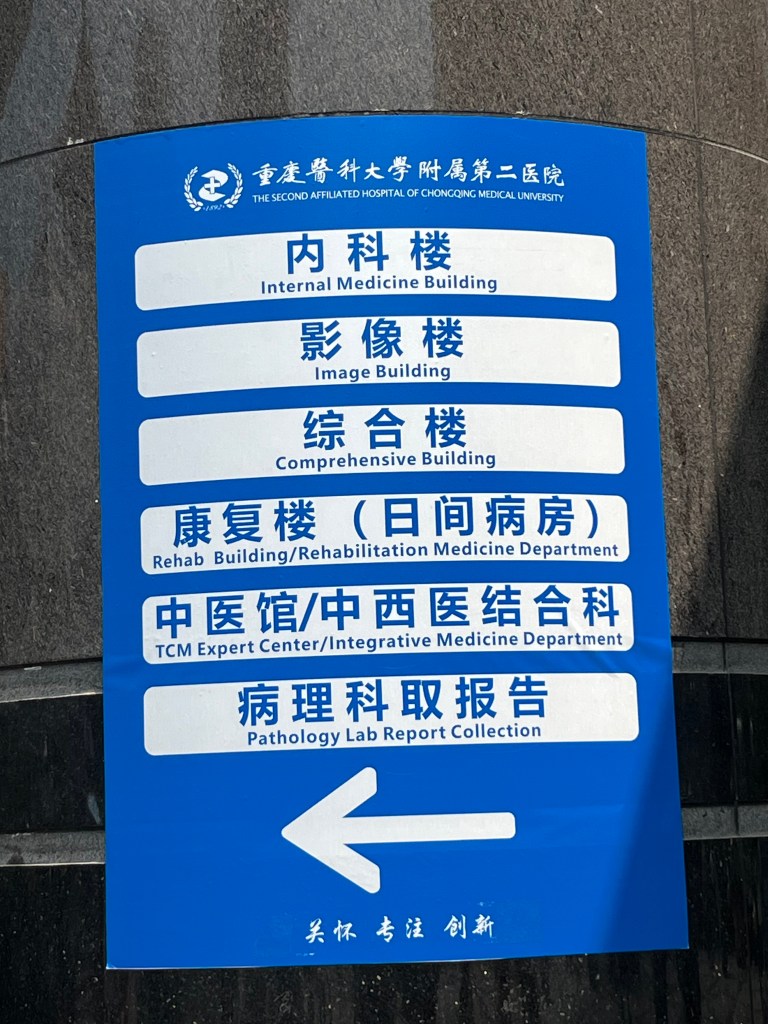
This open square with its many shops is actually the roof of a hospital.

After that we decided we were very tired and thirsty after wandering around this hilly city and so found ourselves a nice noodle bar and a couple of beers.

Part 2 of our time in the fascinating city of Chongqing to follow later.

TTFN

Bibbley

Xi’An

The following morning we set off for the bullet train journey to Xi’An, the former capital of China, from Beijing West railway station.

The 1,134km or 705 mile journey took took only 4hours and 20 minutes!

The excitement was just too much for Gary.

Our hotel for the next 3 nights was in the heart of the old town within the ancient city walls.

Being quite thirsty after the long journey we asked the receptionist if the hotel bar was open but unfortunately it was closed. Our faces lit up however when she drew us a map to “Beer Street” only a 5minute walk away, so off we sped.

A short while later we were sat outside the imitation English pub for a few bottles of Tsing Tao, the local brew which was very good. As luck would have it there was a special offer on beer which we took advantage of.

The following morning we set out for a look around the town.

The many food stalls were busy getting ready for the day ahead.

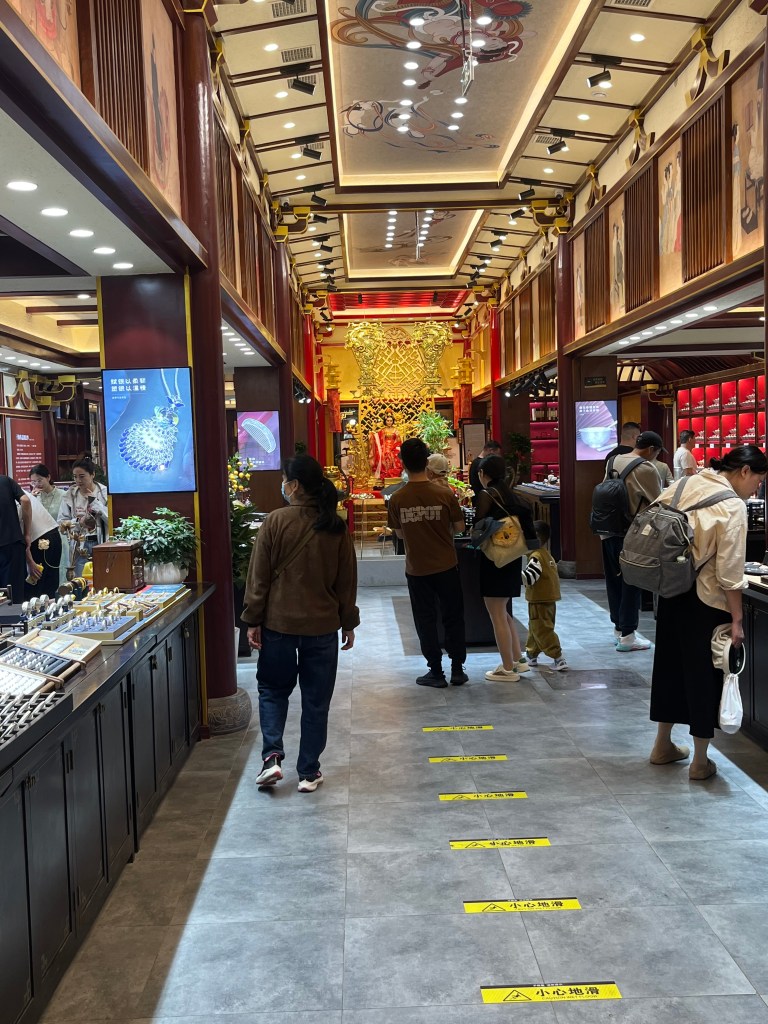
Diane soon found a jewellery store where Gary bought her a lovely pair of Jade earrings for an anniversary present.

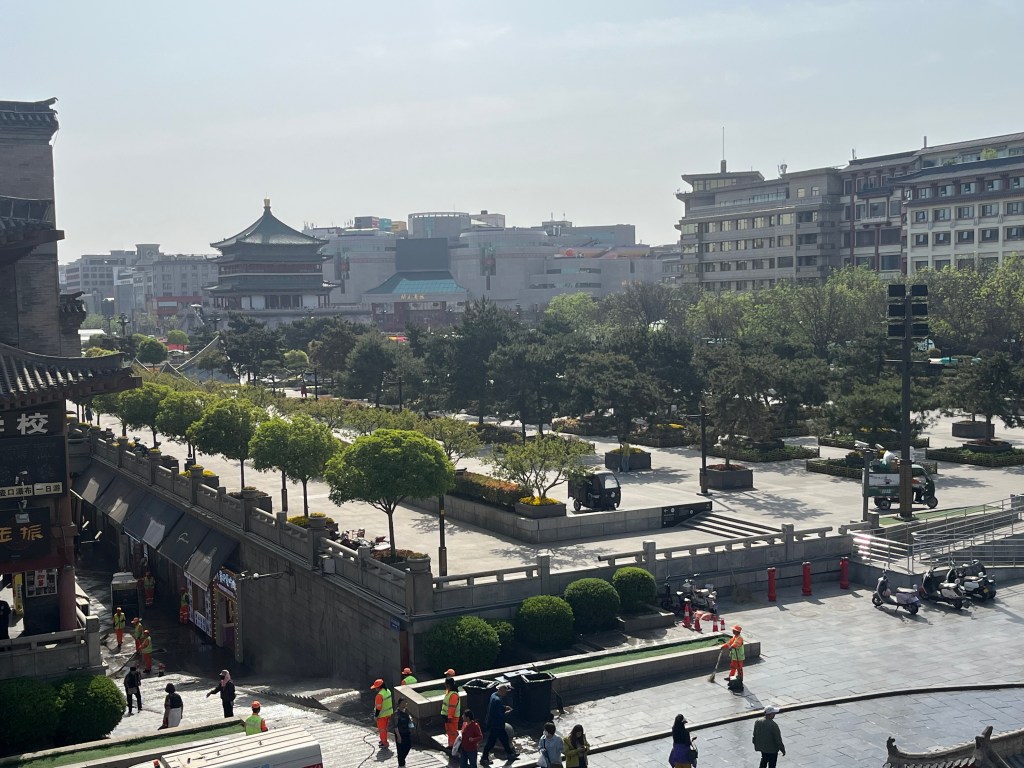
As in everywhere we went in China it was all very clean, always workers sweeping the streets or washing the roads and pavements.

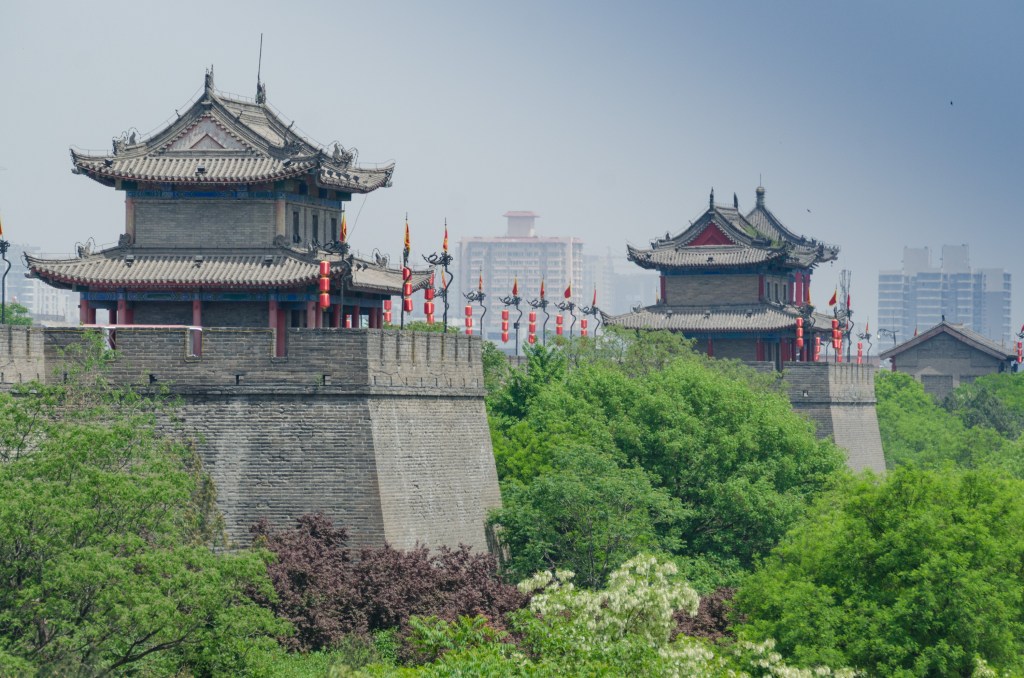
The Drum Tower of Xi’an, along with the Bell Tower is a symbol of the city and was built in 1380 during the Ming Dynasty, it stands towering above the city center and offers a great view of Xi’an.

In the distance you can see the Bell Tower.

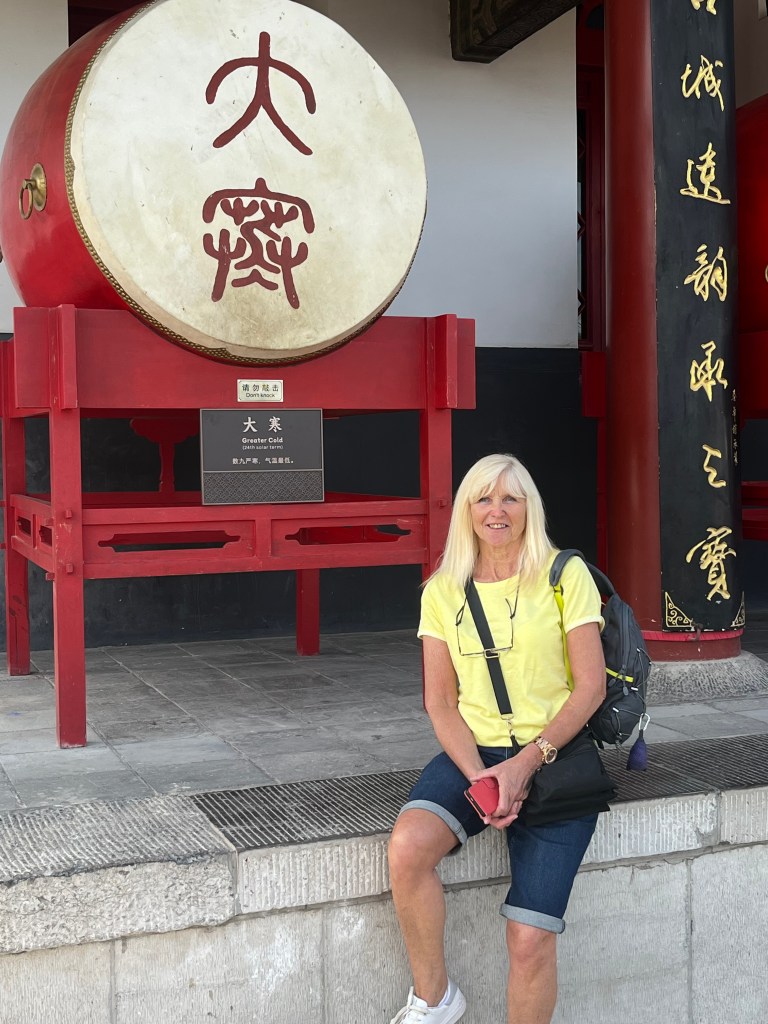
The Drum Tower got its name from the huge drum located within the building. In contrast to the Bell Tower, where the bell was struck at dawn, the drum was beaten at sunset to indicate the end of the day.

The impressive arrays of drums are only on show and visitors are not allowed to touch any of them.

But of course some people cannot help themselves and Diane got her first, (and not last!) telling off from the security guards for banging the ancient drum.

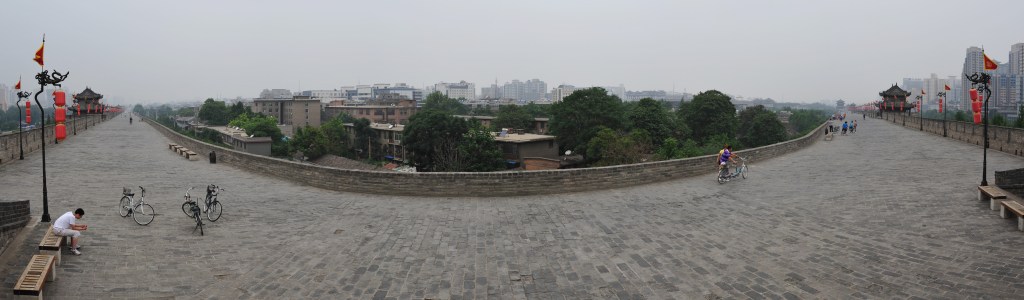
Leaving the Drum Tower we set off for the ancient city walls, one of the 4 main entrance gates you can just see in the background.

The city walls buil;t in the 14th century are very impressive, stretching for 8 miles and marking the end, (or start?) of the silk road, the ancient trading route from China to Europe.

The Chinese took great interest in the security of their trade products, and extended the Great Wall of China to ensure the protection of the trade route.

By the first century AD, Chinese silk was widely sought after in Rome, Egypt, and Greece. Other lucrative commodities from the East included tea, dyes, perfumes, porcelain, gunpowder and paper; among Western exports coming East into China were horses, camels, honey, wine, and gold.

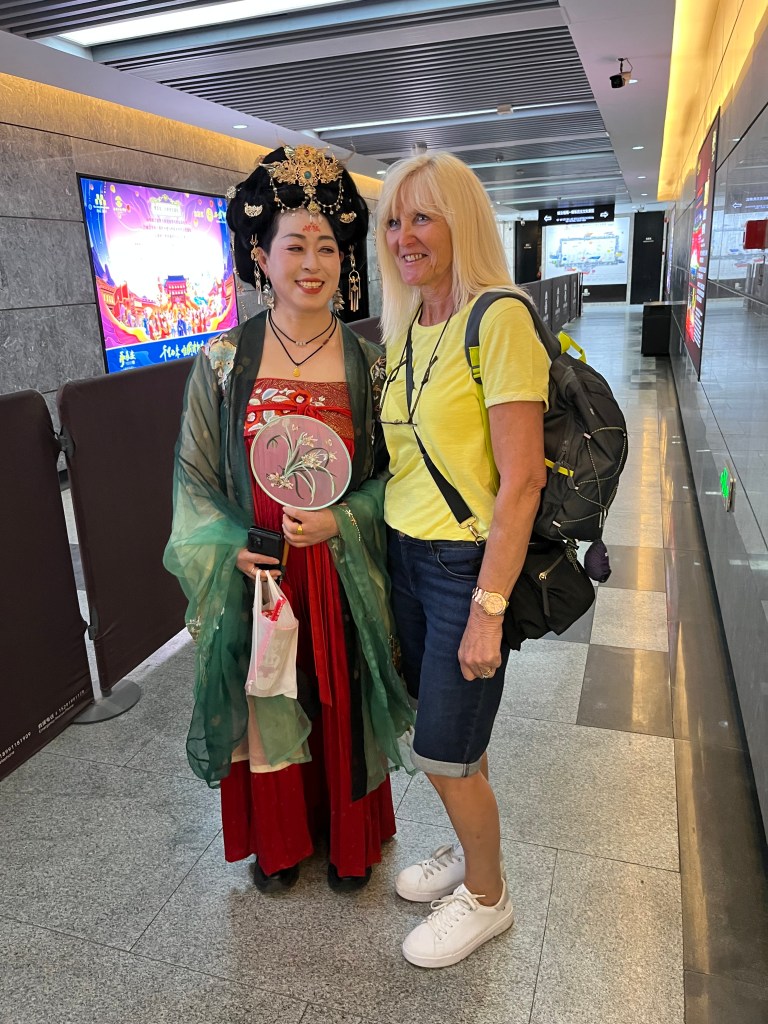
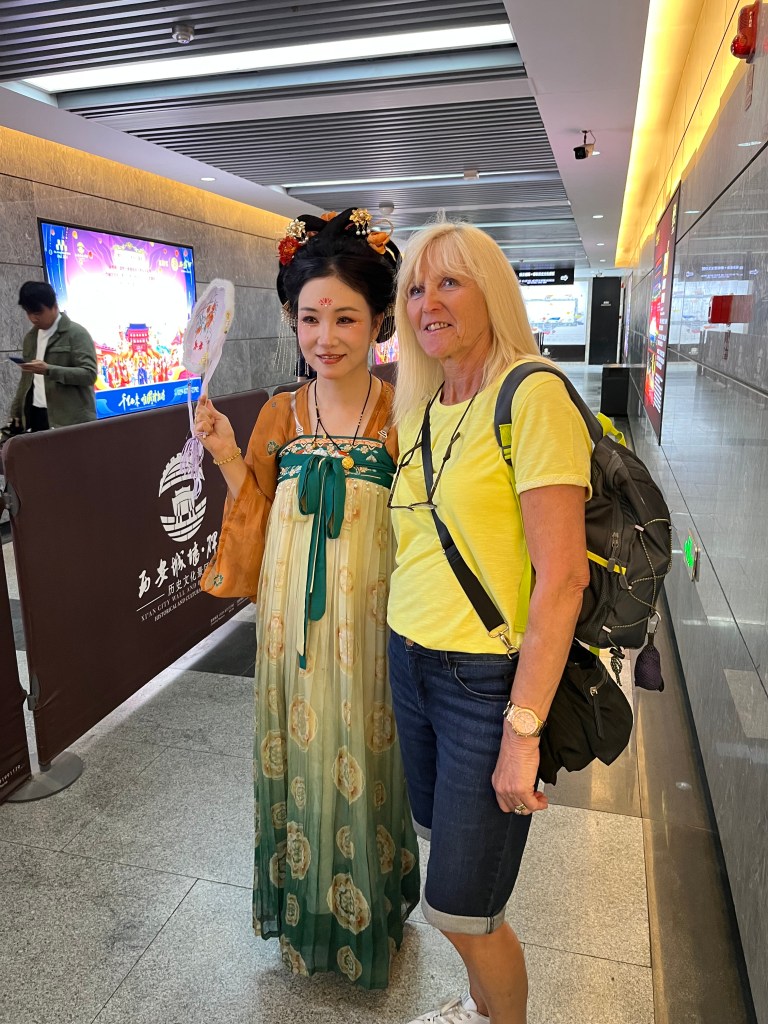
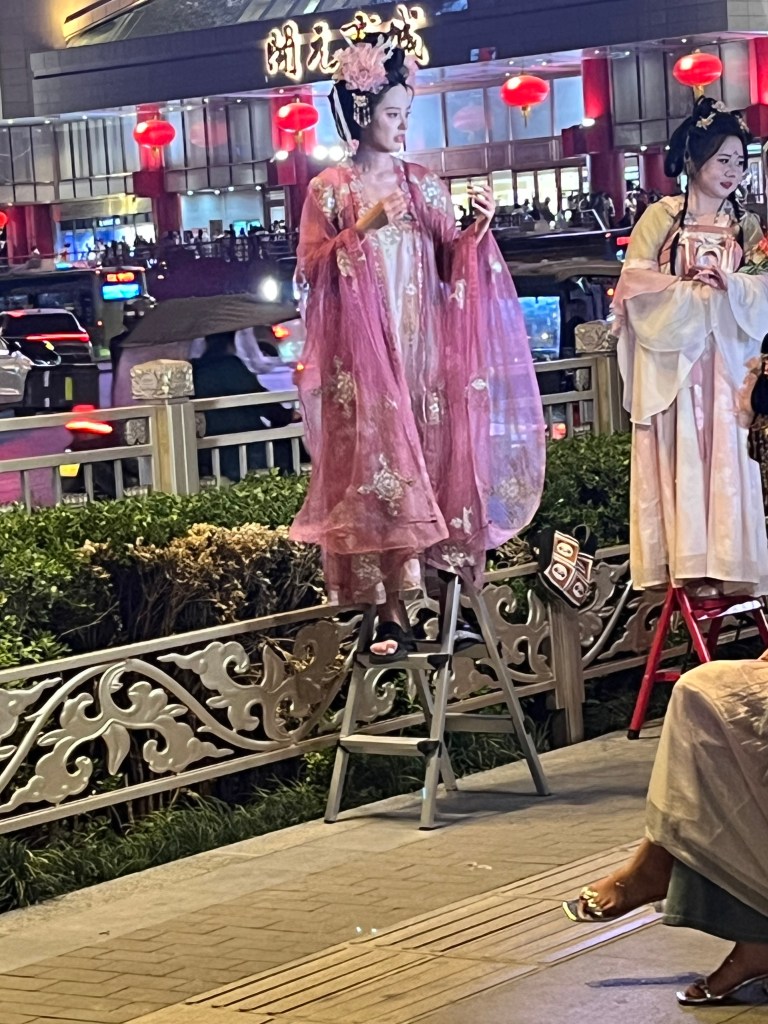
In the underpass on the way to the walls we came across some pretty ladies in traditional dress.

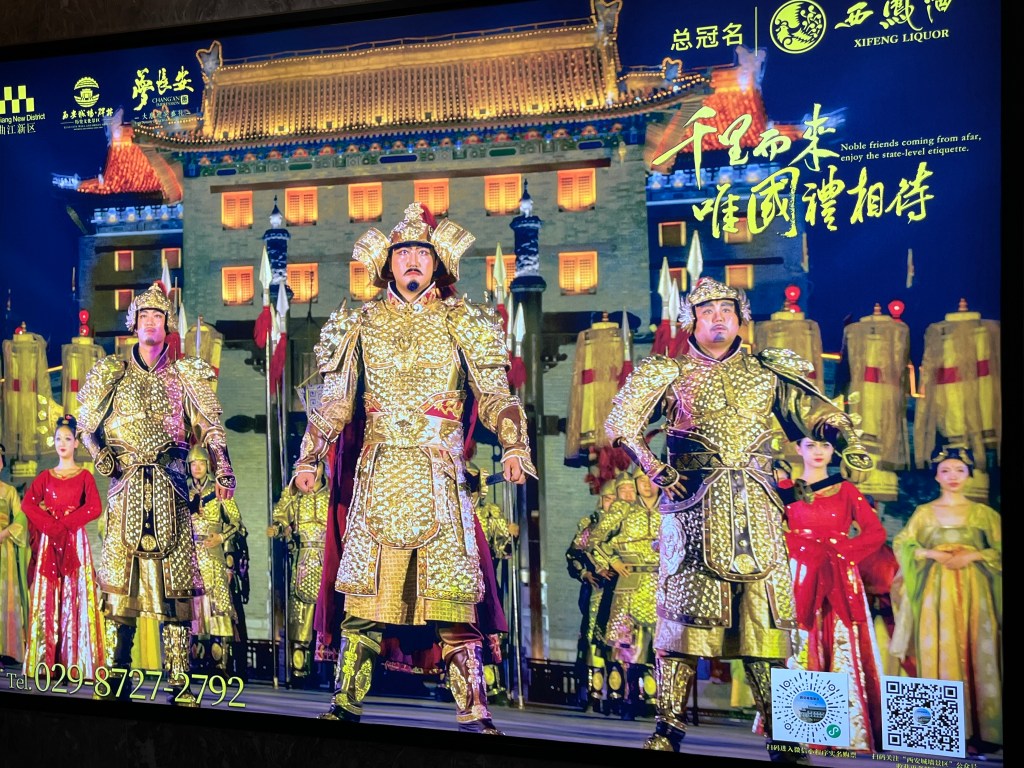
And an advert for a daily show which takes place at the entrance each evening.

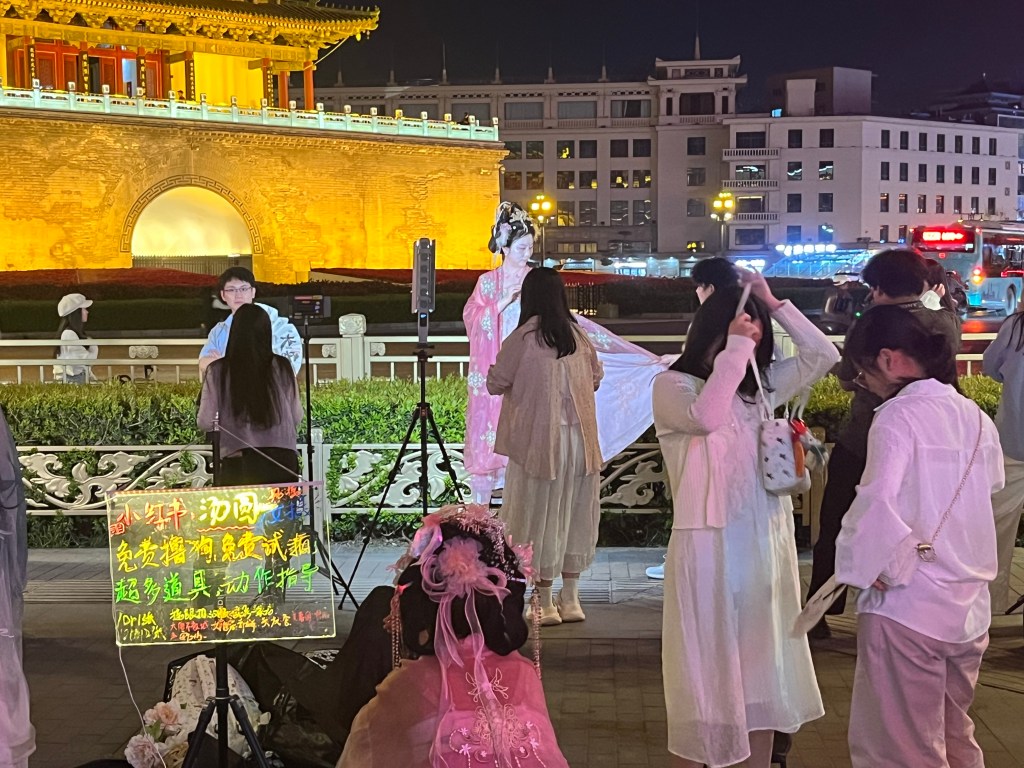
Later that evening we strolled along to the Bell Tower which was stunning all illuminated and busy with girls having their photoshoots or doing live stream on TikTok.

So ended our first full day in Xi’AN

see you all tomorrow.

TTFN

Bibbley
To be notified of future posts please subscribe below.

The Great Wall

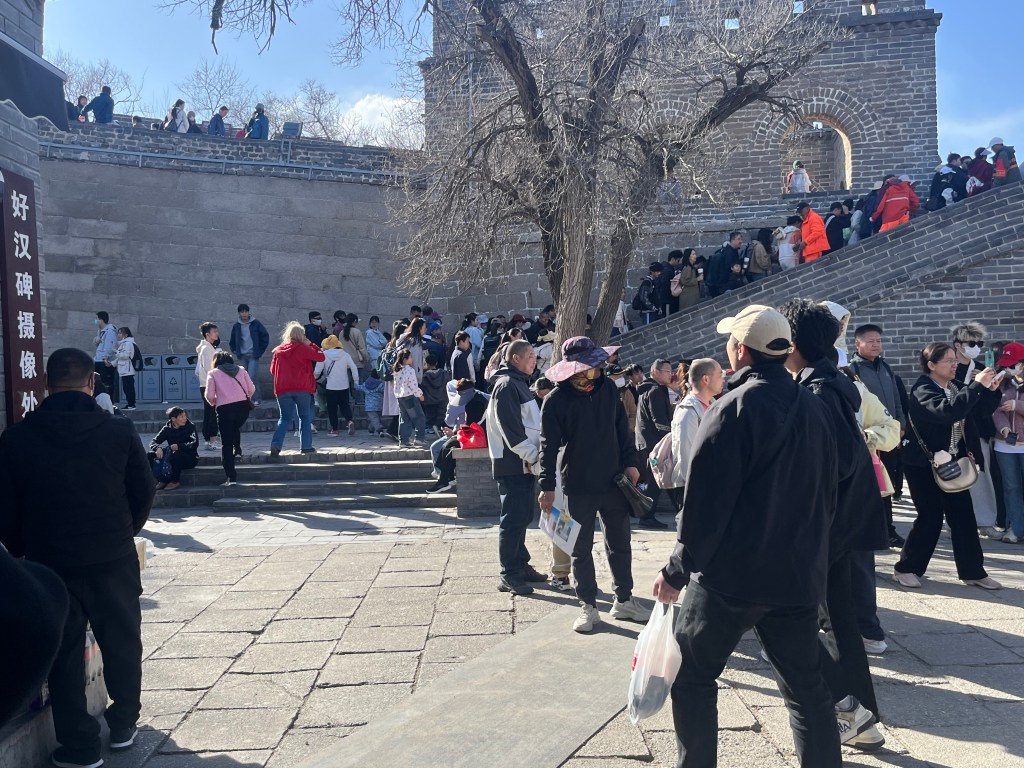
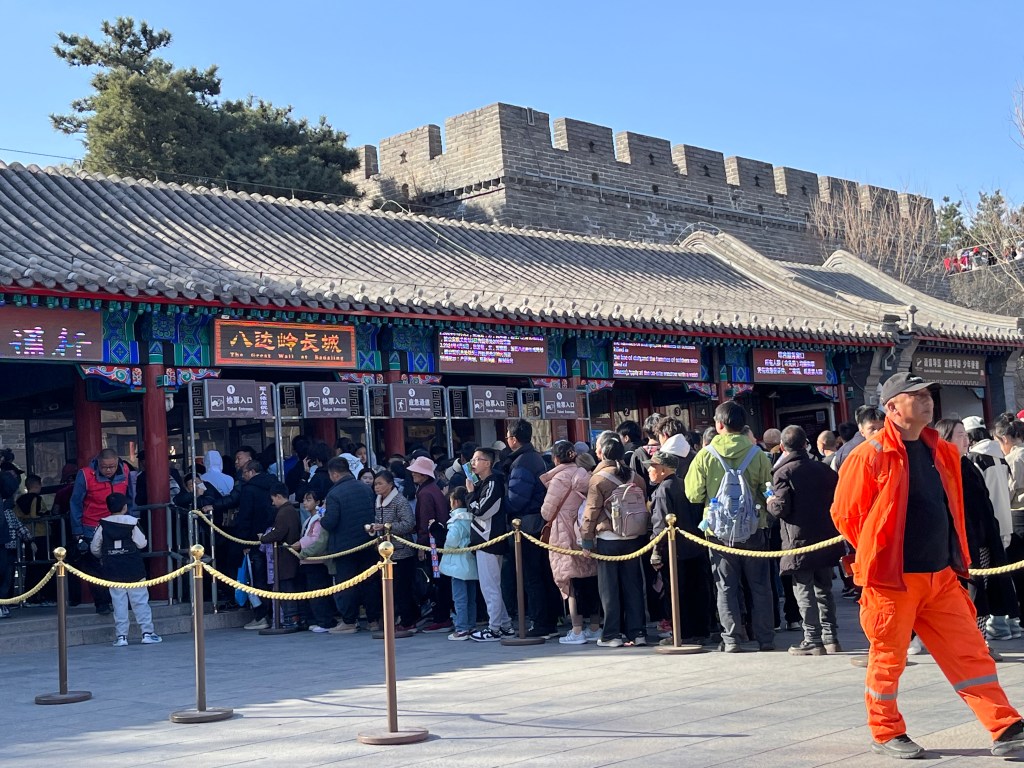
We chose to visit the closest section of the Great wall of China today, (Friday), as we thought it would be quieter then leaving it to the weekend, (WRONG).

After a good night’s sleep after the long journey from London and a lot of walking around Tiananmen Square and the Forbidden Palace yesterday we met in reception at 9AM and stepped outside the hotel to find the road closed to traffic and very busy with pedestrians walking towards the Forbidden Palace.

I tried to book a taxi on WeChat but all were busy so decided to ask the hotel receptionest to call us a cab.

“You would like a taxi to the Great Wall at Badaling, today? now? really?” asked the receptionist.

“yes please” I replied, unaware of why he was looking at me as if I was a stupid foreigner asking for a ticket to visit the moon. Anyway the car soon arrived and off we went for the 25 mile 40 minute ride.

Two hours later after crawling up the motorway in a giant queue of traffic I noticed the road sign that said “Badaling, Great Wall 10 miles”. Another hour later and we were there! The fare just £10, feeling sorry for our poor driver who was obviously not going to earn much today I did tip him £5 for which he was very grateful.

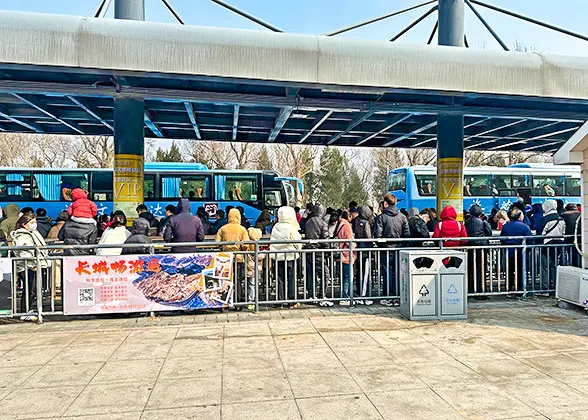
So joining the queue for the shuttle bus from the car park to the entrance of the wall we googled todays date, April 4th, which brought up this.

The “Festival of Sweeping the Graves,” also known as Qingming Festival or Tomb-Sweeping Day, is a Chinese festival celebrated on April 4th or 5th each year. It’s a time for families to visit the tombs of their ancestors, clean the gravesites, and make ritual offerings. The festival is a way to honor and remember deceased ancestors, as well as to celebrate the arrival of spring. It is a public holiday and after cleaning the graves of your ancestors a chance to enjoy a day out.

Well that explained the thousands of people heading for a trip to the great wall.

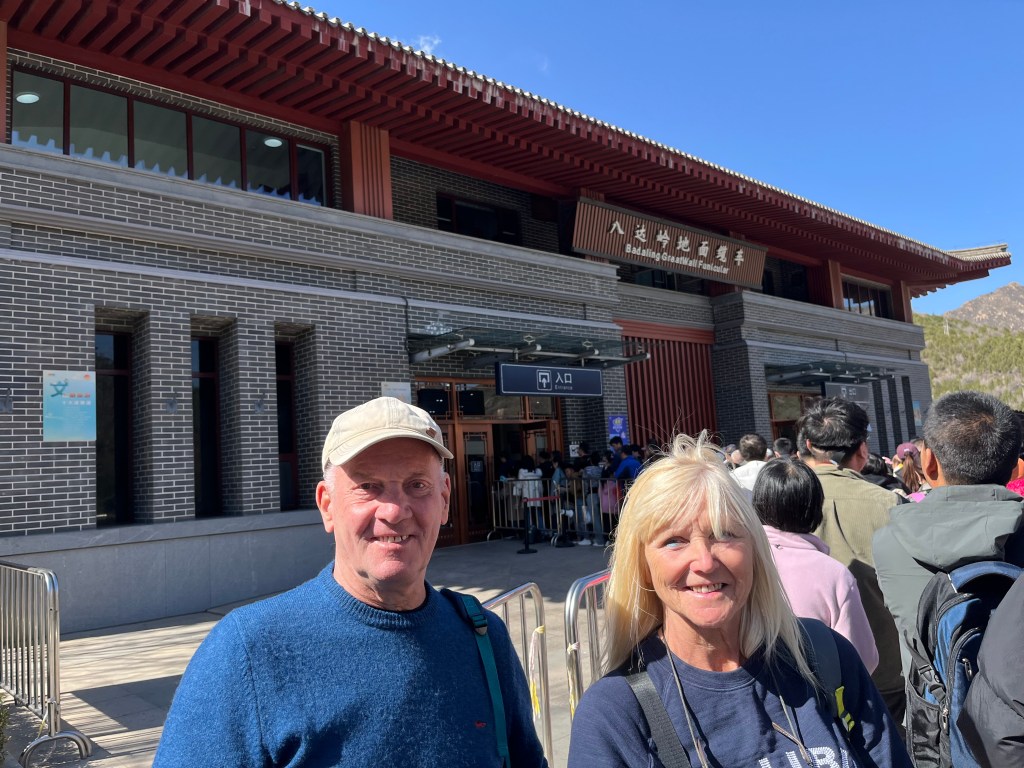
Anyway with typical Chinese efficiency the queue moved swiftly and we were soon atop the wall after a short ride on the funicular railway.

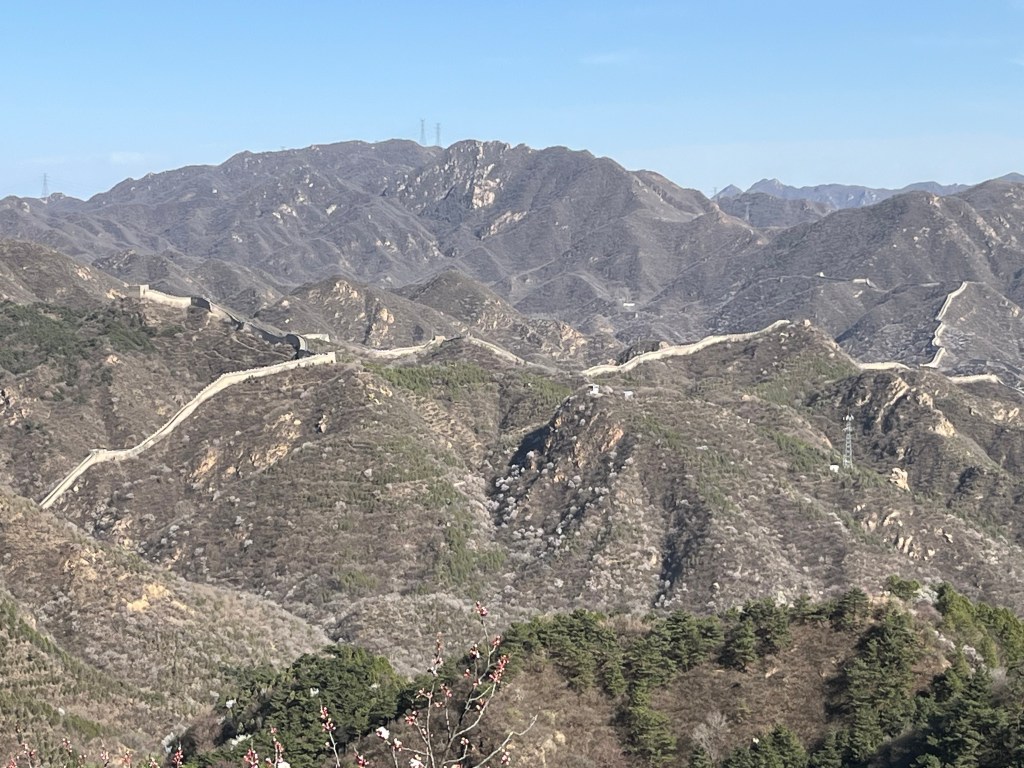
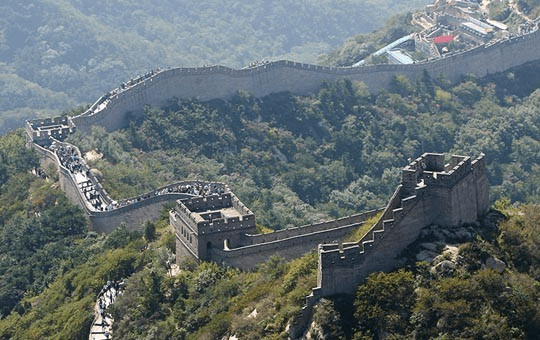
What a view! The long journey was well worth it. The wall stretches off into the distance as far as the eye can see. The whole wall stretches for over 13,000 miles and was started over 2,00 years ago to protect China from invaders from the north and the section at Badaling is one of the best preserved sections and the closest to Beijing which also means it can be very busy at times.

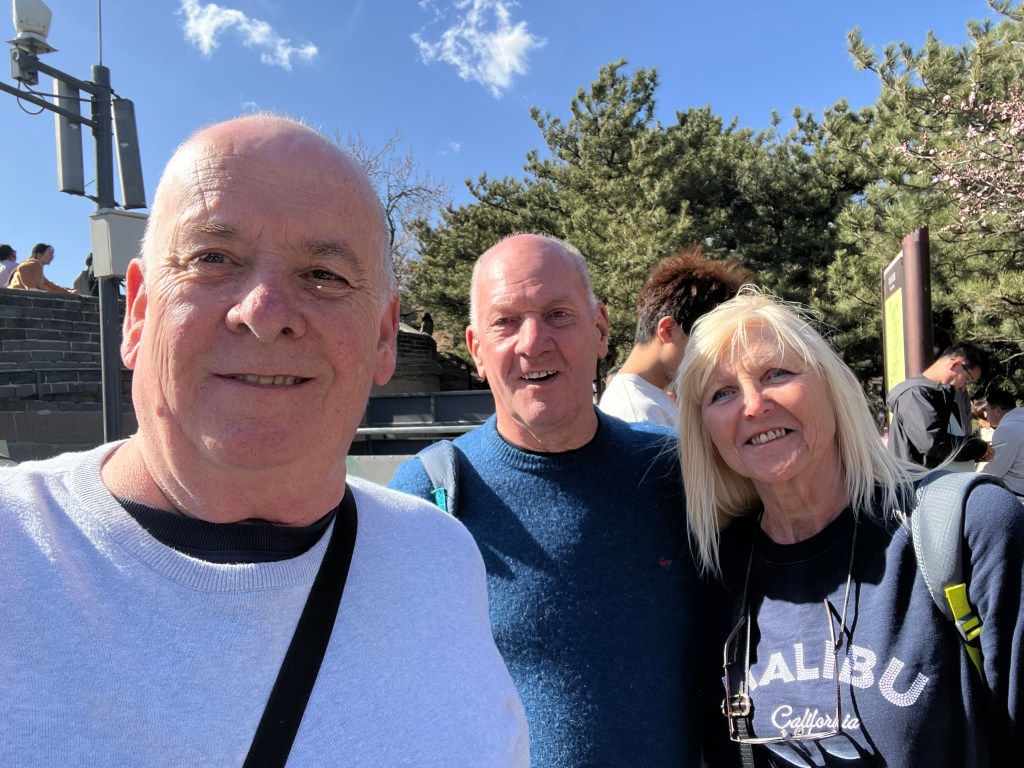
We had finally made it to the wall !

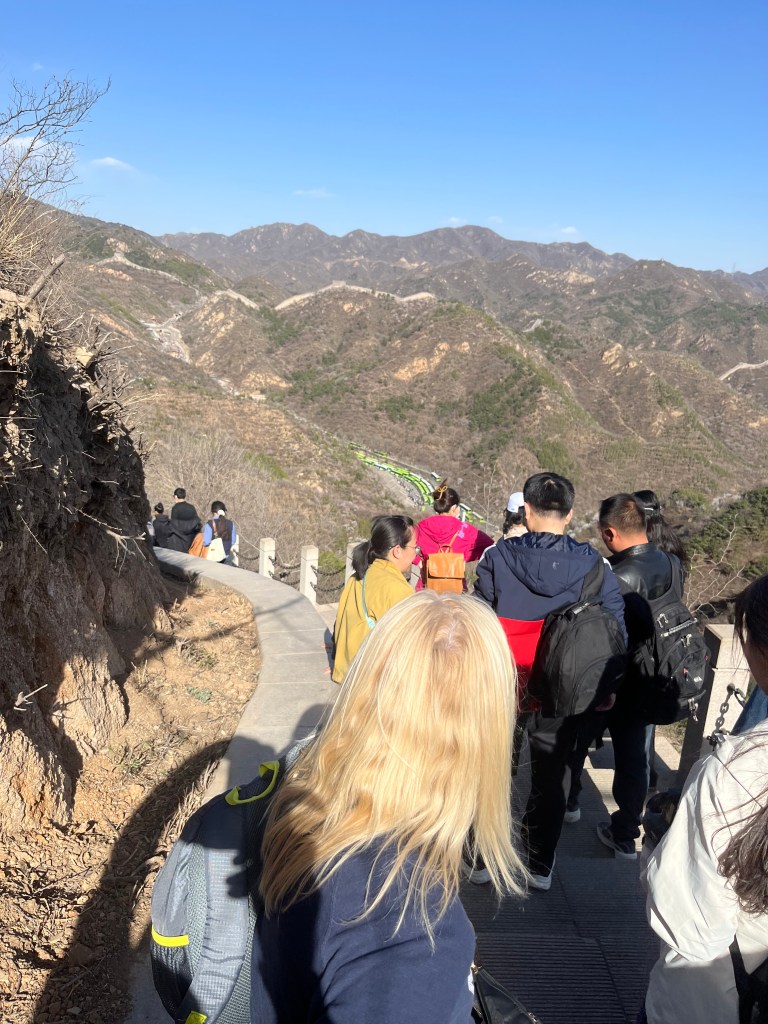
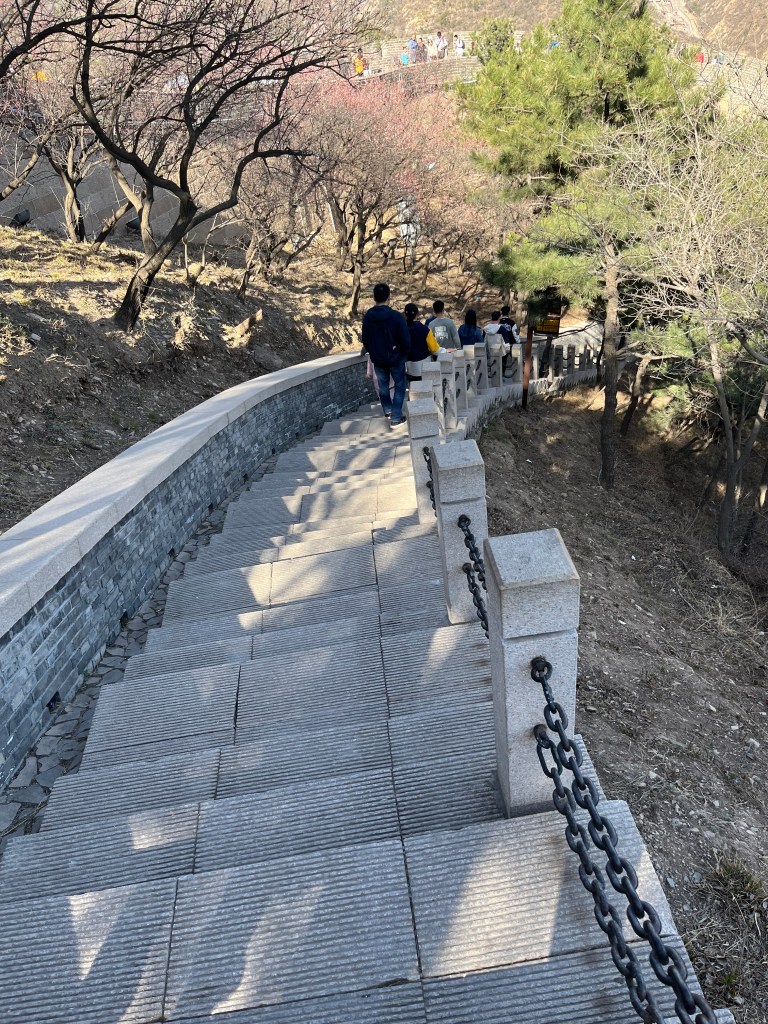
After a walk along the wall admiring the view we decided not to join the masses climbing even higher and thought that a leisurely walk down the mountain would be much easier and enjoyable.

In the distance down below you can just see the car park full of buses ready to take visitors back to beijing.

Luckily there was a good path down!

A lone warrior stands guard and protects the wall, keeping a careful watch for invaders.

Halfway down there was a rest area with toilets and where you could buy an ice cream, a cold drink or some souvenirs. As we reached the entrance there were plenty of people just starting the long walk up to the top! Rather them than me I thought feeling glad we took the railway.

And so we headed back to Beijing on the bus for only 20p each feeling quite tired but so pleased we had reached one of the highlights of our journey.

Hope to see you all for the next installment of our trip.

TTFN

Bibbley
To be notified of future posts please subscribe below.