Star City – A Dream Fulfilled!
Today was no ordinary day.
Of all the places I intended to visit during this expedition, there was one that held a particularly special significance for me.
Star City, the Russian cosmonaut training centre situated outside Moscow.
Having grown up during the great space race of the 1960s, following the exploits of the Soviet cosmonauts and American astronauts with enormous interest, the prospect of actually visiting Star City was something I could scarcely have imagined in my younger days.
Yet here I was, in Moscow, about to do precisely that!
Nine Months of Planning
Arranging a visit to Star City was not simply a matter of turning up at the entrance, purchasing a ticket and wandering around.
This was, after all, an operational cosmonaut training establishment with restricted access.
Some nine months earlier, whilst planning this expedition from the comfort of my home in Bournemouth, I had contacted a gentleman named Alexander, who operated a company called Angel Taxis.
Alexander was able to arrange private visits to Star City, subject, of course, to obtaining the necessary official permissions.
There were forms to complete for Roscosmos, passport details to provide and a considerable amount of waiting.
As my departure from England approached, I still hadn’t received final confirmation that the visit would take place.
Readers may recall that on Sunday evening, whilst sitting in my room at the Hotel Circus enjoying a glass of Russian red wine, my telephone had rung.
It was Alexander, with the wonderful news that everything had been arranged.
He would collect me from outside my hotel at eight o’clock on Tuesday morning.
And now Tuesday morning had arrived!
The Road to Star City
Having made absolutely certain the previous evening that my mobile telephone was fully charged, I made my way downstairs and outside the hotel.
Alexander and his driver were to take me to Star City, situated some distance to the north-east of Moscow.
It was rather pleasant to be driven out of the city, particularly as I could devote my attention to the passing scenery rather than attempting to decipher Russian road signs.
During the journey, we stopped for some dumplings and coffee before continuing towards our destination.
As we approached Star City, I was becoming increasingly excited.
However, our arrival was not quite as straightforward as I had anticipated!
The Wrong Entrance!
We approached an entrance that looked considerably more like the entrance to a military establishment than that of a conventional tourist attraction.
There were substantial gates and armed guards, none of whom appeared to be particularly interested in welcoming an English tourist.
It transpired that we had arrived at the wrong entrance!
Fortunately, Alexander was able to establish where we ought to be, and we proceeded to the correct gate.
Here, my passport and the relevant paperwork were produced for inspection.
Having spent months arranging the visit, I watched these proceedings with considerable interest, hoping that some minor administrative discrepancy would not result in my being sent all the way back to Moscow.
Fortunately, everything appeared to be in order.
We were admitted!
After all those months of preparation, I was finally inside Star City.
In the Footsteps of Yuri Gagarin
One of the first things to catch my attention was an aircraft associated with Yuri Gagarin.
Here, in the surroundings where the world’s first man in space had once lived and trained, were tangible reminders of those pioneering days of space exploration.
It was difficult not to reflect upon the extraordinary courage of those early cosmonauts.
On 12 April 1961, Gagarin had become the first human being to journey into space, completing an orbit of the Earth aboard Vostok 1.
The technology available to the engineers of those days was remarkably primitive by modern standards, yet their achievements were quite extraordinary.
Our driver remained near the aircraft whilst Alexander accompanied me on the tour.
We were introduced to our guide, who would spend the next couple of hours showing us around the establishment.
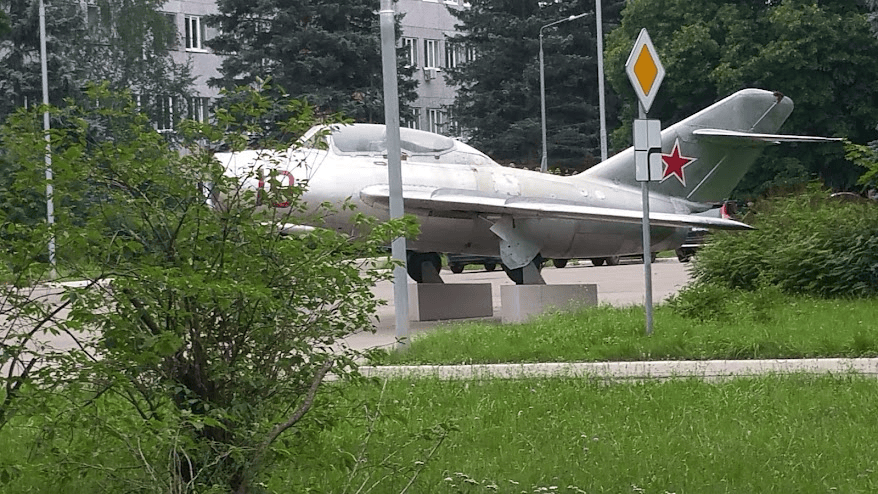
Yuri Gagarin’s plane in the car park
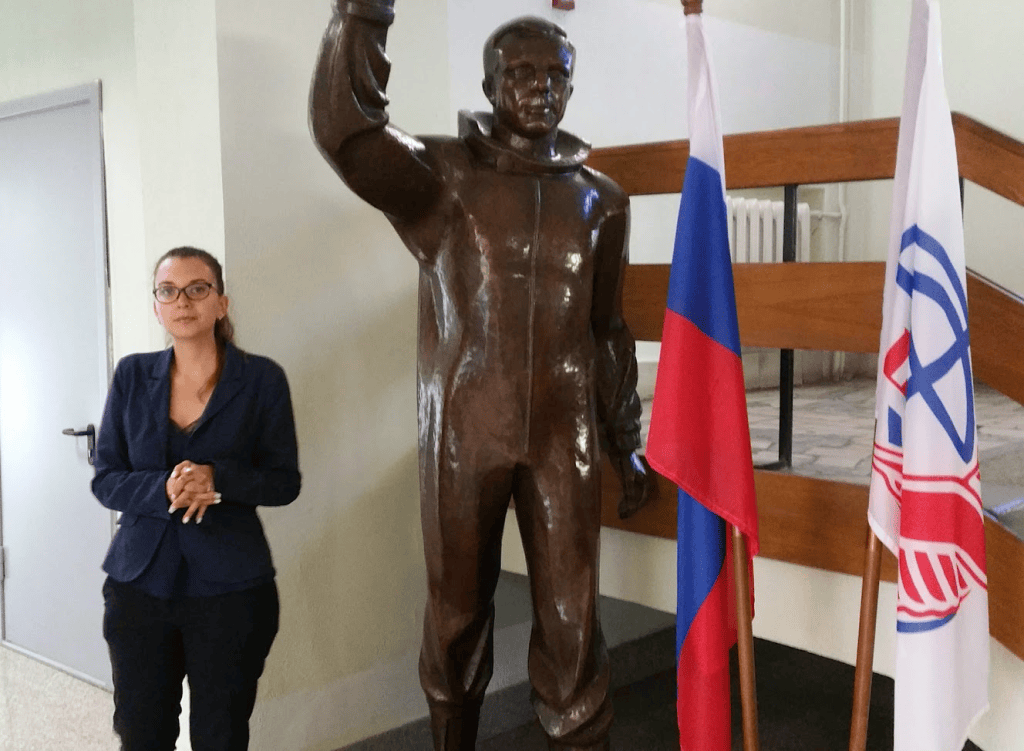
our guide for the day beside Gagarin’s statue
The Mysterious Man in Black
As we proceeded around Star City, I became aware of another gentleman in our vicinity.
He was dressed in black and appeared to be following us at a discreet distance.
Whenever we moved on, so did he.
He didn’t appear to be taking part in the tour, nor did he seem particularly interested in joining our conversation.
What particularly intrigued me was that he always kept one hand behind his back.
Now, having watched rather too many James Bond films over the years, I couldn’t help wondering what he might be holding!
Here I was, an Englishman wandering around a restricted Russian space establishment, apparently being followed by a mysterious man dressed in black who seemed determined not to reveal what he was carrying.
Alexander explained that a previous visitor to Star City had apparently turned out to be a foreign agent, and consequently security arrangements had been tightened considerably.
Well, that certainly explained the presence of our additional companion, although it did little to satisfy my curiosity regarding the object concealed behind his back.
I would have to wait until the end of the visit to discover the answer!
Training for the Unexpected
One of the fascinating aspects of the visit was discovering the considerable amount of training undertaken by cosmonauts in preparation for situations that might arise following their return to Earth.
Whilst considerable attention is understandably devoted to the difficulties of launching human beings into space and keeping them alive whilst in orbit, returning them safely to Earth presents its own particular challenges.
A returning spacecraft might land in a remote forest, on snow-covered terrain or in water, some considerable distance from the waiting recovery teams.
The cosmonauts therefore have to be trained in survival techniques and equipped to cope with a variety of hostile environments.
There were displays illustrating some of this equipment and the preparations undertaken for such eventualities.
It was a reminder that the successful completion of a space mission doesn’t necessarily end when the spacecraft touches the ground.
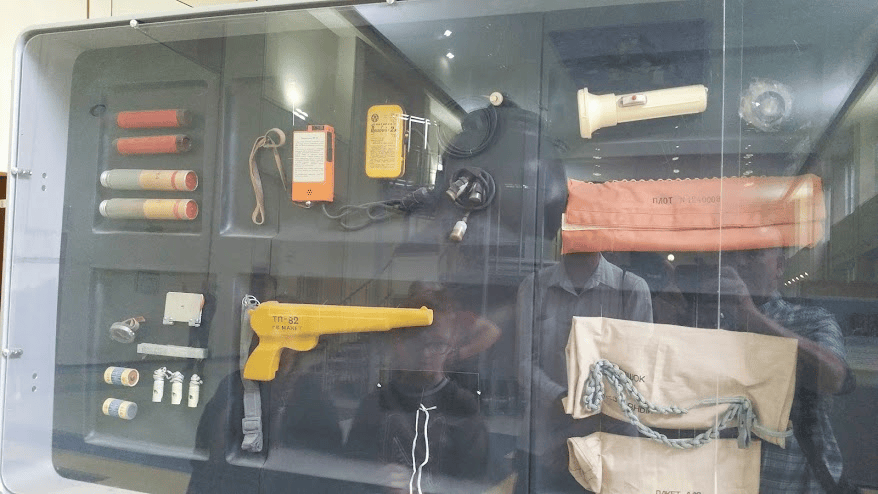
The Giant Centrifuge
One facility I was particularly interested in seeing was the enormous centrifuge used in the training of cosmonauts.
The purpose of this remarkable machine is to subject its occupants to the considerable acceleration forces that they might experience during launch and re-entry.
As an engineer, I would dearly have loved to examine the machinery in some detail.
Unfortunately, access to the facility was restricted, although I did manage to see the building.
I suppose there are limits to what one can reasonably expect to be permitted to see at an operational Russian cosmonaut training centre.
Given that I had been allowed inside Star City at all, I certainly wasn’t going to complain.
And, mindful of our mysterious gentleman in black, I thought it best not to attempt any independent exploration!
Mir, Soyuz and the Technology of Space Travel
We continued our tour, examining various models and examples of spacecraft and equipment associated with the Soviet and Russian space programmes.
There were exhibits relating to the Mir space station and the remarkably successful Soyuz spacecraft.
For someone who had spent decades following the development of these machines through books, magazines and television programmes, it was fascinating to see the equipment at close quarters.
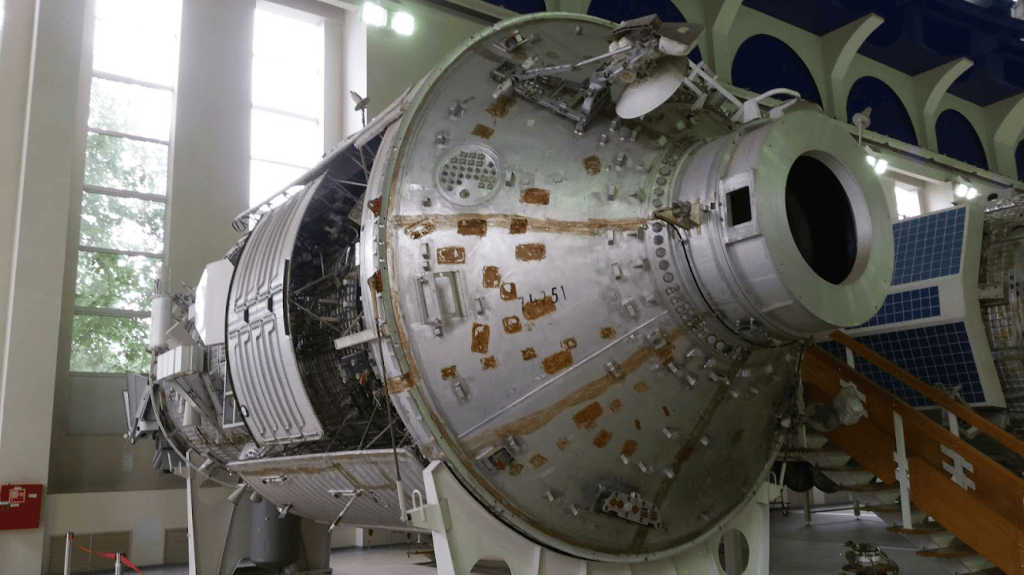
One of the things that particularly strikes you when examining spacecraft is just how little space is available to their occupants.
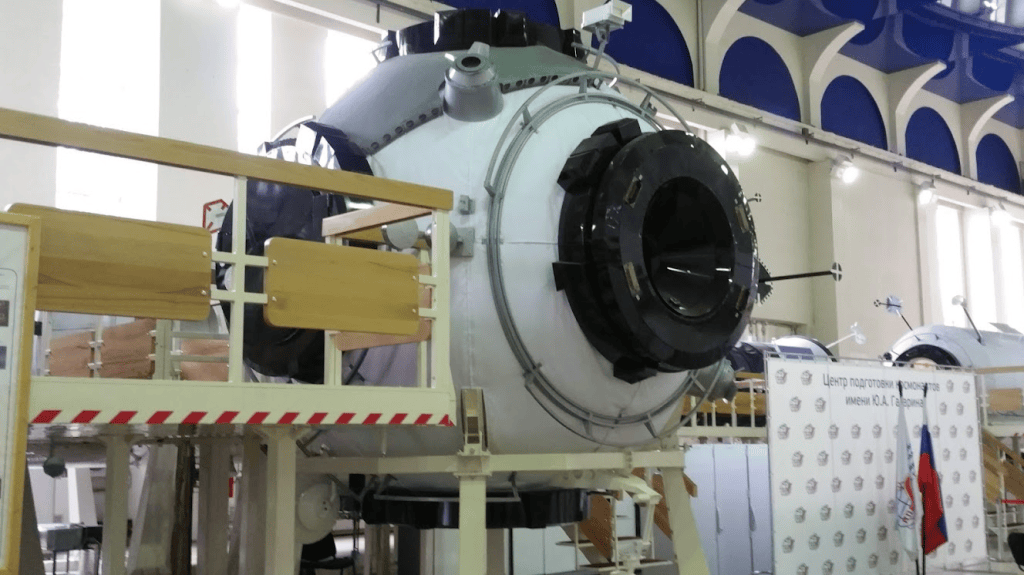
Television pictures taken aboard spacecraft can sometimes give a misleading impression of their size.
When standing beside a re-entry capsule, however, one gains a rather better appreciation of the cramped conditions in which the cosmonauts have to operate.
Quite how three grown men, together with all the necessary equipment, manage to accommodate themselves within a Soyuz capsule is quite remarkable.
I sometimes complain about the amount of legroom provided on an economy-class flight!
Perhaps I ought to be a little more grateful.
The Russian Space Shuttle
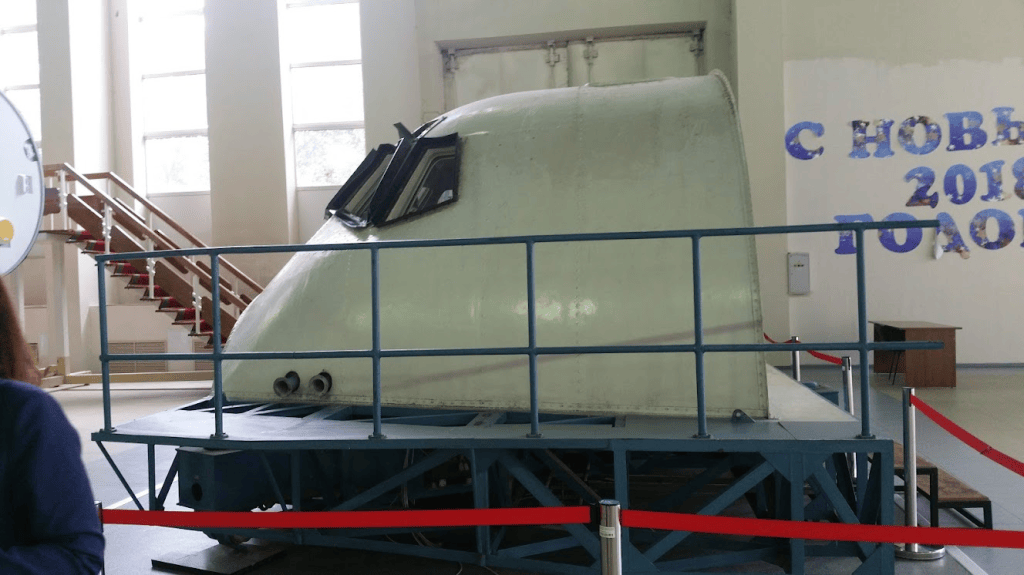
Another particularly interesting exhibit was associated with Buran, the Soviet space shuttle programme.
To the casual observer, Buran bore a remarkable resemblance to the American Space Shuttle, although there were considerable differences in the engineering and operation of the two systems.
Buran made its first and only orbital flight on 15 November 1988.
Remarkably, the entire flight, including its return through the atmosphere and landing on the runway, was accomplished automatically, without a crew aboard.
Considering the technology available in 1988, this was an extraordinary engineering achievement.
Unfortunately, the collapse of the Soviet Union and the subsequent financial difficulties brought the programme to an end.
Here at Star City, however, I had the opportunity to examine a Buran cockpit and its controls.
For someone who had followed the development of spacecraft for so many years, this was particularly fascinating.
A Handshake with a Cosmonaut
During the course of our visit, a gentleman happened to be passing by, whom our guide identified as a Russian cosmonaut.
I had the pleasure of shaking his hand, something I certainly hadn’t anticipated when planning my expedition.
I was particularly interested to note that he was no youngster.
Our guide explained that in Russia, being a cosmonaut was a full-time career extending over many years, during which an individual might undertake several missions into space before eventually retiring.
It was quite a special moment for someone who had followed the exploits of Soviet and Russian cosmonauts since childhood.
There are occasions when a simple handshake can mean a great deal.
This was certainly one of them.
A Little Shopping at Star City
Naturally, I couldn’t possibly leave Star City without acquiring a souvenir or two.
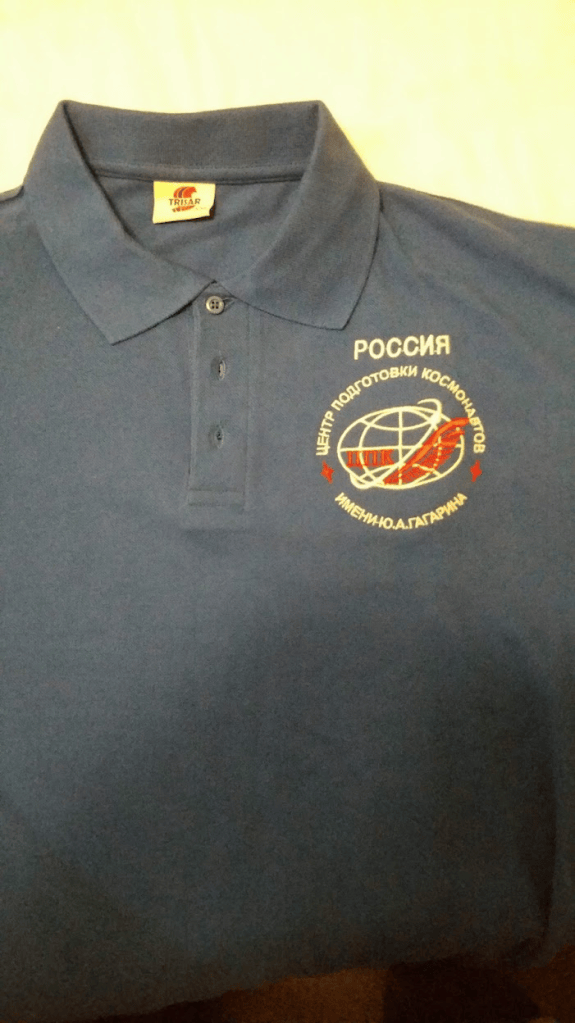
Amongst my purchases was a rather smart polo shirt bearing the embroidered emblem of the Yuri Gagarin Cosmonaut Training Centre.
Whilst I generally collect fridge magnets during my travels, I felt that today’s visit warranted something a little more substantial.
There was a particular satisfaction in knowing that I had purchased the shirt at Star City itself, rather than from some souvenir stall in central Moscow.
I might not have qualified as a Russian cosmonaut, but at least I now had the shirt!
The Mystery Finally Solved!
All too soon, our visit was drawing to a close.
The couple of hours spent exploring Star City seemed to have passed remarkably quickly.
It had been a fascinating experience, and one that I would remember for the rest of my life.
We returned to our waiting taxi and climbed aboard.
Our mysterious gentleman in black, having evidently completed his duties for the morning, turned and began to walk away.
At last, I was able to see what he had been holding behind his back throughout our visit.
An umbrella!
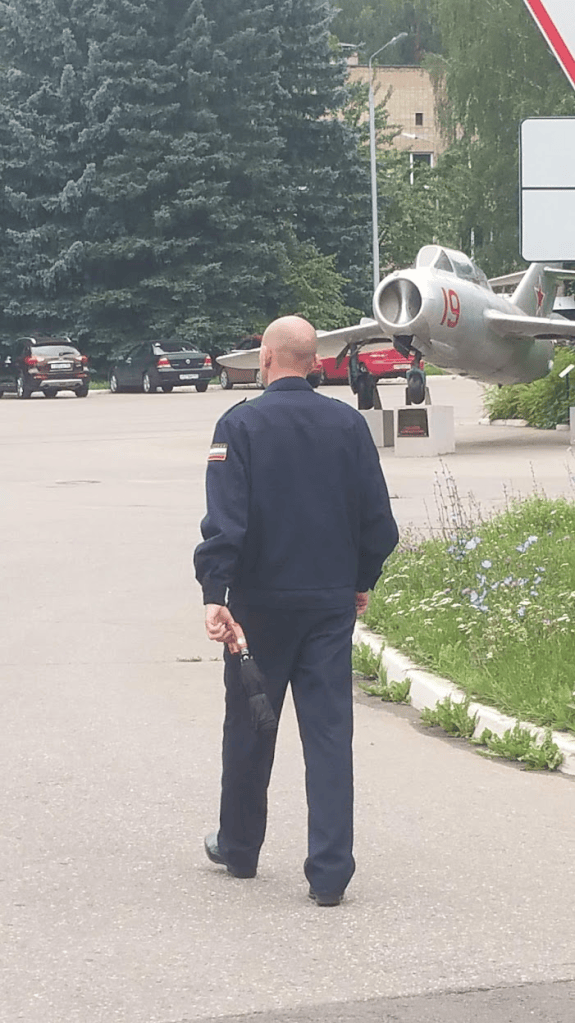
So much for my James Bond-inspired imagination!
I suppose even Russian security personnel have to make provision for the weather.
A Rather Large Bundle of Roubles!
Whilst being driven back towards Moscow, something suddenly occurred to me.
I hadn’t paid Alexander for the excursion!
Indeed, despite having made the initial arrangements some nine months earlier, completed all the necessary paperwork and now actually visited Star City, I hadn’t paid him a single rouble, not even by way of a deposit.
The entire private excursion had been arranged for the equivalent of £220.
I proceeded to count out a rather substantial bundle of Russian banknotes, which I handed to Alexander together with my sincere thanks for arranging such a memorable experience.
In an age when one is frequently required to pay for things months in advance, I found his willingness to conduct business in this manner particularly refreshing.
He had placed a considerable amount of trust in an Englishman whom he had never previously met.
As far as I was concerned, it was money extremely well spent.
A Familiar Rocket!
I hadn’t quite finished with the subject of space exploration for the day, and Alexander kindly dropped me off at the Museum of Cosmonautics in Moscow.
Dominating the surroundings was the magnificent Monument to the Conquerors of Space, an enormous sweeping column depicting the exhaust plume of a rocket soaring skywards.
Unveiled in 1964 and clad in titanium, the monument rises some 107 metres above the ground.
There was something strangely familiar about its design.
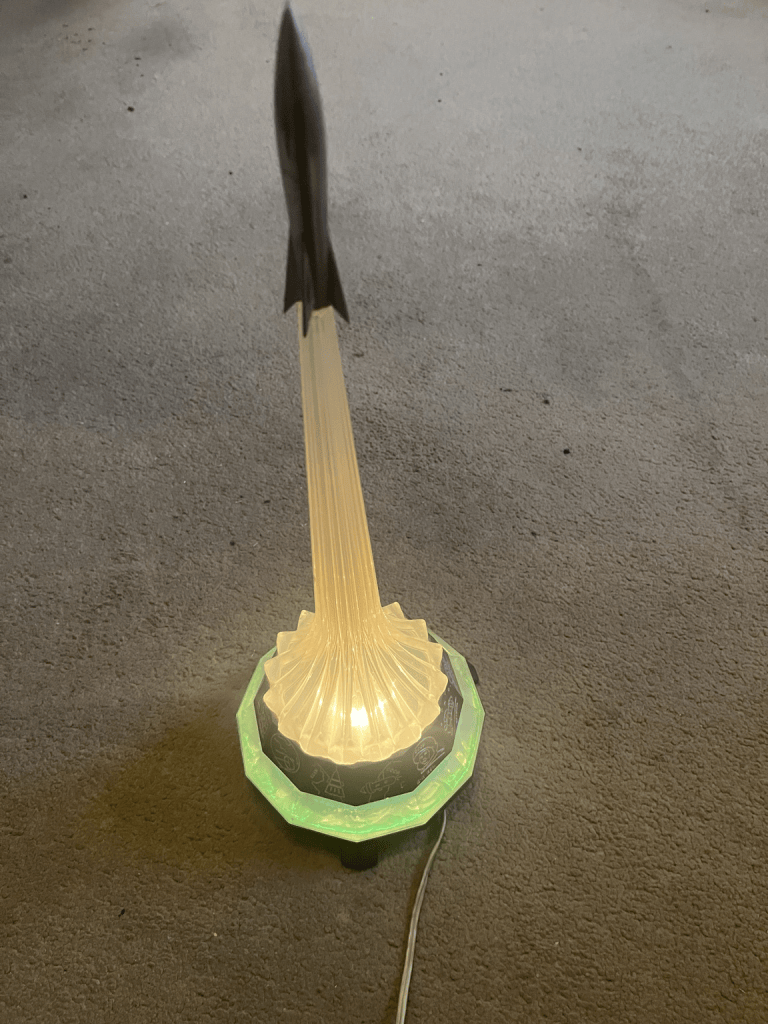
Many years earlier, I had purchased a rather unusual table lamp on eBay from someone in Ukraine. It depicted a rocket soaring skywards upon an illuminated column of exhaust gases.
Standing beneath this magnificent monument in Moscow, I was immediately struck by the similarity.
Naturally, I took a photograph.
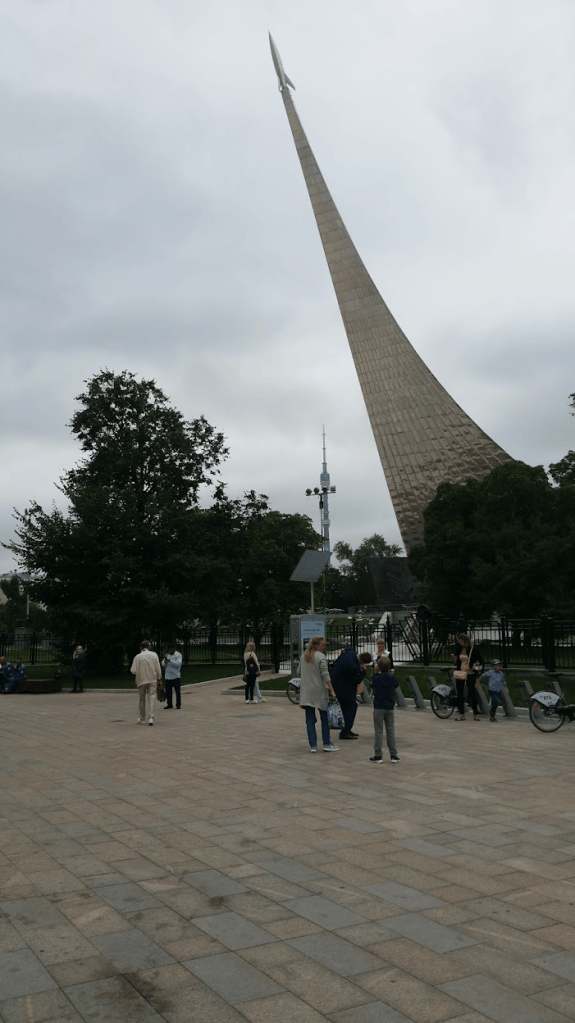
I’ve included photographs of both for comparison, although the Russian version, at 107 metres high, would have presented me with considerable difficulties had I attempted to purchase it on eBay!
The postage alone would have been astronomical!
From the Moon to the Middle of the Ocean
Having admired the magnificent monument, I purchased an entrance ticket to the Museum of Cosmonautics, situated beneath it, and spent the next hour or so examining the numerous exhibits.
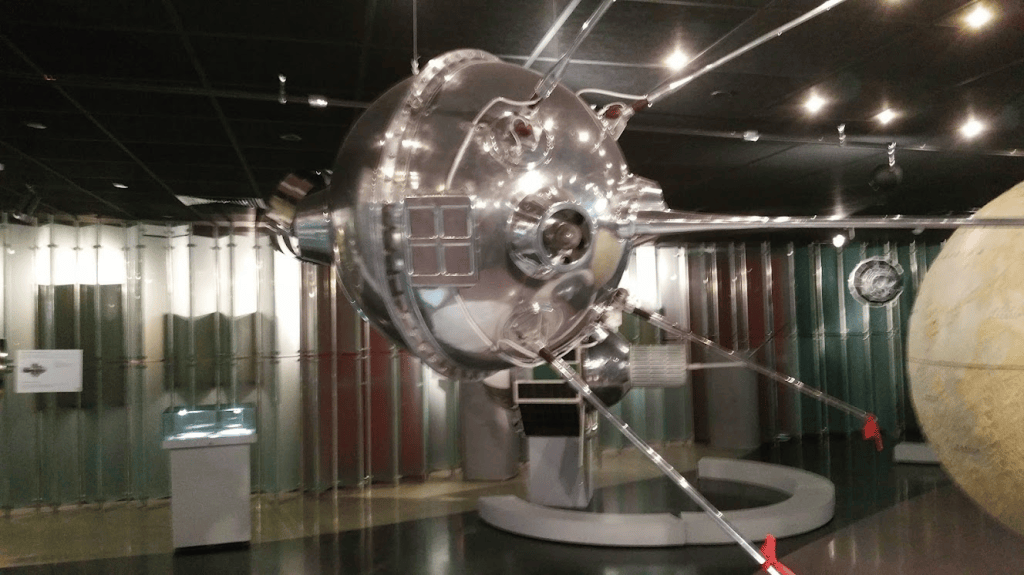
Amongst these were examples of the early Soviet spacecraft, including Luna 1, which in January 1959 became the first spacecraft to escape Earth’s gravity and pass close to the Moon.
Later that same year, Luna 2 became the first man-made object to reach the lunar surface.
Looking at these comparatively primitive machines, one could only marvel at what the Soviet engineers had achieved with the technology available to them at the time.
Another exhibit that particularly caught my attention was a splendid model of the Sea Launch floating rocket launch platform, complete with a rocket perched upon it.
This ingenious international engineering project utilised a converted offshore drilling platform, enabling rockets to be launched from the Pacific Ocean close to the equator, thereby taking advantage of the Earth’s rotation.
The idea of taking an entire rocket launching facility out to sea was quite extraordinary.
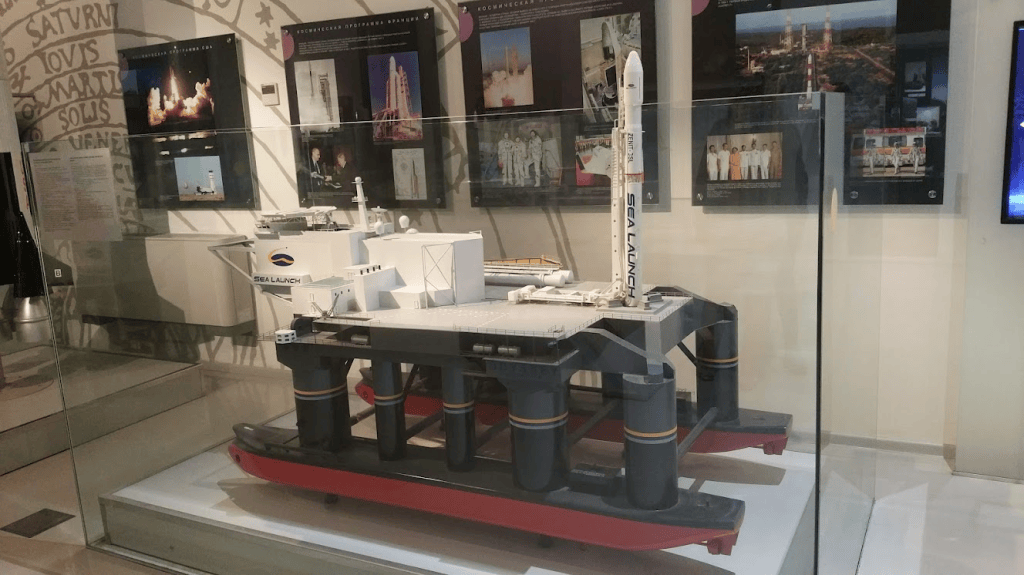
From the pioneering lunar probes of the 1950s to launching satellites from the middle of the Pacific Ocean, the museum provided a fascinating illustration of the remarkable progress made during my own lifetime.
Elsewhere in the museum was a magnificent model of the Buran space shuttle mounted upon its enormous Energia launch vehicle, together with numerous other examples of Soviet and Russian spacecraft.
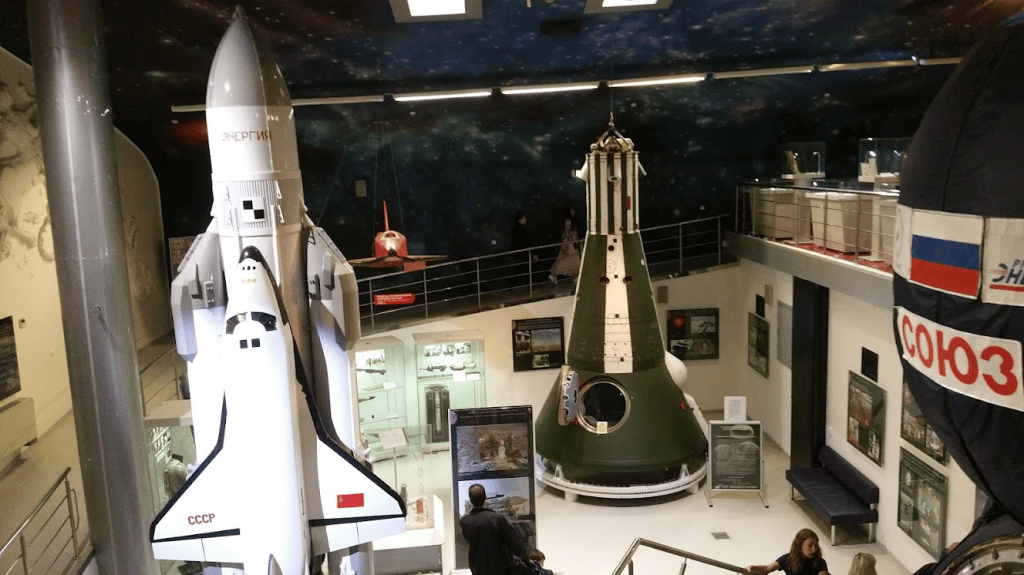
Between my morning at Star City and my afternoon at the Museum of Cosmonautics, I had certainly indulged my enthusiasm for space exploration.
The Optimism of the Space Age
The museum also had a rather tempting souvenir shop, with some splendid reproductions of Soviet space-age posters.
I particularly liked one commemorating Yuri Gagarin’s historic flight on 12 April 1961, bearing the wonderfully optimistic proclamation:
“The way to the planets is open to mankind!”
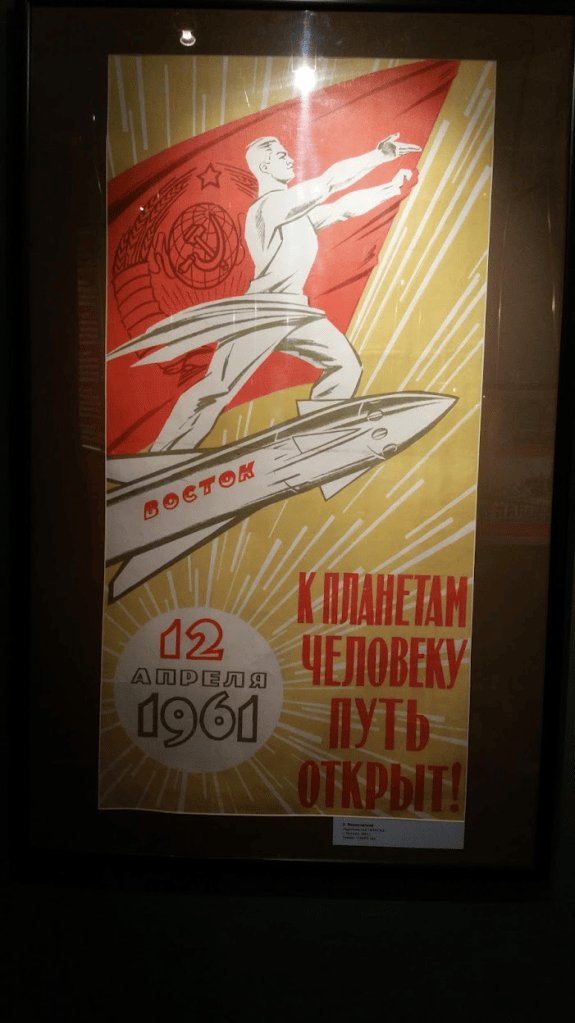
There was something rather appealing about the confidence and optimism of those early years of space exploration.
I was only a small boy when Gagarin made his historic flight, and in those days the prospect of ordinary people eventually travelling to other planets seemed entirely plausible.
More than half a century later, I was still waiting!
I purchased a copy of the poster for my friend Gary, and I am pleased to report that, as I reconstruct this account some eight years later, it still hangs in pride of place in his garage.
The Soviet space programme may have come to an end, but a little of its original optimism survives on a garage wall in England!
Back to the Hotel Circus
Having thoroughly enjoyed my visit to the Museum of Cosmonautics, I returned to the Hotel Circus.
Here I took another look at the polo shirt I had purchased earlier in the day at Star City.
The embroidered lettering, translated into English, reads:
Russia – Yuri Gagarin Cosmonaut Training Centre.
It was a rather splendid souvenir of a very special day.
There was something particularly satisfying about finally visiting a place that had occupied a corner of my imagination since the days of the great space race.
I had been born into a world in which no human being had ever ventured into space.
During my lifetime, I had witnessed the launch of the first artificial satellite, the first man in space, the first Moon landing, the development of space stations and the emergence of reusable spacecraft.
And now, shortly after retiring from my own career in engineering, I had been able to visit one of the establishments where so much of that extraordinary history had been made.
It had certainly been worth the nine months of preparation.
From Star City to the Cream of Manchester!
I decided that a celebratory beer was in order.
It had, after all, been a rather special day, and I felt that the successful completion of an enterprise some nine months in the planning deserved a little celebration.
Consulting Google Maps, I discovered a bar situated not far from the hotel and decided to wander along and investigate.
The establishment was called Heroes, a rather appropriate name considering how I had spent much of the day.
Upon entering, I glanced at the large blackboards above the counter, upon which were chalked the names of the numerous beers available.
To my considerable surprise, the first two entries were immediately familiar.
Old Speckled Hen and Boddingtons!
Good heavens!
Having travelled across Europe, ventured deep into Russia and spent the morning visiting the cosmonaut training centre at Star City, I now found myself in a Moscow bar serving traditional English beer.
It seemed that the Russians had excellent taste in matters other than spacecraft!
Naturally, I took a photograph of the blackboard, lest my friends back home should doubt my discovery.
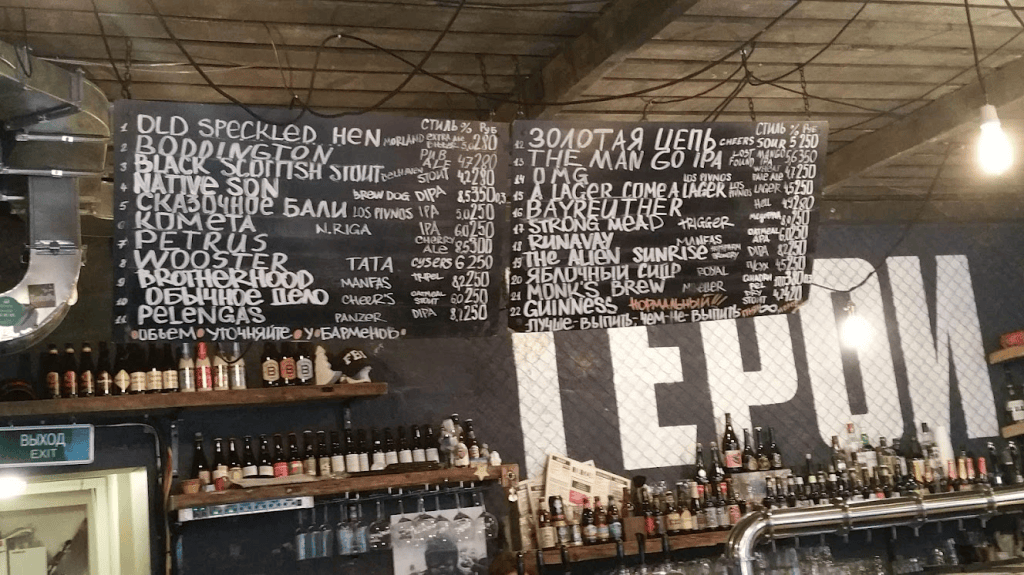
I decided upon the Boddingtons and ordered a burger with fries to accompany it.
There was something rather amusing about sitting in a Moscow bar drinking Boddingtons, having spent the morning at one of the most important establishments in the history of Soviet space exploration.
Two glasses of the Cream of Manchester rounded off what had been a quite extraordinary day.
Reflections on a Rather Special Day
When I first began planning this expedition, there were a number of places that I particularly wanted to visit.
Star City had been very near the top of that list.
There had been occasions during the preceding months when I wondered whether the necessary permissions would ever materialise.
Yet everything had worked out splendidly.
I had visited Star City, examined some remarkable spacecraft, shaken hands with a Russian cosmonaut, acquired a rather splendid polo shirt and even enjoyed the attentions of my own mysterious Russian security escort, complete with umbrella!
And all without having to telephone the Ministry of Extraordinary Situations!
Not bad for a retired engineer from Bournemouth!
Tomorrow I intended to take things at a slightly more leisurely pace, with a cruise along the Moskva River.
But today would take some beating.
I returned to the Hotel Circus a very happy man.
See you all tomorrow, I hope!
TTFN, Bibbley.


